Key takeaways
- Compare the best expansion tanks for water heaters, with volume, acceptance, precharge and connection specs for Amtrol, Watts, Eastman and Zurn models.
Water grows in volume as it heats, and in a closed plumbing system that extra volume has nowhere to go. Once a check valve, a pressure reducing valve, or a backflow preventer sits on the incoming line, heated water can no longer push back toward the street main. Pressure climbs with every heating cycle until something gives: the relief valve on the heater weeps, faucets drip, toilet fill valves wear out early, and the heater works against pressure it was never meant to hold. A thermal expansion tank gives that expanded water a place to sit until a tap opens and the system cools down.
Inside the tank, a flexible diaphragm keeps a cushion of pressurized air apart from the system water. When the heater fires, water enters the tank and squeezes the air cushion; when someone draws hot water, the cushion pushes the stored water back into the line. The five tanks below cover most homes: 2-gallon-class models for 40 and 50 gallon heaters, and 4.4 to 4.5 gallon models for larger heaters or higher pressure. All five are built for potable water and connect with a 3/4 inch male thread.
Disclosure: As an Amazon Associate, we earn from qualifying purchases made through links on this page, at no extra cost to you.
How to Choose an Expansion Tank
Size by acceptance volume, not just tank volume. Tank volume is the size of the shell. Acceptance volume is how much expanded water the diaphragm can actually take in, and that number has to cover your heater. A 40 or 50 gallon heater set to 140°F on ordinary supply pressure fits the 2-gallon class. A 60 to 80 gallon heater, a hotter setting, or supply pressure up toward 80 psi pushes the answer into the 4.4 to 4.5 gallon class.
Measure your supply pressure first. A gauge on a hose bibb, read with no water running, gives the static pressure the tank works against. The same heater needs a bigger tank at 80 psi than at 40 psi, because higher line pressure leaves less room inside the tank for expanded water.
Match the precharge before the tank goes in. Adjust the factory air charge to equal your static supply pressure while the tank is empty of water pressure, using a tire gauge and a hand pump. Amtrol ships at 50 psig, Eastman and Zurn at 40 psi, and Watts at 20 psi, so the Watts tanks in particular need air added for a typical 50 to 60 psi house.
Check the working limits. Four of these tanks carry a 150 psi maximum working pressure and a 200°F ceiling; the Eastman raises the temperature ceiling to 210°F. The Zurn is the exception on pressure: Zurn caps supply pressure for its XT line at 80 psi, fine for homes with a pressure reducing valve but not for unregulated supplies.
Look for potable water certification. A tank on a drinking water line should carry NSF/ANSI 61 certification for its water-contact parts. All five picks meet that mark, and the Zurn adds NSF/ANSI 372 for low lead content.
The 5 Best Expansion Tanks
1. Amtrol ST-5 Therm-X-Trol Expansion Tank

The ST-5 is the default pick for the most common setup in North American homes: a 40 or 50 gallon storage heater on a closed system. Its 2.0 gallon shell accepts up to 0.9 gallon of expanded water, which covers that heater class at 140°F across the full range of supply pressures on Amtrol’s sizing card.
Two details reward a closer look. The InSight indicator cap changes appearance when the diaphragm has failed and the tank has filled with water, so a check takes seconds and needs no tools. The butyl diaphragm is certified to NSF/ANSI 61, the polypropylene liner keeps water off the steel shell, and Amtrol backs the ST line with a seven year warranty, the longest here.
Specs
- Tank volume: 2.0 gal
- Acceptance volume: 0.9 gal maximum
- Dimensions: 8 in diameter x 13 in high
- Connection: 3/4 in NPTM, stainless steel
- Maximum working pressure: 150 psig
- Maximum working temperature: 200°F
- Factory precharge: 50 psig
- Diaphragm: butyl, NSF/ANSI 61 certified
- Weight: 5 lb
- Warranty: 7 years
2. Amtrol ST-12 Therm-X-Trol Expansion Tank

The ST-12 is the step up for 60 and 80 gallon heaters, and for smaller heaters on high pressure lines where the 2-gallon class runs out of room. Its 4.4 gallon shell accepts 3.2 gallons of expanded water, the strongest acceptance figure here relative to shell size, so it handles big heating cycles without the pressure spikes that make relief valves weep.
Everything that applies to the ST-5 applies here: the InSight indicator cap, the Turbulator insert, a butyl diaphragm certified to NSF/ANSI 61, a polypropylene liner, and a stainless steel connector. At 11 inches across and 15 inches tall it needs more clearance, and the piping should be braced for the extra weight once it takes on water.
Specs
- Tank volume: 4.4 gal
- Acceptance volume: 3.2 gal maximum
- Dimensions: 11 in diameter x 15 in high
- Connection: 3/4 in NPTM, stainless steel
- Maximum working pressure: 150 psig
- Maximum working temperature: 200°F
- Factory precharge: 50 psig
- Diaphragm: butyl, NSF/ANSI 61 certified
- Weight: 9 lb
- Warranty: 7 years
3. Watts PLT-12 Potable Water Expansion Tank
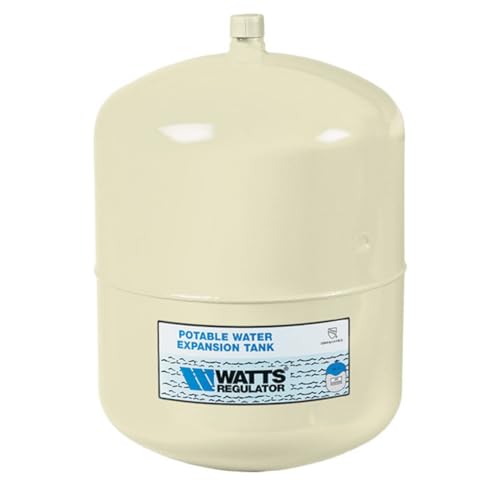
The PLT-12 is Watts’ answer in the same size class as the ST-12: a 4.5 gallon shell with 2.8 gallons of acceptance volume, sized for heaters from about 60 to 80 gallons and for smaller heaters on higher pressure lines. Watts publishes an acceptance table for the PLT line at several precharge levels, which helps if your supply pressure is unusual.
The tank is drawn steel with a butyl diaphragm and a polypropylene liner, listed by IAPMO and certified to ANSI/NSF 61. Two practical notes set it apart. First, the factory precharge is only 20 psi, well below most house pressures, so plan on adding air with a pump before installation; Watts recommends charging to match supply pressure, up to 80 psi. Second, the warranty runs one year.
Specs
- Tank volume: 4.5 gal
- Acceptance volume: 2.8 gal
- Dimensions: 10.5 in diameter x 13.5 in high
- Connection: 3/4 in male, stainless steel inlet
- Maximum working pressure: 150 psi
- Maximum working temperature: 200°F
- Factory precharge: 20 psi
- Diaphragm: butyl
- Weight: 10 lb
- Warranty: 1 year
4. Eastman 60022 Expansion Tank

Eastman’s 60022 covers the same 40 to 50 gallon heater class as the ST-5, and it brings one spec nothing else matches: a maximum working temperature of 210°F, ten degrees above the rest. Homes that run a hotter thermostat setting get extra headroom from that ceiling, and the tank carries the same 150 psi maximum working pressure as the other 2-gallon picks.
The build follows the pattern plumbers expect from Eastman: a butyl rubber diaphragm, a corrosion resistant 304 stainless steel connection, and certifications to UPC and NSF-61 requirements. The 40 psi precharge sits between the Amtrol and Watts figures and still needs matching to your measured supply pressure. One gap in Eastman’s data is worth knowing: the maker does not publish an acceptance volume, so sizing leans on its heater capacity guidance rather than a full acceptance table. Warranty terms also differ between the catalog and retail listings, so confirm the term on the listing.
Specs
- Tank volume: 2 gal
- Acceptance volume: not published
- Dimensions: 8 in diameter x 12.5 in high, nominal
- Connection: 3/4 in MIP, 304 stainless steel
- Maximum working pressure: 150 psi
- Maximum working temperature: 210°F
- Factory precharge: 40 psi
- Diaphragm: butyl rubber
- Weight: about 5 lb
5. Zurn XT-8 Thermal Expansion Tank

The XT-8 is Zurn Wilkins’ entry in the 2-gallon class, and on paper it edges the ST-5 in one respect: its 2.1 gallon shell accepts 1.0 gallon of expanded water, a touch more than the Amtrol’s 0.9. For a 50 gallon heater whose sizing math lands at the edge of the smaller tank, that extra tenth of a gallon is a real reason to pick the Zurn.
The construction is trade grade: a carbon steel shell with an epoxy finish, a polypropylene liner, an FDA approved butyl rubber diaphragm, and a stainless steel 3/4 inch NPT connection. The XT line is IAPMO listed and certified to NSF/ANSI 61 and 372, the second mark covering low lead content. The one limit to respect is pressure: Zurn sets the maximum supply pressure for this line at 80 psi, below the 150 psi working pressure of the other picks. On a regulated system at or below 80 psi the XT-8 is a strong, often overlooked alternative; on an unregulated high pressure supply, choose one of the 150 psi tanks instead.
Specs
- Tank volume: 2.1 gal
- Acceptance volume: 1.0 gal maximum
- Dimensions: 8 in diameter x 10.5 in high
- Connection: 3/4 in NPT, stainless steel
- Maximum supply pressure: 80 psi
- Maximum working temperature: 200°F
- Factory precharge: 40 psi
- Diaphragm: butyl rubber, FDA approved
- Weight: 5.5 lb
- Warranty term: not published
Comparison Table
| Model | Tank volume | Acceptance volume | Factory precharge | Connection | Pressure limit |
|---|---|---|---|---|---|
| Amtrol ST-5 | 2.0 gal | 0.9 gal | 50 psig | 3/4 in NPTM | 150 psig |
| Amtrol ST-12 | 4.4 gal | 3.2 gal | 50 psig | 3/4 in NPTM | 150 psig |
| Watts PLT-12 | 4.5 gal | 2.8 gal | 20 psi | 3/4 in male | 150 psi |
| Eastman 60022 | 2 gal | not published | 40 psi | 3/4 in MIP | 150 psi |
| Zurn XT-8 | 2.1 gal | 1.0 gal | 40 psi | 3/4 in NPT | 80 psi supply |
Frequently Asked Questions
What size expansion tank does a 50 gallon water heater need?
A 2-gallon-class tank covers a 50 gallon heater at a 140°F setting on supply pressure up to about 80 psi. The Amtrol ST-5, Zurn XT-8, and Eastman 60022 all sit in that class. If the heater runs hotter, or two heaters share one line, move up to the 4.4 or 4.5 gallon class.
Does every water heater need an expansion tank?
Only heaters on closed systems need one. If a check valve, pressure reducing valve, or backflow preventer sits between the heater and the street main, expanded water has no escape route and a tank is required, by plumbing code in many areas and by heater makers as a condition of proper installation. On a truly open system a tank is optional.
How do I set the precharge on a new tank?
Measure the static supply pressure with a gauge on a hose bibb and no water running. With the tank still off the system, or isolated and drained of water pressure, check the air valve with a tire gauge and add or release air with a hand pump until the charge equals the supply pressure. Follow the maker’s ceiling when charging; Watts and Eastman both cap it at 80 psi.
Where does the expansion tank get installed?
On the cold water supply line to the heater, between the heater and any check valve, pressure reducing valve, or backflow preventer. The piping must carry its weight once it fills with water, so add bracing or a strap, and keep the air valve reachable for the yearly charge check.
How can I tell if an expansion tank has failed?
A failed diaphragm leaves the tank full of water, so it feels heavy and gives a dull thud rather than a hollow sound when tapped. Water at the air valve is a sure sign, and a relief valve that weeps during every heating cycle often points the same way. These are sealed units, so a failed tank is replaced, not repaired.
Conclusion
For the typical 40 or 50 gallon heater, the Amtrol ST-5 is the easiest recommendation here: correct size, a failure indicator in the cap, and seven year coverage. The Zurn XT-8 matches it closely on regulated systems at or below 80 psi and accepts slightly more water, while the Eastman 60022 adds temperature headroom to 210°F. Larger heaters and high pressure lines belong to the 4.4 and 4.5 gallon class, where the Amtrol ST-12 offers the strongest acceptance volume and warranty and the Watts PLT-12 stands as an equivalent alternative. Whichever tank you choose, measure your supply pressure first and set the precharge to match; that step decides whether the tank protects your plumbing or simply hangs there.
FAQ
What size expansion tank does a 50 gallon water heater need?
Does every water heater need an expansion tank?
How do I set the precharge on a new tank?
Where does the expansion tank get installed?
How can I tell if an expansion tank has failed?
More from Amazon
Programs that pair well with the guide above. Offers and eligibility are set by Amazon and may change.
Set up recurring deliveries of everyday items on eligible products. Terms and savings are set by Amazon.
Explore Subscribe & SaveCollect the home and kitchen items you want in one registry that guests can shop from.
Create a wedding registryFree shipping on eligible items, Prime Video and more. Eligible new members can start with a free trial.
Start a Prime free trialAudiobooks and podcasts to listen to on the go. Eligible new members can start with a free trial.
Try Audible freeAs an Amazon Associate we earn from qualifying purchases.