Key takeaways
- Compare the best pressure tanks for well systems by drawdown, pre-charge, connection and build, with five verified picks sized for homes on private wells.
A pressure tank is the buffer between a well pump and the taps in a house. The pump fills the tank, an air cushion inside pushes water out on demand, and the pump stays off until pressure falls to the switch cut-in point. A well-sized tank keeps showers steady and cuts pump cycles per day, the single biggest factor in how long a submersible or jet pump lasts.
The five tanks below are pre-charged diaphragm models for private well systems, spanning 20 to 32 gallons of tank volume. Two come from WaterWorker, the retail line built by Amtrol, two carry the Amtrol Well-X-Trol name with a higher pressure class and longer warranty, and one VEVOR unit serves farm and irrigation duty where drinking water rules do not apply. Each entry lists drawdown at common switch settings, the figure the pump actually works against.
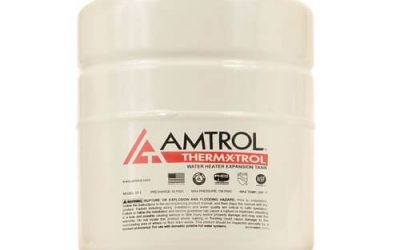
One point of scope: these are pressure tanks for well and booster pump systems, not the small thermal expansion tanks that protect a water heater loop.
Disclosure: As an Amazon Associate, we earn from qualifying purchases made through links on this page, at no extra cost to you.
How to Choose a Pressure Tank
Drawdown first, tank volume second. Tank volume is the size of the steel shell. Drawdown is the water the tank hands over between the pump cutting out and cutting back in, and it is always much smaller, roughly a quarter to a third of the shell volume. Drawdown also shrinks as switch settings climb. The common sizing rule asks for drawdown at least equal to the pump flow in gallons per minute, giving the pump about a minute of run time per cycle. A 10 gpm pump on a 30/50 switch wants close to 10 gallons of drawdown at that setting.
Match the pre-charge to the switch. Every tank here ships with a factory air charge that must sit 2 psi below the switch cut-in, checked while the tank holds no water. A 38 psi factory charge pairs with a 40/60 switch as shipped. Homes on 30/50 or 20/40 switches need air let out at install, down to 28 or 18 psi. A charge set too high shrinks drawdown; too low, and the diaphragm over-flexes.
Pressure headroom. Household switches top out at 40/60 or 50/70, well under the limit of any tank here. The difference is margin: the 100 psi class covers normal home systems with room to spare, while the 150 psi class adds headroom for deep wells, booster setups, and switches set high.
Connection and footprint. Most residential tanks use a 1 inch NPTF elbow at the base, mating with standard tank tees that carry the switch, gauge, and drain. The 20 gallon class stands about 32 inches tall on a 15 inch diameter, while a 32 gallon tank in the same diameter runs 47 inches tall. Measure vertical clearance before ordering the taller shell.
Build and water contact. Diaphragm tanks fix a flexible butyl membrane inside the shell, so air and water never mix and the tank cannot waterlog the way an old galvanized tank does. A polypropylene liner keeps water off the steel, and a stainless connection resists the corrosion that eats plain steel elbows. For drinking water, look for a listing to NSF/ANSI Standard 61.
The 5 Best Pressure Tanks
1. WaterWorker HT-20B Vertical Well Tank
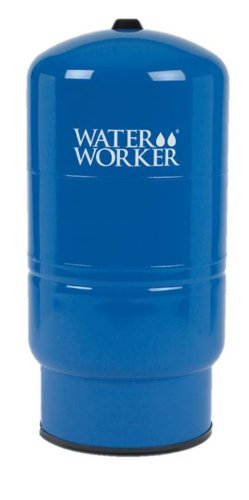
The HT-20B is the entry point in the WaterWorker line: a 20 gallon vertical tank with a one-piece butyl diaphragm, a polypropylene liner, and a deep-drawn steel shell finished in blue. Drawdown runs 7.31 gallons at a 20/40 switch, 6.18 at 30/50, and 5.35 at 40/60, suiting pumps up to about 6 gpm under the one-minute rule, plus cabins and small homes.
The system connection is 1 inch NPTF with a stainless steel insert, a thoughtful detail since the elbow is where lesser tanks corrode first. The tank is listed to NSF/ANSI Standard 61 for drinking water contact, and WaterWorker backs it for five years. One quirk: the maker guide sets the factory charge at 38 psi while some listings print a lower figure, so check the charge with a gauge before plumbing it in.
Specs
- Model: HT-20B
- Tank volume: 20 gal
- Drawdown: 7.31 gal at 20/40, 6.18 gal at 30/50, 5.35 gal at 40/60
- Maximum working pressure: 100 psi
- Factory pre-charge: 38 psi per maker guide
- Connection: 1 in NPTF with stainless steel insert
- Diaphragm: butyl, one-piece
- Liner: polypropylene
- Dimensions: 15 in diameter x 32 in high
- Weight: 27 lb
- Warranty: 5 years
2. WaterWorker HT-30B Vertical Well Tank

The HT-30B stretches the same WaterWorker platform into a taller shell. The listing describes a 30 gallon tank with 26 gallons of usable capacity, and the drawdown table steps up with it: 8.78 gallons at 20/40, 7.42 at 30/50, and 6.43 at 40/60. That makes it the natural match for 7 gpm class pumps and two-bath homes that found a 20 gallon tank cycling too often.
Construction mirrors the smaller model: one-piece butyl diaphragm, polypropylene liner, steel shell, the same 1 inch NPTF connection, and the same NSF/ANSI Standard 61 listing. Height grows to 39 inches on the same 15 inch diameter, so it drops into the footprint of the tank it replaces in most pump corners, and at 41 pounds it is still a one-person carry when empty.
Specs
- Model: HT-30B
- Tank volume: 30 gal (26 gal usable as listed)
- Drawdown: 8.78 gal at 20/40, 7.42 gal at 30/50, 6.43 gal at 40/60
- Maximum working pressure: 100 psi
- Factory pre-charge: 38 psi per maker guide
- Connection: 1 in NPTF
- Diaphragm: butyl, one-piece
- Liner: polypropylene
- Dimensions: 15 x 15 x 39 in
- Weight: 41 lb
- Warranty: 5 years
3. Amtrol Well-X-Trol WX-202D Well Tank
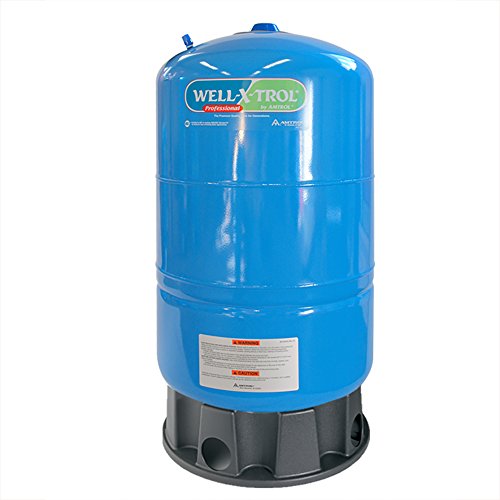
The WX-202D is Amtrol’s 20 gallon Well-X-Trol on a DuraBase composite stand, in a different pressure class from the pair above. The shell carries a 150 psig maximum working pressure, half again the WaterWorker limit, and the warranty runs seven years. Drawdown is 6.2 gallons at 30/50, 5.4 at 40/60, and 4.7 at 50/70, sized for pumps around 5 to 6 gpm.
Inside, a heavy-duty butyl diaphragm works against an antimicrobial polypropylene liner, and the system connection is stainless steel in 1 inch NPTF. The composite stand is the detail damp pump houses will appreciate: it cannot rust, it shrugs off floor moisture that eats steel stands, and it lets the tank be rolled into place during install.
Specs
- Model: WX-202D
- Tank volume: 20 gal
- Drawdown: 6.2 gal at 30/50, 5.4 gal at 40/60, 4.7 gal at 50/70
- Maximum working pressure: 150 psig
- Factory pre-charge: 38 psig
- Connection: 1 in NPTF, stainless steel
- Stand: DuraBase composite
- Diaphragm: heavy-duty butyl
- Liner: antimicrobial polypropylene
- Dimensions: 15 in diameter x 32 in high
- Warranty: 7 years
4. Amtrol Well-X-Trol WX-203 Well Tank

The WX-203 is the largest tank in this guide and the one most mid-size homes should shortlist. Its 32 gallon shell delivers 9.9 gallons of drawdown at 30/50, 8.6 at 40/60, and 7.6 at 50/70, enough to give a 10 gpm pump its full minute of run time at the two lower settings.
It shares the Well-X-Trol build of the WX-202D: high-strength steel shell, heavy-duty butyl diaphragm, antimicrobial liner, stainless 1 inch NPTF connection, 150 psig maximum working pressure, and a seven-year warranty. The trade is height: 47 inches needs real vertical clearance, and the 47 pound shipping weight is easier to place with a second pair of hands.
Specs
- Model: WX-203
- Tank volume: 32 gal
- Drawdown: 9.9 gal at 30/50, 8.6 gal at 40/60, 7.6 gal at 50/70
- Maximum working pressure: 150 psig
- Factory pre-charge: 38 psig
- Connection: 1 in NPTF, stainless steel
- Diaphragm: heavy-duty butyl
- Liner: antimicrobial polypropylene
- Dimensions: 15 in diameter x 47 in high
- Warranty: 7 years
5. VEVOR 20-Gallon Vertical Well Pressure Tank ET-80LV

The VEVOR ET-80LV is a 20 gallon vertical tank built from 1.2 mm carbon steel, pre-charged to 29 psi, with a maximum internal pressure of 87 psi and a 1 inch NPT connection. It lands near the WaterWorker HT-20B in size, at 15.35 inches across and 32.1 inches tall, and suits irrigation lines, farm water, and other utility systems needing a simple pressure buffer.
Read the maker’s limit before ordering: VEVOR states this tank is not suitable for drinking water, so it has no place on a potable home well system. It also publishes no drawdown table and no warranty term, which is why it sits last here despite the sturdy shell. For a barn or greenhouse line fed from a non-potable source, it does the basic job; for household taps, choose one of the four listed tanks above.
Specs:
– Model: ET-80LV
– Tank volume: 20 gal
– Drawdown: not published
– Maximum internal pressure: 87 psi (6 bar)
– Factory pre-charge: 29 psi (2 bar)
– Connection: 1 in NPT
– Shell: carbon steel, 1.2 mm
– Maximum working temperature: 194 degrees Fahrenheit (90 degrees Celsius)
– Dimensions: 15.35 x 15.35 x 32.1 in
– Warranty: not published
Comparison Table
| Model | Tank Volume | Drawdown at 30/50 | Max Working Pressure | Pre-charge | Connection |
|---|---|---|---|---|---|
| WaterWorker HT-20B | 20 gal | 6.18 gal | 100 psi | 38 psi | 1 in NPTF |
| WaterWorker HT-30B | 30 gal | 7.42 gal | 100 psi | 38 psi | 1 in NPTF |
| Amtrol WX-202D | 20 gal | 6.2 gal | 150 psig | 38 psig | 1 in NPTF |
| Amtrol WX-203 | 32 gal | 9.9 gal | 150 psig | 38 psig | 1 in NPTF |
| VEVOR ET-80LV | 20 gal | Not published | 87 psi | 29 psi | 1 in NPT |
Frequently Asked Questions
What size pressure tank does a home need?
Work from the pump, not the house. Find the pump flow in gallons per minute, then pick a tank whose drawdown at your switch setting at least matches that number, giving roughly a minute of run time per cycle. A 5 gpm pump pairs well with a 20 gallon tank, a 7 gpm pump with the 26 to 30 gallon class, and a 10 gpm pump with a 32 gallon tank or larger.
What is drawdown, and why does it matter more than tank size?
Drawdown is the water a tank delivers between the pump cutting out and cutting back in. Because the air cushion takes much of the shell, drawdown is only about a quarter to a third of tank volume, and it falls as switch settings rise. Two tanks with the same gallon figure can post different drawdown numbers.
How should the pre-charge be set?
Set it 2 psi below the cut-in pressure of the switch, measured with the tank drained of water. A 40/60 switch wants a 38 psi charge, a 30/50 switch wants 28 psi, and a 20/40 switch wants 18 psi. Check the charge once a year with a tire gauge on the air valve; a tank that will not hold air has a failed diaphragm and needs replacement.
What are the signs a pressure tank is failing?
Rapid pump cycling is the classic symptom, followed by pressure that surges and fades at the taps. A tank that feels heavy and solid full height when knocked on, with no hollow ring near the top, has likely waterlogged. Water at the air valve or a charge that drops within days of being set points the same way: the diaphragm has failed.
Can these tanks be used with drinking water?
Four of the five can. The WaterWorker pair is listed to NSF/ANSI Standard 61, and the Amtrol Well-X-Trol models are built for potable well systems with liners made for drinking water contact. The exception is the VEVOR ET-80LV, whose maker states it is not suitable for drinking water; keep that one on irrigation and farm lines only.
Conclusion
For most homes on a private well, the Amtrol Well-X-Trol WX-203 is the balanced pick: the largest drawdown here, a 150 psig shell, and a seven-year warranty. Smaller systems get the same build in the WX-202D, whose composite stand suits damp pump spaces. The WaterWorker HT-20B and HT-30B cover the value end with honest drawdown tables and a drinking water listing, while the VEVOR ET-80LV serves only off the potable line, on farms and irrigation. Size by drawdown, set the charge 2 psi under cut-in, and the tank will protect the pump for years.
FAQ
What size pressure tank does a home need?
What is drawdown, and why does it matter more than tank size?
How should the pre-charge be set?
What are the signs a pressure tank is failing?
Can these tanks be used with drinking water?
More from Amazon
Programs that pair well with the guide above. Offers and eligibility are set by Amazon and may change.
Set up recurring deliveries of everyday items on eligible products. Terms and savings are set by Amazon.
Explore Subscribe & SaveCollect the home and kitchen items you want in one registry that guests can shop from.
Create a wedding registryFree shipping on eligible items, Prime Video and more. Eligible new members can start with a free trial.
Start a Prime free trialAudiobooks and podcasts to listen to on the go. Eligible new members can start with a free trial.
Try Audible freeAs an Amazon Associate we earn from qualifying purchases.