A rolling island is judged while moving, parked, locked for work, and expanded. A cart that fits in one state can fail in another. The leaf may block an appliance, a caster may catch at a threshold, or a heavy drawer may shift the center of gravity when opened.
Affiliate disclosure: This site may receive a commission when a reader completes a qualifying purchase through a product link. Model inclusion still follows the mobility and fit criteria described here.
Our top picks


 ONBRILL 60" Kitchen Island with Trash Can
- Number Of Shelves: 2
- Maximum Weight Recommendation: 220 pounds
- Item Dimensions D x W x H: 27.5"D x 60.2"W x 35.4"H
Built-in power outlet with USB ports for countertop devices
Drop-leaf countertop adds extra prep space when needed
Five caster wheels with brakes keep it from rolling
96.1-pound unit is heavy for one person to assemble
Countertop load rated at 220 pounds caps heavier appliances


 IRONCK Rolling Kitchen Island with 360° Swivel
- Number Of Shelves: 6
- Number of Drawers: 2
- Assembly Instructions Description: Includes clear assembly instructions
Tabletop rotates 360 degrees to extend into a 71-inch table
Seven locking caster wheels allow secure repositioning
Six shelf levels across cabinets and side rack
86-pound weight makes it a two-person setup job
Swivel mechanism adds a moving part to maintain
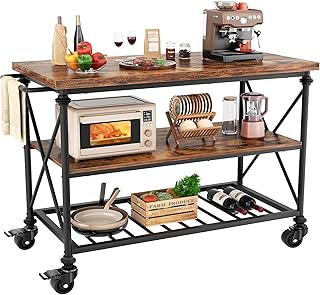
As an Amazon Associate we earn from qualifying purchases at no extra cost to you.
Editorial method: No cart was assembled, rolled, or load-tested for this article. Manufacturer product pages and assembly resources were reviewed on August 26, 2026. Three exact products were chosen to compare a compact open cart, an enclosed drop-leaf cart, and a furniture-style mobile island. Their order is not a safety or durability ranking.
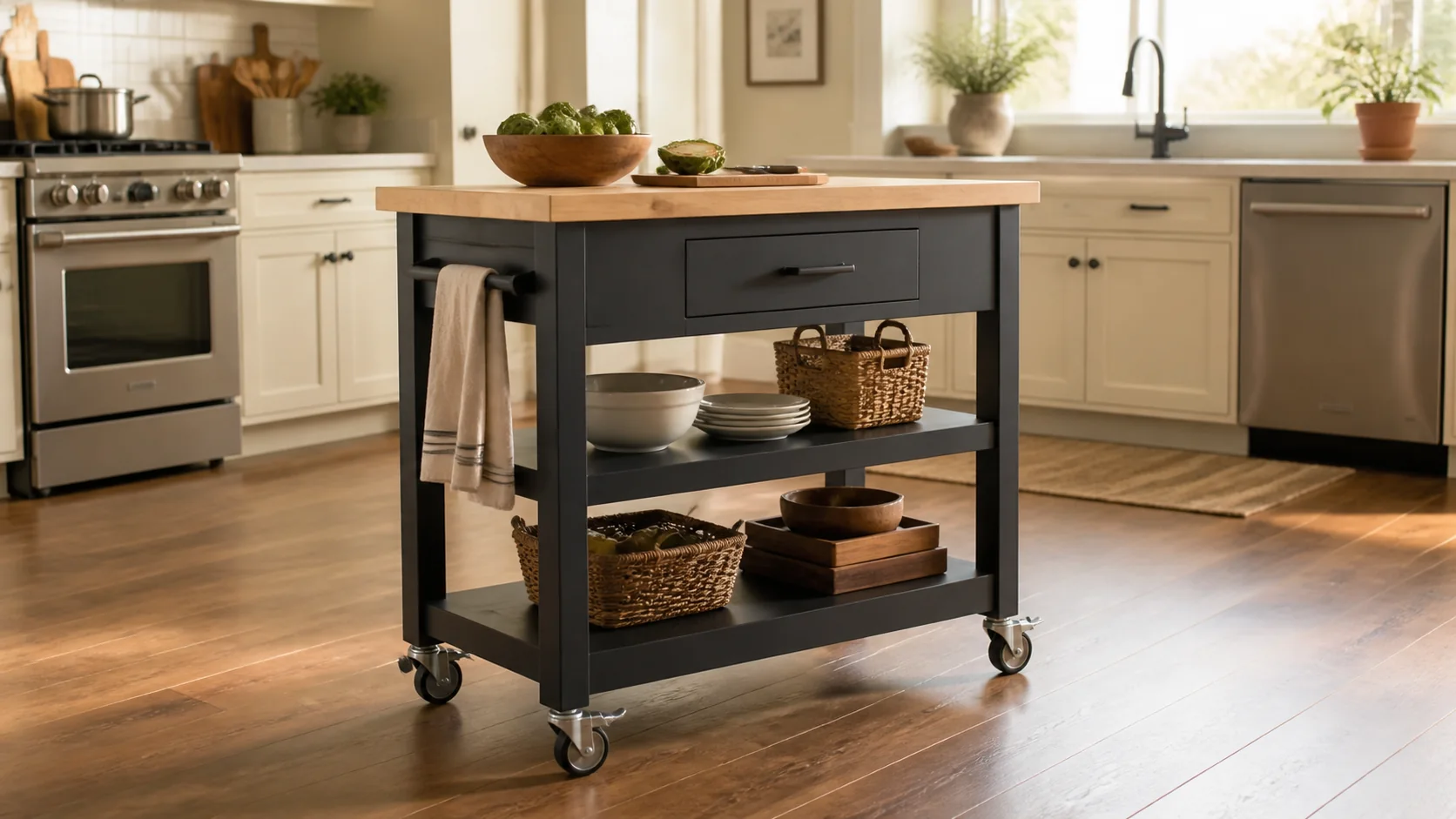
Three Exact Mobile Work Surfaces
| Exact model | Documented layout | Primary fit question |
|---|---|---|
| IKEA FÖRHÖJA 800.359.20 | Birch kitchen cart with two drawers, open shelves, and mobility from two wheels | Is a compact push-and-park cart sufficient without four swivel casters or a fold leaf? |
| Homestyles Dolly Madison 4513-95 | Mobile kitchen cart with drop leaf, cabinet storage, drawers, and casters | Does the room accommodate the expanded leaf and the loaded enclosed cabinet? |
| Crosley Alexandria CF3009 | Solid black-granite-top portable kitchen island with drawers, doors, towel bar, and casters | Can the floor and route handle a heavier stone-top furniture cart? |
Product variants can change top material, finish, dimensions, and hardware. Confirm the complete stock or model number on the current primary page and assembly manual. Retailer titles often combine multiple carts into one listing, which can attach the wrong dimensions or caster description to a photograph.
Map the Entire Travel Route
Measure the cart’s maximum width and depth, including towel bars, handles, knobs, and an open leaf. Then measure every doorway, appliance gap, island corner, floor transition, and turn along the route. A cart can pass a doorway straight ahead but fail when it must pivot immediately afterward.
Use painter’s tape to outline the parked and expanded footprints. Add refrigerator, oven, dishwasher, cabinet-door, and drawer swings. Maintain work aisles suitable for the actual kitchen and follow applicable design or accessibility requirements. Mobility is not permission to block an exit or create a trip hazard.
Test the route with a box built to the cart’s full envelope before ordering. Include hand clearance for steering. If the model has only two wheels, as with the FÖRHÖJA format, simulate lifting or guiding the opposite end rather than assuming it will pivot like four swivel casters.
Caster Design Determines Whether “Locked” Means Stable
Ask which casters swivel, which include brakes, and whether braking stops wheel rotation, swivel rotation, or both. A brake on two wheels may prevent rolling in one direction while the cart still pivots. The assembly manual, not a generic product category, should identify caster position and installation.
Check the manufacturer’s stated load information for the whole cart, top, shelf, drawer, and leaf. If no rating is published, do not invent one or assume the caster’s separate hardware rating describes the furniture. Heavy mixers, water jugs, cast iron, and appliances can concentrate load at one corner.
Small hard wheels may mark wood, catch grout joints, or stop abruptly at a threshold. Soft casters can be kinder to some floors but may compress under load. Review flooring guidance and inspect wheels for trapped grit. Never use a mobile cart on stairs, a sloped floor, or an uneven transition it cannot cross under control.
Top Material Changes Use and Momentum
The FÖRHÖJA uses a wood work surface that needs material-appropriate cleaning and periodic care. Dolly Madison’s product documentation should be checked for the exact top supplied with model 4513-95. Alexandria CF3009 uses a solid black granite top, adding mass high on the cart and requiring stone-safe maintenance.
A heavy top can make a cart feel planted when stationary, yet it increases momentum while rolling. Start and stop slowly, steer with the provided handle or structural frame, and keep hands away from pinch points. Never push from an open drawer, leaf, towel bar, or door unless the manual identifies it as a handle.
Fold-Leaf Geometry Needs Its Own Test
A drop leaf changes the center of load and the traffic envelope. On Dolly Madison, measure both leaf-down and leaf-up depth from the primary page. Identify the support mechanism and verify it is fully engaged before placing anything on the extension. Keep the leaf unloaded while raising or lowering it.
Position the expanded leaf away from a hot range, an opening refrigerator, and the main walkway. A person leaning on the unsupported edge creates leverage that a static plate does not reveal. The manufacturer’s leaf rating and assembly instructions control; the extension is not seating unless explicitly designed and rated for that use.
Plan where the cart goes when the leaf is down. Hardware and hinges may project beyond the nominal panel. Fingers, children’s hands, and clothing need clearance while it moves. A leaf that is rarely deployed should not justify a cart too deep for daily circulation.
Model-by-Model Use Cases
IKEA FÖRHÖJA 800.359.20
Choose FÖRHÖJA when open shelves, two drawers, and a compact wood cart solve light prep and staging needs. Its two-wheel arrangement differs from a four-caster island: it is better understood as a cart moved deliberately between parking positions. Confirm current dimensions and wall or tip-over guidance in the assembly documents.
Homestyles Dolly Madison 4513-95
Dolly Madison fits a kitchen that needs enclosed storage and an occasional drop-leaf extension. Map every door and drawer while the leaf is open. Confirm caster brake locations, top care, leaf support, and assembly hardware. Store dense items low and distribute weight instead of filling one side first.
Crosley Alexandria CF3009
Alexandria is the stone-top option. Granite adds a durable-feeling work surface but raises delivered and moving weight. Confirm the exact top and finish suffix, delivery route, floor suitability, caster configuration, and assembly sequence. Two people may be needed for safe assembly according to the current instructions.
Storage Without Destabilizing the Cart
Make a storage list before comparing drawer count. Light utensils belong higher; dense cookware and appliances belong low and near the center. Avoid loading one door compartment while leaving the other side empty. A towel bar is for light textiles or the use stated by the maker, not for hanging heavy pans.
Open one drawer or door at a time when the cart is loaded. Extended drawers shift the center of gravity. Child-resistant practices matter because a mobile cabinet invites climbing and riding. Use any included tip restraint or safety hardware exactly as directed, and never assume locked casters prevent tipping.
Reserve room for cleaning around stored items. Open shelves make inventory visible but collect dust and cooking film. Enclosed cabinets conceal clutter but can trap moisture. Do not store leaking liquids, propane, unsafe chemicals, or high-heat appliances contrary to product and fire-safety guidance.
Mobility and Clearance Decision Table
| Kitchen condition | Favor | Reject or verify carefully |
|---|---|---|
| Narrow doorway with immediate turn | Compact fixed-depth cart and full-size route mock-up | Projecting bars or a cart that only clears straight |
| Need occasional extra depth | Documented drop leaf with positive support | Permanent oversized top that narrows daily aisle |
| Soft or uneven floor | Floor-compatible wheels and controlled low load | Small casters crossing thresholds under heavy load |
| Heavy mixer or cookware storage | Published load limits and low centered placement | Unrated leaf, top, shelf, or towel bar |
| Frequent relocation | Four suitable casters and accessible brakes | Furniture that must be dragged or lifted awkwardly |
Assembly and Handoff Checklist
- Inventory panels, fasteners, casters, brakes, hinges, and top before assembly.
- Build on a protected level floor using the stated sequence.
- Do not substitute screws or enlarge damaged holes.
- Verify every caster and leaf support is oriented correctly.
- Square the cabinet before final tightening.
- Test empty rolling, steering, braking, and leaf operation.
- Add load gradually and keep dense items low.
- Retest brakes and fasteners after initial use.
Stop using the cart if it rocks, a caster loosens, a brake fails, a leaf support bends, the top shifts, or the cabinet goes out of square. Unload it before repair. A rolling island should never carry fixed plumbing, hardwired electricity, or a permanently connected gas appliance.
Coordinate the next decision with the calculate island walkways and seating clearance.
Frequently Asked Questions
Do locking casters make a cart safe for chopping?
They reduce movement only when correctly engaged on a suitable level floor. Stability also depends on caster type, cabinet rigidity, load distribution, top, and user force.
Can a drop leaf be used for seating?
Only when the manufacturer explicitly designs and rates the cart for seating. A prep extension should not be assumed to support a person leaning or sitting.
Is granite always better than wood?
No. Granite adds mass and needs stone-safe care; wood is lighter and may need periodic maintenance. Choose from mobility, task, upkeep, and manufacturer guidance.
How much aisle should remain?
Use the requirements and design guidance applicable to the kitchen, including appliance operation and accessibility. Measure with the cart expanded and every door open.
Can I replace the casters with larger wheels?
Only with manufacturer approval. Different stem, plate, height, leverage, or load characteristics can damage the base or make the cart unstable.
Recommendation: Choose the Safest Operating State
Choose FÖRHÖJA when a compact two-wheel wood cart will move occasionally between defined positions. Choose Dolly Madison 4513-95 when enclosed storage and a properly supported drop leaf solve a measured need. Choose Alexandria CF3009 when the floor, route, and users can manage a stone-top cart. The right model remains stable while locked, controllable while moving, useful while expanded, and unobtrusive while parked.
Sources
- IKEA official product page
- Home Styles Dolly Madison 4510-95 product page
- Crosley Furniture official product page