Bathroom vanity maintenance is not one spray-and-wipe routine. Wood veneer, engineered quartz, natural marble, glazed sinks, plated faucets, runners, and caulk react differently to water and cleaners. Use a component calendar: dry moisture daily, clean with approved products, inspect movement and seals monthly, and investigate swelling or leaks immediately.
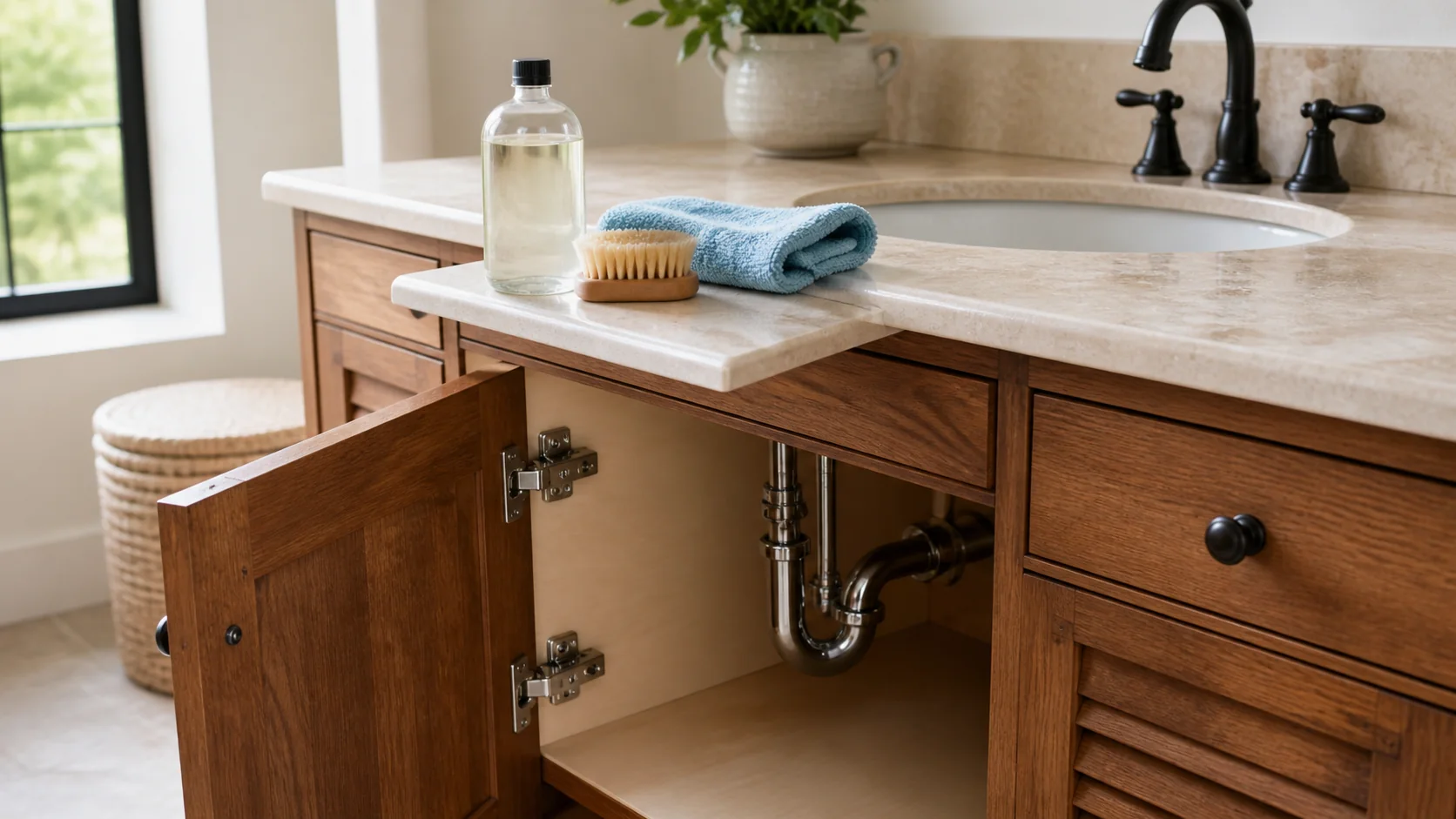
Create a calendar that follows exposure
| Interval | Cabinet and hardware | Top, sink, faucet, and joints |
|---|---|---|
| After use | Blot splashes, especially at edges and drawer fronts | Remove standing water; dry around faucet base and sink rim |
| Weekly | Dust or wipe with the approved finish cleaner | Clean with products confirmed for each surface |
| Monthly | Check door gaps, runner action, loose pulls, and mounting movement | Inspect supply, drain, overflow, sink seam, backsplash, and caulk |
| Twice yearly | Deep-clean only as the cabinet maker directs; review wall fasteners visually | Review material-specific sealer guidance and aerator condition |
| Immediately | Investigate swelling, delamination, musty odor, or a cabinet that shifts | Act on active drips, cracked sink, open joint, or countertop movement |
This is an inspection framework, not permission to override a manual. ROBERN’s Craft Series instructions, for example, prescribe blotting spills promptly, frequent dusting with the grain, wood-specific cleaners, and a six-month soil-removal step using a soft cloth dampened with a 50/50 mixture of warm water and ammonia-free detergent, followed by a water wipe and drying. That exact mixture belongs to that documented finish; do not assume it suits every painted or laminated cabinet.
Our top picks


As an Amazon Associate we earn from qualifying purchases at no extra cost to you.
Cabinet care starts with the finish identity
Wood veneer and lacquered wood
Use a soft cloth and the product maker’s cleaning method. Keep wet towels, diffusers, cosmetics, and leaking dispensers off the finish. ROBERN tells owners to avoid direct sunlight, drying heat, and dampness, to protect surfaces beneath accessories, and not to slide objects. Its Craft guide also warns against oily polish, wax, and products containing silicone. Another furniture finish may allow wax, so the model-specific care sheet remains decisive.
Painted, thermofoil, and laminate surfaces
Wipe with minimal liquid, paying particular attention to seams, drilled holes, lower edges, and areas near the sink. Do not let cleaner pool on a horizontal rail or migrate behind a wrapped edge. Avoid abrasive pads and solvent testing on a visible face. Kohler’s Forefront furniture guidance warns that excessive humidity can damage wood-fiber panels and instructs users to wipe splashes immediately, maintain ventilation, avoid bleach and abrasive cleaners, and keep damp towels off the furniture.
If the care label is missing, begin with a dry microfiber cloth and ask the manufacturer before applying a chemical. “Natural,” “bathroom safe,” and “multi-surface” do not prove compatibility with lacquer, adhesive, foil, edge banding, or touch-up coating.
Match countertop cleaning to the actual material
Engineered quartz and quartzite are different products. Cambria directs owners of its engineered quartz to remove residue with warm water, a soft cotton cloth, and mild soap if desired. It prohibits abrasive pads, topical sealers, penetrants, and harsh products including bleach, oven cleaner, abrasive powders, and paint remover. Those restrictions are exact for Cambria; another engineered surface requires its own care document.
Natural stone varies by mineral composition and treatment. The Natural Stone Institute recommends neutral cleaner, stone soap, or mild dishwashing liquid with warm water, followed by rinsing and drying. It cautions that acids such as lemon or vinegar may etch calcareous marble and limestone, while abrasive products can scratch. It also explains that an impregnator improves stain resistance rather than making stone stain-proof, and that some stones do not require sealing. Ask the fabricator what the slab is and which sealer, if any, was applied. The site’s guide to compare quartz and marble vanity tops explains why their care plans cannot be swapped.
For cultured marble, solid surface, porcelain, glass, or laminate tops, use the brand’s instructions. Avoid inventing a resealing interval. A dull patch may be residue, etching, abrasion, or coating damage; treating the wrong diagnosis can enlarge it.
Clean the sink and faucet as separate finishes
Remove toothpaste, soap, cosmetics, and mineral residue before they harden, but do not scrub a faucet with the same pad used on a sink. Faucet plating, powder coat, living finish, glazed ceramic, composite basin, and drain trim can each have different restrictions. Spray cleaner onto a cloth when the fixture maker recommends it so liquid does not enter seams or remain around the faucet base.
At the monthly check, operate hot and cold controls, inspect the faucet base, feel each supply connector for moisture, and look beneath the drain and overflow. Clean an aerator only by its faucet instructions; note its washer order before disassembly. Green deposits, rust streaks, a stiff valve, or repeated moisture deserve diagnosis, not stronger cleaner.
Read moisture patterns before repairing the finish
A single splash usually leaves a surface mark. Plumbing leaks create patterns: a faucet-base leak wets the top and rear rail; a supply leak appears below a valve or hose; a drain leak follows basin use; an overflow leak appears only during a high fill; failed backsplash caulk darkens the wall joint. Dry everything, place clean paper beneath individual connections, and test cold, hot, a filled basin, overflow, and full drain separately.
Raised fibers, bubbling foil, a soft panel edge, separated veneer, swollen particleboard, black spotting, or persistent musty odor indicate more than dirt. Shut off the source, empty the cabinet, ventilate safely, and document the extent. The guide to install a bathroom vanity correctly covers accessible plumbing and structural checks. Suspected mold, contaminated water, concealed wall moisture, or damage near electrical equipment requires qualified help.
Do not seal wet material behind trim, coat swollen board with paint, or tighten plumbing until the cabinet distorts. Drying can stop progression but does not restore lost fastener strength or compressed board thickness.
Adjust hinges and drawers without chasing the gap
First identify the hardware maker and series from a stamped logo or part number. Empty the door or drawer, confirm the cabinet is still level and square, tighten visibly loose mounting screws by hand, and inspect for stripped holes or corrosion. A door that suddenly rubs may signal cabinet movement or swelling rather than hinge adjustment.
Concealed hinges commonly offer side, height, and depth adjustments, but screw functions and limits vary. Blum’s COMPACT BLUMOTION documentation explicitly describes those three adjustments. Make one small change at a time, note the starting position, and support the door. Do not use an adjustment screw to compensate for a loose mounting plate or damaged cabinet wall.
Drawer systems may provide height, side, tilt, and sometimes depth control. Blum’s TANDEM resources separate these adjustments by mechanism. Remove and reinstall a drawer only with the correct release sequence. Stop if a runner is bent, a locking device is cracked, mounting screws no longer hold, or plumbing interferes with the drawer path.
Inspect caulk as a joint, not decoration
Look for separation from either surface, splits, missing sections, trapped discoloration, softness, or movement when the top is gently loaded. Surface mildew on sound caulk and an open joint are different failures. If replacement is needed, identify the substrate and original specification, remove failed material without scratching finishes, clean and dry the joint, and apply a compatible product in the geometry and cure conditions its maker requires.
Do not automatically substitute 100-percent silicone. Some Kohler vanity instructions require siliconized acrylic caulk and warn that 100-percent silicone damages the cabinet finish. Conversely, other countertop or sink systems specify silicone. Cure time comes from the sealant label under actual temperature, humidity, and bead size; “dry to touch” is not permission to expose the joint to water.
Repair, reseal, or replace?
Cleaning is appropriate for compatible surface soil. Adjustment suits intact, correctly mounted hardware. Recaulking suits a stable joint after the leak source is excluded. A stone professional can assess etching, chips, failed impregnator, or seam problems; a cabinet specialist can evaluate localized finish damage and hardware mounting.
Replacement becomes more well-supported when structural panels are swollen or crumbling, wall attachment is loose in damaged material, delamination is extensive, a sink or top is cracked through, mold or rot extends into concealed assemblies, or repairs cannot preserve safe plumbing access. If layout also performs poorly, use the guide to choose a vanity for a small bathroom rather than rebuilding the same clearance problem.
Frequently asked questions
Can vinegar clean every vanity top?
No. Acid can etch marble, limestone, and other calcareous stone, and may affect sealers. Use the exact surface maker’s approved cleaner.
How often should natural stone be resealed?
There is no universal interval. Identify the stone and existing treatment, then follow the fabricator and sealer manufacturer. Some stone does not need an impregnator.
Why did a cabinet door become misaligned after years of normal use?
Loose hinge screws are one possibility, but also check cabinet level, wall attachment, moisture swelling, and a loaded or damaged hinge before turning adjustment screws.
Can swollen particleboard be flattened and reused?
Drying may stabilize a minor incident, but permanently expanded or softened board has lost geometry and possibly holding strength. Replace structural parts when safe fastening cannot be verified.
Should stained caulk always be covered with a new bead?
No. New caulk over failed or contaminated material rarely restores adhesion and can conceal moisture. Determine whether the joint is intact, remove failed sealant, correct the source, and let surfaces dry.
The goal is a dry, stable assembly
A clean vanity is not necessarily a healthy vanity. The meaningful maintenance record shows approved products, dry cabinet edges, stable mounting, smooth hardware, intact joints, and plumbing that remains dry through staged tests. Keep model numbers and care sheets with dated photos. Early evidence—a shifted door gap, dark seam, swollen edge, or single tissue-detected drip—is cheaper to address than finish failure that has reached the cabinet structure.
Primary care references
- ROBERN Craft Series vanity care and maintenance
- Kohler Forefront bathroom furniture care guidance
- Cambria quartz product care
- Natural Stone Institute care and cleaning guidance
- Blum COMPACT BLUMOTION adjustment resources
- Blum TANDEM drawer adjustment resources