Key takeaways
- No exact housing or cartridge model is published.
- One vague badge implies removal of chlorine, chloramine, hardness, metals, bacteria, and every other concern.
- Only a media component is certified, while the assembled shower system is not identified.
- There is no operating temperature, pressure, flow, capacity, or replacement interval.
- Health or cosmetic promises replace measurable contaminant claims.
- Replacement cartridges cannot be sourced from an accountable channel.
- The housing requires unsupported adapters or creates excessive leverage.
- The seller advises removing flow controls or exceeding local limits.
A filtered shower head is a housing, treatment cartridge, and shower outlet connected in series. The housing must tolerate hot water and pressure, the cartridge must have a documented claim for the target substance, and the shower head must still deliver an acceptable legal flow. A cartridge that merely fits is not proof that it performs.
Evidence policy: This guide does not claim that a shower filter cures dry skin, prevents hair loss, treats disease, or makes microbiologically unsafe water potable. Manufacturer pages, NSF consumer resources, EPA drinking-water information, and current Delta Clarifi documentation were reviewed on August 26, 2026. Verify exact listings and performance sheets at purchase time.
Our top picks
 Aquabliss High Output Revitalizing Shower Filter
- Set Name: SF100
- Item Dimensions D x W x H: 3.3"D x 3.3"W x 4.7"H
- External Testing Certification: UL


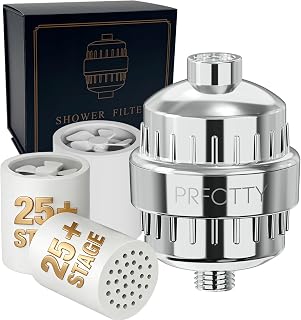
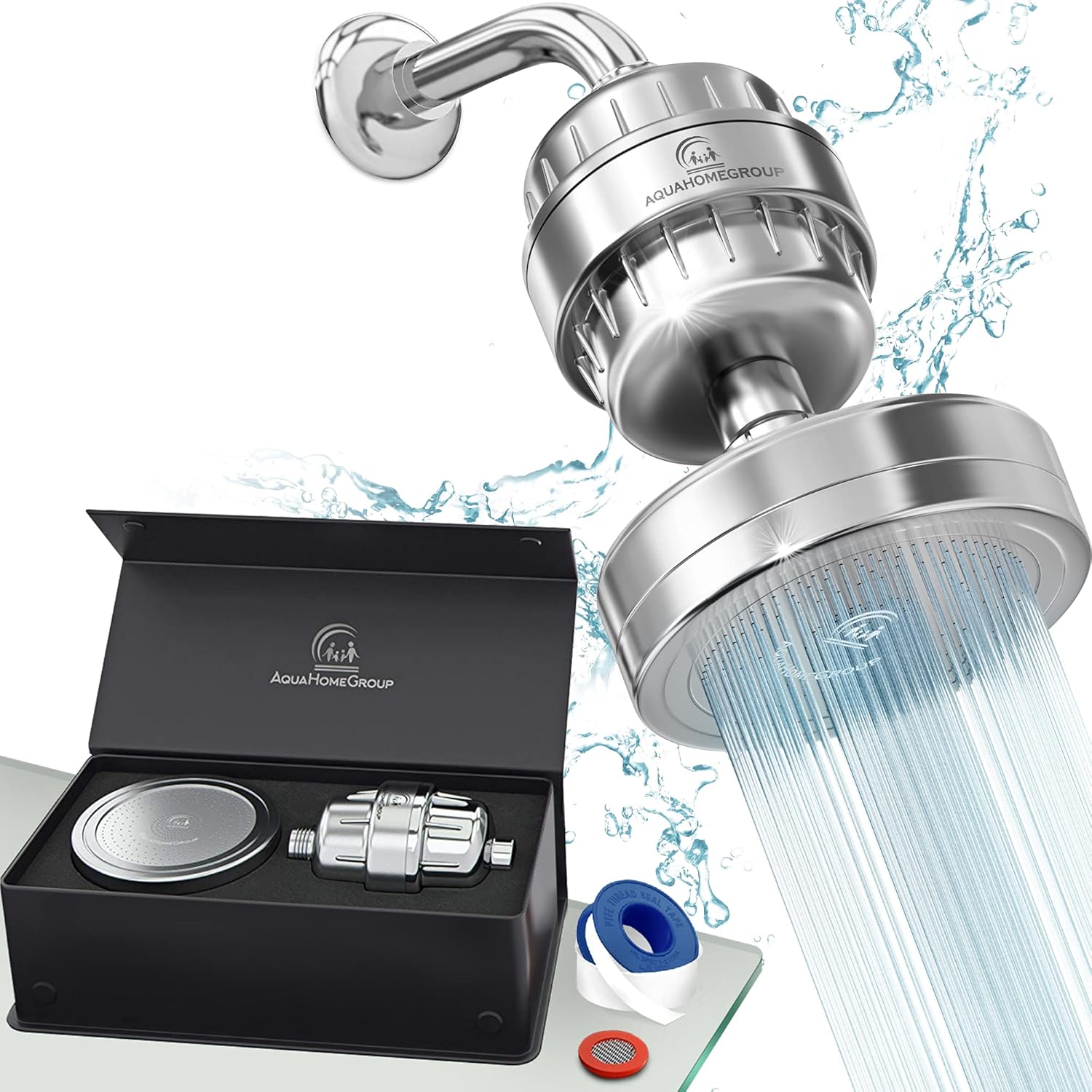 AquaHomeGroup Filtered Shower Head
- Installation Type: Wall Mounted
- Number of settings: 20
- Setting Type: Rain
20-plus stage filtration targets chlorine and heavy metals
Vitamin-infused cartridge aims to be gentler on skin and hair
Reinforced brass holder resists sliding or drooping
Filter cartridges need periodic replacement to stay effective
Metal body adds weight versus plastic showerheads

As an Amazon Associate we earn from qualifying purchases at no extra cost to you.
Begin With the Utility’s Disinfectant
Public water systems commonly use free chlorine or chloramine for disinfection. These are not interchangeable treatment targets. EPA explains that chloramine is formed by combining chlorine and ammonia and can provide longer-lasting distribution-system protection. A cartridge claim for free available chlorine should not be extended to chloramine without exact evidence.
Read the current consumer confidence report and utility treatment notice. Ask whether disinfectant changes seasonally. Private wells usually do not contain a utility residual unless the owner chlorinates them; well users need appropriate laboratory testing rather than selecting a shower cartridge from odor alone.
Sediment, hardness, iron, sulfur odor, acidity, microorganisms, and disinfectant residual are separate issues. A shower filter marketed for chlorine may capture some particulate material but is not automatically a softener, iron filter, sulfur treatment, or disinfection system.
Understand Which NSF Standard Applies
NSF/ANSI 177 is the standard specifically associated with shower filtration systems and free available chlorine reduction. It addresses performance and material requirements under defined test conditions. Certification to 177 does not establish removal of every contaminant and does not mean the output is drinking water.
NSF/ANSI 42 and 53 are widely seen on drinking-water filters; Standard 42 includes aesthetic effects and Standard 53 includes specified health-effect claims. Those numbers on another product category should not be treated as a substitute for an exact shower-system listing. Search the certifier database using the complete housing and cartridge identifiers.
Distinguish “certified by” from “tested to” or “uses certified media.” Independent certification should identify the listed model, replacement element, claim, rated capacity, flow, and conditions. A laboratory report or component certification may still be useful, but it must be described accurately rather than converted into a system-wide badge.
Treatment Media and Hot-Water Constraints
| Media or mechanism | Potential role | Verification question |
|---|---|---|
| Activated carbon | Adsorption of certain compounds under suitable contact conditions | Does the exact hot-water cartridge have a listed chlorine or chloramine claim? |
| Calcium sulfite | Common shower-media chemistry for free-chlorine reduction | What temperature, flow, capacity, and certification apply? |
| KDF process media | Redox media used in some shower cartridges | Which exact system-level claim is independently verified? |
| Sediment screen or pad | Captures particles above its effective size | Is micron performance stated, and can loading reduce flow? |
| Vitamin C or ascorbate | Chemically reacts with disinfectant in some products | Is dose, exhaustion, microbial care, and exact reduction documented? |
Hot water changes adsorption and reaction behavior. A media effective in a cold drinking-water test may not have the same capacity at shower temperature. Use the housing’s operating-temperature and pressure range, and never place a cold-water-only cartridge in a shower because the threads appear compatible.
Use Delta Clarifi as a Traceable Example
Delta’s current Clarifi family provides exact identifiers that demonstrate why housing and cartridge must be tracked together. The `7SF100` is listed as the Clarifi Standard Shower Filter Attachment, while `5SF100` is the Premium Shower Filter Attachment. Delta identifies `7RC100` as the standard replacement cartridge and `5RC100` as a premium replacement two-pack on its shower-filter product pages.
The `7SF110B` combines a filter attachment with a four-setting In2ition shower configuration. Bundles such as `FVS2-CF7801` pair a standard filter with a shower head. A bundle code, filter housing, and cartridge code describe different purchase units. Record all three when applicable so a future replacement is not chosen from finish or appearance.
Delta states that Clarifi reduces chlorine and sediment. That manufacturer statement should be checked against the current exact performance and certification documents for the chosen standard or premium system. Do not assume the premium label means broader contaminant treatment without comparing claim sheets.
Flow, Pressure, and Added Projection
A filter adds media resistance and physical length between the shower arm and outlet. Measure static and flowing conditions when a pressure problem already exists. Clean the current inlet screen and diagnose valve or pipe restrictions before adding another component. A filter cannot restore pressure that the supply does not deliver.
Compare the rated flow of the filter with the shower head and local legal limit. The lowest or most restrictive component can govern delivered performance. Wide rain heads, hand showers, and multi-outlet systems may respond differently from a compact fixed head when pressure drops.
Measure clearance from the wall, ceiling, enclosure, and user’s head. An inline housing can move the shower head forward or downward and increase leverage on the shower arm. Use the orientation and support described by the manufacturer. Stop if the arm moves inside the wall or its threads are corroded.
Cartridge Capacity Is Both Gallons and Time
Rated capacity is produced under specified test conditions. Estimate household shower gallons from rated flow, average duration, frequency, and number of users. Compare that estimate with the cartridge gallon limit and maximum time interval, then replace at whichever comes first.
Water temperature, disinfectant concentration, sediment load, pressure, and actual flow can alter service. Flow decline, odor return, visible media damage, leakage, or manufacturer indicators may require earlier replacement. Extending a cartridge because water still passes through it does not preserve the original claim.
Do not quote a permanent replacement price. Check current genuine-cartridge cost, shipping, subscription terms, pack quantity, local availability, and disposal instructions. Calculate annual cost under the household’s expected change interval. A low purchase price can conceal proprietary consumables that are difficult to source.
Housing and Cartridge Compatibility Checklist
- Record housing, bundle, and current cartridge model numbers.
- Match the replacement element in the manufacturer documentation.
- Confirm the exact independent certification listing and claim.
- Check thread, seal, orientation, temperature, and pressure limits.
- Measure cartridge-removal and housing-opening clearance.
- Verify the shower head’s flow and physical compatibility.
- Inspect genuine packaging, seals, date coding, and seller authorization.
- Keep the installation date and calculated replacement date visible.
A third-party cartridge may physically fit yet use different media, seals, capacity, or quality control. Unless the exact replacement is independently listed for the housing and supported by the system maker, do not represent it as preserving the original certification.
Installation and Maintenance Protocol
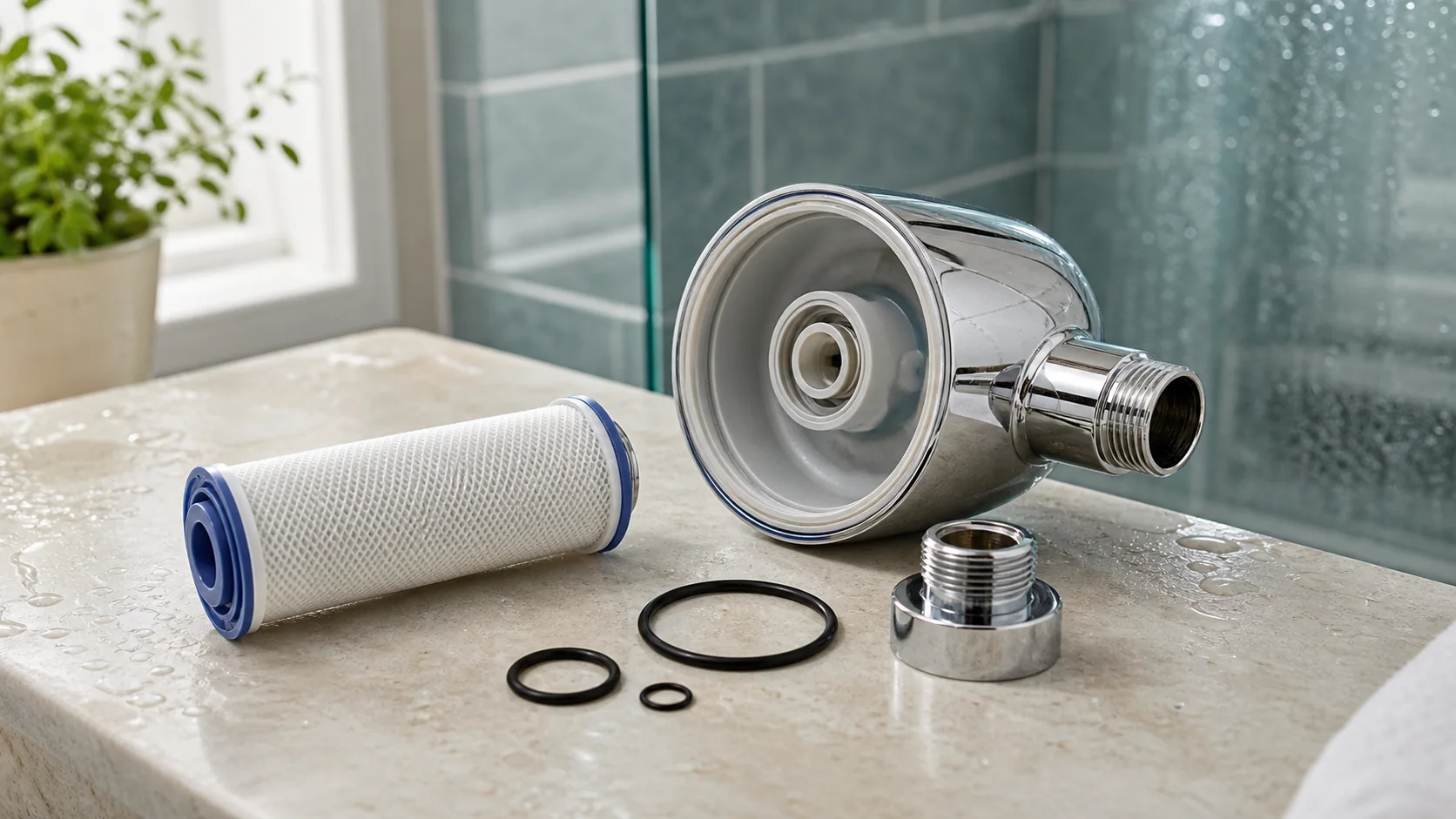
Close water at the shower control and relieve flow. Remove the shower head while supporting the arm so torque is not transferred into the wall. Clean threads without scratching them, install the filter in the specified direction with the supplied seals, and use thread tape only where the manual instructs.
Flush a new cartridge for the specified time before normal use. Check every joint while flowing and after shutdown. Reinspect following a hot shower because temperature cycling can expose a seal problem. Do not overtighten plastic or plated housings.
At each change, clean only the serviceable housing areas listed by the maker, inspect O-rings, and replace seals when directed. Never add bleach, fragrance, loose media, or cleaning chemicals inside the cartridge chamber. Record flow changes and keep the old cartridge isolated from clean parts.
Red Flags That Should Stop a Purchase
- No exact housing or cartridge model is published.
- One vague badge implies removal of chlorine, chloramine, hardness, metals, bacteria, and every other concern.
- Only a media component is certified, while the assembled shower system is not identified.
- There is no operating temperature, pressure, flow, capacity, or replacement interval.
- Health or cosmetic promises replace measurable contaminant claims.
- Replacement cartridges cannot be sourced from an accountable channel.
- The housing requires unsupported adapters or creates excessive leverage.
- The seller advises removing flow controls or exceeding local limits.
Also pause when the household has medically vulnerable occupants, a private well with uncertain microbiology, recurring boil-water notices, or a known regulated contaminant. A shower accessory is not a substitute for qualified water-safety advice or appropriate whole-system treatment.
Coordinate the next decision with the test water and identify the disinfectant.
Frequently Asked Questions
Does NSF/ANSI 177 prove chloramine reduction?
No. Standard 177 is associated with free available chlorine reduction in shower filtration. Chloramine requires a separate exact claim and suitable test evidence.
Will a shower filter soften hard water?
Usually not. Hardness is dissolved calcium and magnesium. Verify a specific hardness-treatment mechanism rather than inferring softening from reduced scale appearance or chlorine claims.
Can a cartridge be used until flow stops?
No. Replace at the applicable gallon, time, performance, indicator, or condition limit. Water can continue flowing after treatment capacity has declined.
Is filtered shower water safe to drink?
A shower-filter claim does not establish potability. Drinking-water safety depends on the source, exact contaminants, system certification, and public-health guidance.
Why did pressure fall after installation?
Possible causes include a clogged screen, unflushed cartridge, incorrect orientation, exhausted media, incompatible flow ratings, supply restriction, or a valve problem. Diagnose before removing legal flow controls.
Decision Standard
Select a shower filter only when the utility or test identifies a target, the exact housing-and-cartridge combination has a relevant verified claim, the plumbing can support its flow and projection, and replacement cost is sustainable. Treat claims about skin or hair as unproven unless supported by appropriate evidence; contaminant reduction is the measurable buying question.
Sources
- NSF support guidance
- NSF official product page
- U.S. EPA official product page
- Delta Faucet official product page
- Delta Faucet official product page