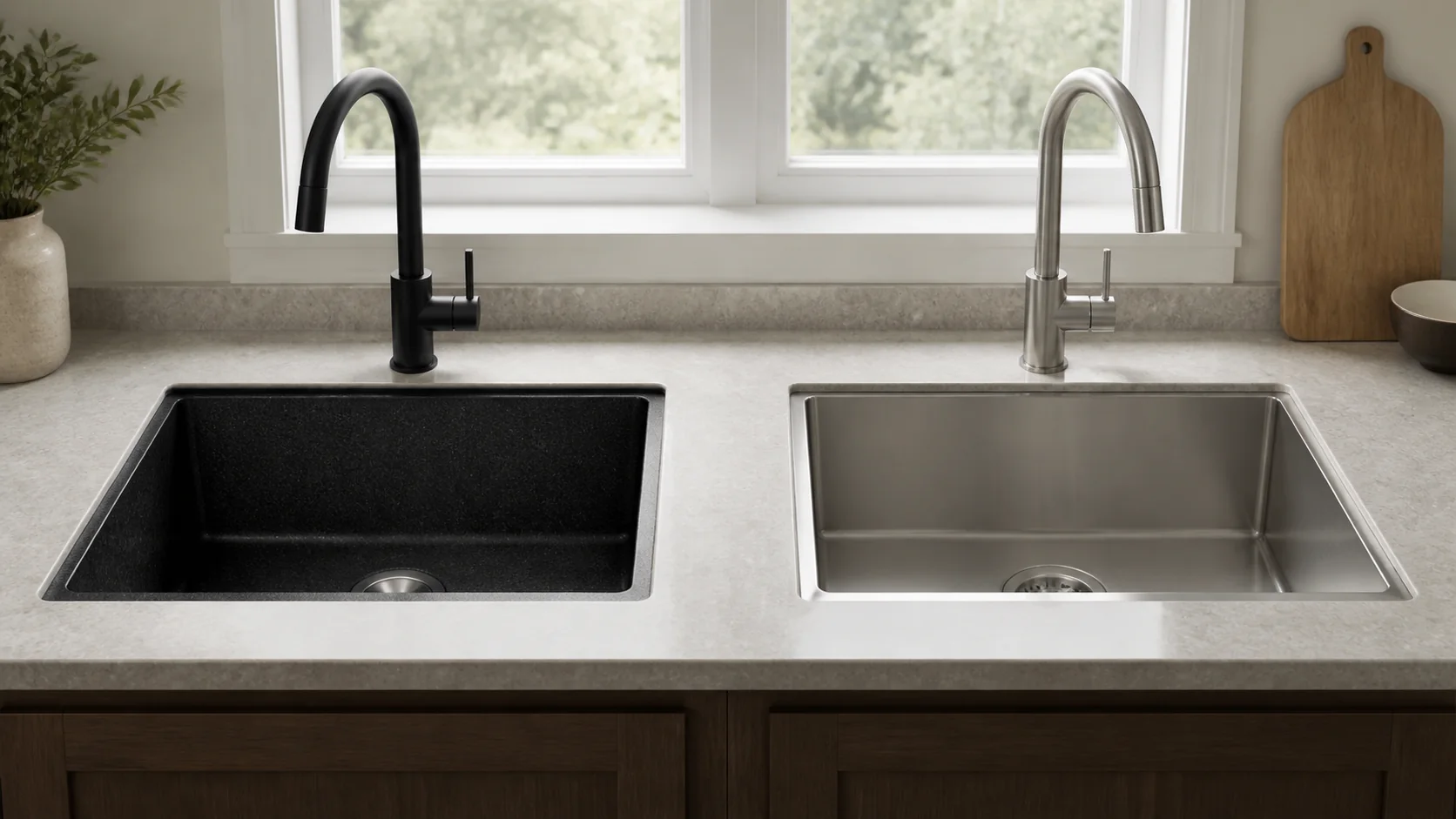
“Granite composite” and “stainless steel” describe material families, not identical products. Composite recipes vary in mineral, resin, pigment, molding, and surface treatment; steel sinks vary in alloy, gauge, construction, finish, and sound-deadening. Check the exact model’s specification and care sheet before borrowing another brand’s claims.
Composition claims need a product name
BLANCO describes SILGRANIT as a patented composite made with up to 80 percent natural granite blended with acrylic. Elkay describes Quartz Classic as natural quartz combined with high-performance acrylic resin. Those are brand-specific systems. An unbranded “granite sink” may use a different mineral fraction or binder, so its resistance and care rules must come from its own documentation.
Our top picks




As an Amazon Associate we earn from qualifying purchases at no extra cost to you.
Stainless composition also deserves precision. BLANCO specifies premium 304-series steel with 18/10 chromium-nickel content for its stainless sink range; one Precision model is also identified as 18 gauge. A 304, 18-gauge example does not make every stainless sink that alloy or thickness. Ask for alloy, nominal gauge, construction method, finish, and sound treatment.
Impact: stiffness and ductility fail differently
A mineral composite feels rigid and substantial. Elkay markets Quartz Classic as molded from fine quartz sand to resist banging and chipping. Still, “impact resistant” is not “unbreakable.” A hard strike at an edge, unsupported installation, shipping damage, or a heavy disposal load can initiate a chip or crack that does not bend back into shape.
Stainless steel is ductile: an impact may dent or crease the basin rather than fracture it. Thinner flat areas can flex more, while formed ribs, corner geometry, undercoating, and gauge influence response. A dent may remain serviceable but visually obvious. Compare actual bowl construction instead of assuming lower gauge number alone predicts every performance outcome.
Scratches and scuffs have different visual signatures
Composite makers publish strong scratch-resistance claims, but metal cookware can leave transfer marks that resemble scratches. Use the documented cleaning method before diagnosing material loss. Dark composite colors can hide some food stains yet show pale mineral film; light colors may reveal dark pan transfer more readily.
Brushed stainless develops directional fine scratches and changes in sheen. BLANCO’s care guidance says to wipe and dry in the direction of the brushed finish and warns that circular rubbing can permanently alter surface structure. Its older Precision care sheet says scratches are inevitable and tend to become more uniform with the grain over time. That aging pattern can look acceptable in a work-focused kitchen but disappoint someone expecting a pristine mirror-like surface.
A grid reduces contact, but trapped grit can abrade either surface.
Heat ratings are limits, not cooking practices
Elkay states that Quartz Classic is heat-safe up to 535°F. BLANCO publishes heat resistance up to 280°C for SILGRANIT in its international material information. These exact numbers are not interchangeable with other composites, and a brief material rating does not answer thermal shock, hot-oil, accessory, sealant, disposal, or countertop limits.
Stainless steel itself tolerates kitchen heat well, but the complete installation includes pads, undercoating, caulk, clips, drains, and adjacent counter material. Use a trivet or protected landing area for hot cookware rather than making the sink a routine heat sink. Rapid, uneven temperature change can stress materials and joints even below a headline maximum.
Noise depends on the assembled sink
Dense composite typically produces a lower, muted sound when water or utensils strike it. Stainless can ring, especially where broad panels lack damping. Better stainless models add pads and undercoating, and a heavier bowl or bottom grid changes acoustics. Disposal vibration also travels through mounting flanges, sinks, counters, and cabinets.
Ask how much of the stainless underside is treated, whether pads can loosen near heat, and whether the composite model needs special disposal support. A loud sink is not automatically thin, and a quiet empty-bowl demonstration does not predict a disposal attached below.
Hard water changes the visual winner
Hard-water minerals remain when droplets evaporate. On stainless, spotting interrupts reflectivity; on dark composite, pale film can create a chalky haze; on light composite, deposits may blend until they trap other discoloration. BLANCO notes that both stainless and SILGRANIT can develop limescale and soap scum and provides separate cleaner formulations.
Drying after use is the lowest-risk control for either material. BLANCO instructs SILGRANIT users to wash with dish soap on the soft side of a sponge, rinse, and dry with microfiber. Its stainless procedure uses similar supplies but requires wiping along the brushed grain. Local hardness, frequency of drying, sink color, and light direction often influence visible maintenance more than marketing terms such as “stain resistant.”
Cleaning chemistry is not transferable
Do not apply a stainless polish, rust remover, drain cleaner, chlorine product, solvent, or abrasive to composite unless its manufacturer allows that exact use. BLANCO’s international SILGRANIT care page warns against drain cleaners, chlorine-containing cleaners, lyes or solvents, and abrasives. Its DeepClean SILGRANIT product is specifically limited to SILGRANIT sinks and must not be used on faucets.
Stainless surfaces also differ. BLANCO warns against aggressive cleaner, hypochlorite bleach, silver-cleaning baths, scratchy brushes, scouring pads, and steel wool in its current international guidance. Coated, linen, satin, natural, and hardened finishes may have different polish rules. Follow the document for the installed finish, rinse residues, and never mix chemicals.
The related kitchen sink cleaning guide can organize a routine, but the model care sheet remains the chemical authority.
Color and finish age differently
Composite color is integrated into the molded material on many branded products, reducing the contrast of a small surface mark compared with a thin decorative coating. Yet mineral film, food residue, metal transfer, UV exposure, chemicals, and localized wear can change perceived color. A dark sink that looks faded may first need correct descaling rather than recoloring.
Uncoated stainless does not fade like applied color, but scratches change its sheen. Indiscriminate polishing can create a glossy patch; coated stainless is a separate care category.
Weight changes handling and support
Composite sinks are generally heavier and less forgiving of twisting during transport. Inspect before installation and lift with adequate help. Cabinet width, rail locations, countertop structure, sink flange, clips, and any support frame must satisfy the exact installation instructions. Heavy sinks should not hang from sealant alone.
Stainless is usually lighter, easing handling and future removal, but weight does not eliminate support requirements. Large workstations, apron fronts, deep bowls, and disposal-equipped installations still impose meaningful load. Verify cabinet and counter capacity before cutting.
Garbage disposal compatibility includes vibration
Confirm drain-opening size, flange compatibility, bowl thickness, under-cabinet clearance, and manufacturer permission. A heavy disposal can amplify stress at an undermount joint or composite drain area if support is poor. On stainless, it may add vibration and sound. Do not overtighten the disposal flange to chase a leak; use the disposal and sink makers’ seal and torque sequence.
After installation, operate the disposal with water and inspect the flange, mounting ring, discharge, dishwasher branch, trap, sink supports, and countertop joint. New movement, cracking, metallic contact, or a changed reveal requires shutdown and investigation.
Installation and replacement
Both materials appear in drop-in, undermount, and farmhouse configurations. Material does not determine mounting style. Composite may require careful handling and specific clip torque; stainless may flex if fasteners are uneven. The guide to select an undermount or drop-in sink covers the counter interface separately.
Replacement must match cutout, corners, flange, reveal, cabinet, faucet holes, drain, and support. Composite cannot be reshaped casually; any greater availability of familiar stainless dimensions must be verified locally.
Lifecycle means acceptable aging plus repair access
Compare warranty terms for thermal damage, chips, discoloration, finish, accessories, labor, and commercial use. Then check replacement grids, drains, clips, templates, and color continuity. Composite can preserve a uniform matte color while risking difficult crack repair; stainless can accumulate visible scratches while remaining structurally serviceable.
Household decision matrix
| Household condition | Likely starting point | Verify on the model |
|---|---|---|
| Wants stable matte color | Granite composite | Pigment system, UV and chemical limits |
| Accepts a developing work patina | Stainless steel | Alloy, finish direction, gauge, pads |
| Hard water and minimal drying | Either with caution | Chosen color, approved descaler, daily visibility |
| Frequent heavy cookware impacts | Model-dependent | Impact warranty, grid, edge geometry, support |
| Noise-sensitive open kitchen | Composite or damped stainless | Complete acoustic treatment and disposal behavior |
| DIY handling or future replacement | Stainless often easier | Actual weight, cutout, clips, safe lifting |
| Highly controlled sink color | Composite | Physical sample under kitchen lighting |
After choosing the material behavior, compare granite composite and stainless models against the actual counter, cabinet, and water conditions.
Frequently asked questions
Is every granite composite sink 80 percent granite?
No. BLANCO publishes up to 80 percent natural granite for SILGRANIT, but recipes vary. Use the exact product’s technical statement.
Does stainless steel rust?
Quality stainless resists corrosion, but external iron particles, harsh chemicals, damaged finishes, and contamination can create rust-colored marks. Diagnose and clean by the manufacturer’s method.
Which material hides hard-water marks?
It depends on mineral load, sink color, sheen, and lighting. Reflective stainless and dark composite can both show deposits prominently. Drying matters most.
Can a chipped composite sink be repaired invisibly?
Not reliably. Small repairs depend on location, color, structural depth, and an approved kit. Cracks near drains, supports, or disposal mounts need manufacturer or professional review.
Is thicker stainless always quieter?
No. Gauge influences panel behavior, but geometry, forming, pads, undercoating, cabinet, faucet flow, grid, and disposal also shape sound.
Choose the aging pattern you can maintain
Granite composite favors integrated color, mass, and muted sound, with brand-specific chemical limits and a greater need for careful support. Stainless favors lower weight, ductility, and a serviceable work patina, while scratches, directional finish, and sound treatment remain visible considerations. Choose after viewing physical samples with dried local water, reading the precise care sheet, and confirming installation and disposal support.
Primary manufacturer references
- BLANCO SILGRANIT composition and material information
- BLANCO SILGRANIT care guidance
- BLANCO stainless steel care guidance
- BLANCO stainless steel composition information
- Elkay Quartz Classic material and heat information
- BLANCO Precision stainless warranty and care instructions