Key takeaways
- For 1080p: Choose an RTX 4070 Super or RX 7800 XT unless you plan to move to 1440p soon.
- For the best 1440p balance: Choose the RX 9070 XT or RTX 5070 Ti.
- For value-focused 1440p: Choose the RX 9070 or RTX 5070.
- For 4K: Choose the RTX 5080 when you want high performance without the extreme power requirement of the flagship.
- For uncompromising 4K: Choose the RTX 5090, but budget for a large case, stronger PSU, and more heat.
The best graphics cards gpus pairing for 7800x3d depends mainly on your target resolution: choose a Radeon RX 9070 XT or GeForce RTX 5070 Ti for the most balanced 1440p build, step up to an RTX 5080 or Radeon RX 9070 XT for high-refresh 4K, and reserve the RTX 5090 for uncompromising 4K performance.
The Ryzen 7 7800X3D remains an excellent gaming processor because its 3D V-Cache keeps frame rates high without requiring an expensive platform change. It can support anything from a sensible midrange card to a flagship GPU, but the right pairing changes with resolution, ray tracing, power capacity, and budget. At 1080p, the processor will often become the limiting factor before the graphics card does; at 1440p and 4K, the GPU matters much more.
Our top picks
 KOTIN Prebuilt Gaming PC Ryzen 7 7800X3D
- Ryzen 7 7800X3D High-Cache Processor Built for Gaming:…
- Plug and Play Gaming PC: This KOTIN prebuilt…
- 9.16-Inch Smart Display: The built-in 9.16-inch smart display…
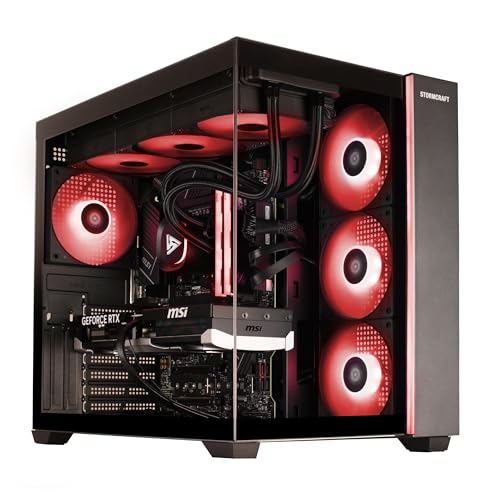 STORMCRAFT Falcon Prebuilt RTX 5070 Gaming PC
- Dominate 1440p & Max-Out Competitive Esports: Engineered for…
- Elite B850 Platform with 360mm AIO Cooling: Built…
- Your All-in-One Content & Streaming Command Center: Beyond…
 STORMCRAFT Valkyrie Gaming PC
- Elite Gaming Performance with 3D V-Cache CPU: AMD…
- High-Speed Memory & Massive Storage Bundle: 32GB Dual…
- Premium Stable Cooling & Power Supply: Pre-installed 360mm…
As an Amazon Associate we earn from qualifying purchases at no extra cost to you.
Quick picks by gaming situation
| Gaming goal | Recommended GPU tier | Typical board power | Recommended PSU | Best fit |
|---|---|---|---|---|
| 1080p high refresh | GeForce RTX 4070 Super or Radeon RX 7800 XT | 220–263W | 650–750W | Competitive games and high settings |
| 1440p value | Radeon RX 9070 or GeForce RTX 5070 | 220–275W | 650–750W | Most modern single-player games |
| 1440p ultra and ray tracing | GeForce RTX 5070 Ti or Radeon RX 9070 XT | 285–304W | 750–850W | High-refresh 1440p with longer-term headroom |
| 4K high settings | GeForce RTX 5080 | 360W | 850W | 4K gaming with upscaling |
| 4K maximum performance | GeForce RTX 5090 | 575W | 1000–1200W | Very high-refresh 4K and demanding ray tracing |
Best overall balance: Radeon RX 9070 XT or GeForce RTX 5070 Ti
For a new 7800X3D system, the Radeon RX 9070 XT and GeForce RTX 5070 Ti occupy the most comfortable performance tier. Either card can drive demanding 1440p gaming at high settings while leaving enough CPU capability for high frame rates in esports titles.
The RX 9070 XT is particularly attractive when traditional rasterized performance and 16GB of video memory are priorities. It is a strong choice for a 1440p monitor with a 165Hz or 240Hz refresh rate, and it can handle many 4K games when settings or upscaling are adjusted.
The RTX 5070 Ti is the better direction if you care heavily about ray tracing, frame-generation features, CUDA-supported applications, or creator software compatibility. Its 16GB memory capacity is also more comfortable than lower-tier cards for new games using high-resolution textures.
Expect general market pricing to vary, but this tier usually occupies roughly the $700–$900 range depending on availability and cooler design. The 7800X3D will rarely hold either card back at 1440p.
Best value for 1440p: Radeon RX 9070 and GeForce RTX 5070
The Radeon RX 9070 and GeForce RTX 5070 make sense for buyers who want excellent 1440p performance without building around an oversized power supply or premium 4K display. They are well matched with the 7800X3D for a mainstream gaming computer.
Choose the RX 9070 when you want strong conventional rendering performance and a generous memory configuration. Choose the RTX 5070 when ray tracing, upscaling quality, or Nvidia-specific software features matter more than the lowest price.
This tier generally draws around 220–275W, making it easier to cool quietly than higher-end cards. A quality 750W power supply is a practical target, although the exact recommendation depends on the card manufacturer and the rest of the system. These GPUs are ideal for a 27-inch 1440p display, particularly at 144Hz or 165Hz.
Why not automatically buy the most powerful card?
At 1440p, a flagship GPU can produce impressive benchmark numbers, but the benefit is not always visible if the monitor is limited to 60Hz or 75Hz. In CPU-limited games, especially competitive titles at reduced settings, the 7800X3D may become the performance ceiling. Money saved on the graphics card can instead fund a faster monitor, larger SSD, better cooling, or a more reliable power supply.
Best high-end choice: GeForce RTX 5080
The RTX 5080 is a strong companion for the 7800X3D if your priority is 4K gaming rather than maximum benchmark performance. Its 360W board power is substantial but more manageable than the RTX 5090, and an 850W quality PSU is commonly appropriate for a complete system.
At 4K, the graphics card performs most of the work, so the 7800X3D remains capable of delivering a balanced experience. The RTX 5080 is especially compelling for games that use ray tracing or for buyers who want access to modern upscaling and frame-generation technologies.
Its main limitation is value: it is usually a premium purchase, often around $1,000–$1,400 depending on the model and market conditions. If you mostly play older games, esports titles, or 1440p games, a less expensive card will usually provide a better-balanced system.
Maximum 4K performance: GeForce RTX 5090
The RTX 5090 is the fastest option in this group and the logical choice for a 4K 240Hz display, demanding ray-traced games, or productivity workloads that benefit from substantial GPU compute capability. The 7800X3D can run it, but this is not the most efficient gaming pairing in every situation because some 1080p and 1440p workloads will be limited by the CPU.
Power and physical installation deserve serious attention. With a listed board power around 575W, the RTX 5090 typically calls for a 1000W or 1200W power supply, depending on the exact card and processor configuration. Many models are also more than 330mm long and occupy three or more expansion slots.
Before buying, measure the computer case rather than relying only on its advertised GPU length. Leave at least 30mm of practical clearance beyond the card’s stated length for cable routing, and check that the side panel does not press against the power connector. A spacious case with front-to-back airflow is essential.
Lower-cost options for a 7800X3D build
A GeForce RTX 4070 Super or Radeon RX 7800 XT can still be a sensible pairing when the target is 1080p high refresh or standard 1440p gaming. The processor has more than enough performance for these cards, and both are easier to cool than flagship hardware.
The RTX 4070 Super is appealing for efficient operation, ray tracing, and software support. The RX 7800 XT offers 16GB of memory and is often attractive for traditional rasterized performance. These cards generally consume about 220–263W and fit comfortably in many mid-tower cases.
They become less ideal for a new 4K-focused build because demanding games can require reduced settings or aggressive upscaling. They are better choices when the total graphics budget is usually around $500–$700 or when electricity use and noise matter more than maximum frame rate.
GPU clearance, airflow, and power checks
| Check | Practical target | Why it matters |
|---|---|---|
| GPU length | Case limit should exceed card length by at least 20–30mm | Allows front fans and cable routing without contact |
| GPU thickness | Reserve three to four slots for high-end models | Prevents blocking needed expansion slots |
| Front intake clearance | At least 25mm between fans and a restrictive front panel | Improves airflow and reduces fan noise |
| CPU cooling | Quality dual-tower air cooler or 240mm-plus liquid cooler | Keeps sustained gaming temperatures under control |
| Power connector bend | Keep the cable straight for roughly 35–40mm before bending | Reduces stress on modern high-power connectors |
Use a reputable power supply with the correct native connector where possible. Avoid sharply bending a high-power GPU cable immediately at the plug, and ensure every connector is fully seated. A larger PSU is not automatically better if it is low quality; stable voltage delivery and appropriate protections matter more than an inflated wattage label.
Which pairing should you buy?
- For 1080p: Choose an RTX 4070 Super or RX 7800 XT unless you plan to move to 1440p soon.
- For the best 1440p balance: Choose the RX 9070 XT or RTX 5070 Ti.
- For value-focused 1440p: Choose the RX 9070 or RTX 5070.
- For 4K: Choose the RTX 5080 when you want high performance without the extreme power requirement of the flagship.
- For uncompromising 4K: Choose the RTX 5090, but budget for a large case, stronger PSU, and more heat.
For most people building around the Ryzen 7 7800X3D in 2026, the RTX 5070 Ti and RX 9070 XT are the safest all-around recommendations. They use the processor effectively at 1440p, provide enough memory for current games, and avoid the cost, heat, and diminishing returns associated with the very highest GPU tier.