Key takeaways
- 24-35mm: Wide to wide-normal. Captures more environment, ideal for interiors, kitchens, small studios, and vlogging. Requires you to be close, which can distort faces if you get too near.
- 50mm: Natural perspective. Good for general walkaround, tabletop details, and documentary style without obvious distortion.
- 85-135mm: Portrait telephoto. Flattering compression, strong background separation, but needs more distance between camera and subject.
- 70-200mm: Versatile telephoto zoom. Covers portraits, events, and product details from a distance, but demands more room and support.
The best lenses for Sony A7 IV for most shooters are a 24-70mm f/2.8 standard zoom for all-around versatility, a 35mm f/1.4 or f/1.8 prime for low light and tight indoor spaces, and a 70-200mm f/4 or 85mm f/1.8 for portraits and compression, with the right choice depending on how focal length, aperture, and weight balance against your photo and video needs.
Our top picks
 Sony Alpha 7 IV Full-frame Mirrorless Interchangeable
- 33MP full-frame Exmor R back-illuminated CMOS sensor.Operating temperature…
- 8x more powerful, next generation BIONZ XR image…
- Up to 4K 60p 10-bit 4:2:2 w/ full…
 Sony Alpha 7 IV Full-Frame Mirrorless Interchangeable
- 33MP1 full-frame Exmor R back-illuminated CMOS sensor
- 8x more powerful2, next generation BIONZ XR image…
- Up to 4K 60p11 10-bit 4:2:2 w/ full…
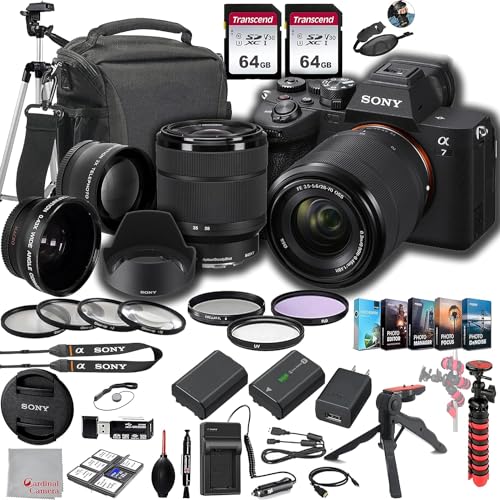 Sony a7 IV Mirrorless Digital Camera 33MP
- Includes Full SONY USA WARRANTY, Camera Package Includes…
- Sony a7 IV Mirrorless Camera: 33MP Full-Frame Exmor…
- Sony FE 28-70mm f/3.5-5.6 OSS Lens: Combining impressive…
As an Amazon Associate we earn from qualifying purchases at no extra cost to you.
How Focal Length, Aperture, and Weight Work on the Sony A7 IV
The Sony A7 IV has a 33MP full-frame sensor with excellent autofocus and in-body stabilization, so almost any modern Sony E-mount lens will perform well. The real decision is not sharpness alone, but how a lens fits your shooting distance, light, and how long you can comfortably hold it.
Focal length: field of view and working distance
Focal length determines how much of a scene you capture and how far you need to stand from your subject. On full frame:
- 24-35mm: Wide to wide-normal. Captures more environment, ideal for interiors, kitchens, small studios, and vlogging. Requires you to be close, which can distort faces if you get too near.
- 50mm: Natural perspective. Good for general walkaround, tabletop details, and documentary style without obvious distortion.
- 85-135mm: Portrait telephoto. Flattering compression, strong background separation, but needs more distance between camera and subject.
- 70-200mm: Versatile telephoto zoom. Covers portraits, events, and product details from a distance, but demands more room and support.
Aperture: light, depth of field, and video exposure
Aperture controls light gathering and background blur. An f/1.4 or f/1.8 prime lets in 2-3 times more light than an f/2.8 zoom and 4 times more than an f/4 zoom. That matters for:
- Low-light stills without raising ISO above 3200-6400 on the A7 IV
- Shallow depth of field for subject separation in portraits and product features
- Video where you want to keep shutter speed locked at 1/50 for 24p and control exposure with aperture and ND
The trade-off is that f/1.4 primes are larger, heavier, and have a thinner plane of focus, which makes nailing eye-AF at close distance more critical. An f/2.8 zoom is brighter than an f/4 zoom but adds 200-400g of weight and larger front elements.
Weight and balance for photo vs. video
The Sony A7 IV body weighs about 658g. A lens that weighs 300g feels very different from one that weighs 900g after an hour of handheld shooting or on a compact gimbal. For video, lighter primes and f/4 zooms are easier to balance on gimbals like the DJI RS 3 series and cause less arm fatigue. For stills on a tripod, weight matters less than reach and aperture.
What Focal Length Actually Looks Like in a Real Room
Specs only tell part of the story. In a typical 10×12 ft home office, bedroom studio, or kitchen dining area, your wall-to-subject distance is limited. This table shows approximate working distances to frame a single person (head-to-waist) on the Sony A7 IV full-frame sensor, and whether that lens is practical without moving furniture.
| Lens Focal Length | Distance for Head-to-Waist Portrait | Full-Body Framing Distance | Fits in 10×12 ft Room? |
|---|---|---|---|
| 24mm | 2.5 – 3 ft | 4 – 5 ft | Yes, but close distortion on faces |
| 35mm | 3.5 – 4.5 ft | 6 – 7 ft | Yes, ideal for tight spaces |
| 50mm | 5 – 6 ft | 8 – 10 ft | Yes, requires clearing a table or island |
| 85mm | 8 – 10 ft | 12 – 14 ft | Tight; needs diagonal placement or hallway |
| 70-200mm at 135mm | 12 – 14 ft | 18 – 20 ft | No, unless shooting through doorway into next room |
If you primarily shoot in a kitchen, bath showroom, or small apartment, a 35mm or 24-70mm will save you from constantly backing into cabinets and walls. For dedicated portrait corners or garage studios with 15+ ft of clear floor, 85mm and 70-200mm options become practical.
Best Lenses for Sony A7 IV by Situation
1. Most versatile all-rounder: 24-70mm f/2.8
Models like the Sony FE 24-70mm f/2.8 GM II and Sigma 24-70mm f/2.8 DG DN Art II cover wide interiors to short portraits without lens changes. This range is usually $900-$2,200 depending on brand and generation. Weight is typically 695-860g. It is the best single-lens solution for hybrid shooters who do both photos and video and want constant f/2.8 for low light and background blur. The downside is size and weight for travel or long gimbal sessions.
2. Best lightweight prime for small spaces and video: 35mm f/1.8 or f/1.4
Options like the Sony FE 35mm f/1.8, Sony FE 35mm f/1.4 GM, and Sigma 35mm f/1.4 DG DN Art weigh 280-645g and usually cost $450-$1,400. A 35mm lets you shoot handheld video at 1/50 sec in dim kitchens or baths without pushing ISO, and it frames a full scene in a 10×12 ft room from about 6 feet away. It is wide enough for interiors but not so wide that faces distort heavily. If you vlog or film process videos at a counter or workbench, this focal length keeps the camera within arm’s reach of a tripod or overhead rig.
3. Best portrait and detail lens without heavy weight: 85mm f/1.8
The Sony FE 85mm f/1.8 and similar 85mm f/1.8 lenses from Samyang/Rokinon and Sigma (usually $500-$700, 350-380g) deliver strong compression and creamy backgrounds for headshots, product hero shots, and before/after bath details. It needs 8-10 ft of clearance but remains light enough for handheld shooting. If you want even more separation and shoot in a larger space, an 85mm f/1.4 (usually $800-$1,800, 600-700g) adds extra blur at the cost of weight.
4. Best telephoto zoom for events and compression: 70-200mm f/4
The Sony FE 70-200mm f/4 G OSS II and Tamron 70-180mm f/2.8 G2 are popular for their reach. An f/4 version is typically 680-800g and usually $1,400-$1,800, while f/2.8 versions are 1,030-1,150g and usually $1,800-$2,800. An f/4 is significantly easier to hold, pack, and gimbal-balance, and pairs well with the A7 IV’s IBIS. Choose f/2.8 only if you consistently shoot indoor events or need the shallowest depth of field at 200mm.
5. Best compact walkaround prime: 50mm f/1.8 or f/1.4
The Sony FE 50mm f/1.8, Sony FE 50mm f/1.4 GM, and Sigma 50mm f/1.4 DG DN Art (usually $250-$1,300, 280-670g) sit between wide and telephoto. A 50mm is excellent for tabletop styling, flat-lay details, and natural-looking documentation of cabinetry and finishes without the distortion of wider lenses. It is also one of the smallest ways to get f/1.4 low-light capability.
How Your Furniture and Workspace Change the Right Choice
For creators shooting at home, lens choice is also an ergonomics and storage decision. A lens that forces you to shoot from 14 feet away is not useful if your island, dining table, or vanity leaves only 6 feet of free floor.
| Workspace Setup | Clearance Needed | Lens Fit Note | Storage / Furniture Tip |
|---|---|---|---|
| Standard desk 29-30 in high, 24 in deep | 36 in behind chair for tripod legs | 35mm or 50mm for desk tutorials | Drawer depth 15-18 in fits 2-3 primes + body; keep weight under 25 lbs per drawer |
| Kitchen island 36 in high, 48-60 in long | 48 in aisle on both sides per code ideal | 24-70mm at 35-50mm for overhead and 45-degree shots | Wall cabinet 12-14 in deep fits lens cases vertically; add shelf liner to prevent rolling |
| 10×12 ft spare room studio | Leave 30-36 in walk path to door | 85mm requires diagonal corner-to-corner placement | Tall pantry cabinet 18-24 in deep, 84 in high holds light stands and 70-200mm without crowding doorway (standard doorway 30-32 in wide) |
| Compact apartment, folding table | Boxed lens kits 18x12x8 in need floor space | Lightweight 35mm f/1.8 + 85mm f/1.8 two-lens kit totals under 700g | Use 30-36 in wide media console with 150 lb top weight limit for tripod + gimbal storage |
Box weight matters when moving or reorganizing: a 24-70mm f/2.8 ships at 3-4 lbs boxed, while a 70-200mm f/2.8 ships at 5-7 lbs boxed with hood and case. If you are a renter or frequently rearrange, two small primes are easier to store in an existing linen cabinet or office credenza than a large telephoto that needs a dedicated deep shelf.
Decision Matrix: Match Your Situation to the Lens
Use this matrix to narrow quickly without overbuying:
| If You Are… | Primary Need | Best Lens Type | Why |
|---|---|---|---|
| Small apartment / kitchen creator | Film in tight spaces, natural light | 35mm f/1.8 prime + 24-70mm f/2.8 later | Wide enough for rooms, fast for dim interiors, light on gimbal |
| Portrait and family shooter | Flattering faces, blur | 85mm f/1.8 and 50mm f/1.4 | Compression without extreme distance, strong bokeh |
| Hybrid photo/video on gimbal | Balance, autofocus, zoom flexibility | 24-70mm f/2.8 GM II or 20-70mm f/4 G, plus 35mm prime | Constant aperture zoom for video + light prime for low light |
| Detail and product for kitchens/baths | Texture, material accuracy | 50mm f/1.4 or 90mm macro | Minimal distortion, true color for wood, tile, stone |
| Travel and everyday carry | Low weight, one-lens kit | Tamron 28-75mm f/2.8 or Sony 24-105mm f/4 | Under 550-700g, covers 90% of scenes |
Material and Construction Trade-offs
Lens build affects durability in a home environment where dust, steam from kitchens and baths, and temperature changes are common.
| Construction | Pros | Cons | Best For |
|---|---|---|---|
| Metal barrel, weather-sealed (GM, Art) | Resists dust/moisture, holds calibration, smooth focus ring | Heavier by 150-300g, higher price | Daily professional use, humid bath/kitchen shoots |
| Polycarbonate / engineered composite | Lightest weight, lower cost, good for gimbals | Less sealing, can show wear on mount over years | Travel, renters, creators who prioritize portability |
| Internal zoom vs. external zoom | Internal zoom does not extend, better balance on video rigs | Usually larger at rest | Video and overhead rigs above islands/tables |
What wears first is rarely the glass. Focus rings loosen with dust, front elements collect micro-scratches from wiping, and lens hoods crack from doorway bumps. Keeping lenses in a closed cabinet with 40-50% humidity, using front and rear caps, and storing vertically prevents rolling and reduces cleaning frequency.
Assembly, Moving, and Daily Durability Realities
Unlike furniture, lenses need no assembly, but their support gear does. A tripod with a 60-65 in max height needs about 30 in of floor diameter when legs are spread. A C-stand or light stand needs a 36 in circle. Measure your doorway (usually 30, 32, or 36 in wide) before buying a rolling cabinet for gear; a 24 in deep cabinet plus a 70-200mm with hood (about 11-13 in long) will not allow the door to open if placed behind it. For wall-mounted cabinets, confirm wall anchors are rated for 50-75 lbs per stud when loaded with bodies, lenses, and lighting.
FAQ
Do I need f/1.4 or is f/1.8 enough on the Sony A7 IV?
For most people f/1.8 is enough. The A7 IV handles ISO 3200-6400 well, so f/1.8 gives clean low-light files and strong blur, especially at 50mm and 85mm. f/1.4 helps if you shoot handheld video in very dim rooms or want the absolute shallowest depth of field, but it adds weight and cost.
What is the best single lens if I can only buy one?
A 24-70mm f/2.8 if you shoot mixed photo and video and want no lens changes, or a 35mm f/1.8 if you work in small rooms and prioritize low light and light weight. If you shoot mostly people in a larger space, start with a 50mm f/1.4 or 85mm f/1.8 and add a zoom later.
Are third-party lenses good on the Sony A7 IV?
Yes. Sigma Art, Tamron, and Samyang/Rokinon E-mount lenses support Eye-AF and fast autofocus on the A7 IV. Native Sony GM lenses often focus slightly quieter for video and have more consistent weather sealing, but third-party options usually cost less and weigh less, which helps for home studios and gimbals.