Key takeaways
- Steel: Usually the most durable choice for columns, braces, and desk panels. It resists dents better than thin aluminum but adds weight.
- Aluminum: Light and convenient for travel. It can flex or vibrate more than steel, especially with a large score at maximum height.
- Wood: Attractive in a home setting and naturally rigid when properly built. A solid-wood stand may be heavier and more vulnerable to scratches or humidity changes than metal.
- Composite or plastic components: Useful for knobs, feet, and lightweight trays. Inspect threaded knobs and hinge areas, since these parts usually wear before the main frame.
The best music stands depend on where and how you play: choose a wide, stable desk stand for orchestral scores and home practice, a lightweight folding stand for travel, or a height-adjustable orchestral stand for seated and standing performance.
Our top picks
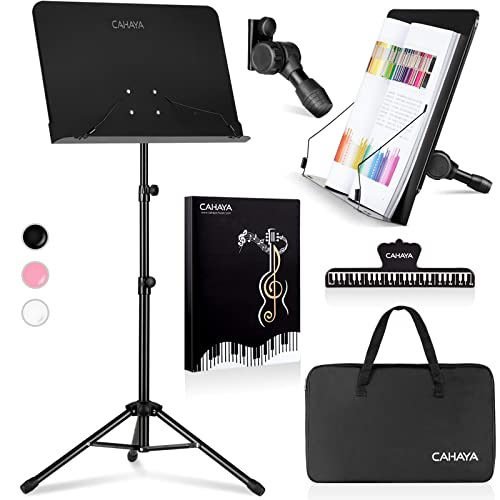


As an Amazon Associate we earn from qualifying purchases at no extra cost to you. Ratings are shown as listed on Amazon.
Quick picks by playing situation
| Situation | Best stand type | Useful specifications | Why it fits |
|---|---|---|---|
| Daily practice at home | Solid-base or heavy-duty folding stand | Desk 19–24 inches wide; height 28–52 inches; 5–12 lb | Stable enough for repeated page turns without taking much floor space |
| Orchestra or band performance | Orchestral desk stand | Desk at least 20 inches wide; height 28–48 inches; metal construction | Supports large folders and remains steady under stage lighting and frequent use |
| Air travel or public transport | Compact folding stand | Collapsed length under 20 inches; 1.5–4 lb; carrying bag | Fits in luggage or a backpack, although it sacrifices some stability |
| Guitar, cello, or standing wind instruments | Wide-range adjustable stand | Height range of roughly 28–54 inches | Positions music above the instrument without forcing the player to bend forward |
| Children, pets, or crowded rooms | Low-center-of-gravity stand | Broad tripod spread or weighted base; 5 lb or more | Less likely to tip when bumped, while still allowing safe height adjustment |
What separates the best music stands?
Height range and playing posture
A stand should place the center of the music close to eye level. For seated piano, violin, or guitar practice, a useful range is about 28–40 inches from the floor to the lower edge of the sheet holder. Standing musicians generally need 38–54 inches. Measure to the music surface rather than relying only on the manufacturer’s maximum height, because telescoping poles and tray angles can change the practical position.
When seated, leave enough space for your knees and instrument. A stand with a three-foot base may need approximately 24–30 inches of clear floor depth. In a 10-by-12-foot practice room, place it at least 18 inches from a wall so the legs, chair, and instrument case do not create a narrow passage. A low stand can work for a child, but an adult who regularly leans down to read music may develop unnecessary neck and back strain.
Sheet-holder size and angle
Small travel stands often have a music tray around 16–18 inches wide and 9–12 inches high. That is enough for loose pages or a thin method book, but not always enough for a thick score. Full-size stands commonly provide 19–24 inches of width and 12–16 inches of height. For orchestra, choir, or musical-theatre folders, a desk at least 20 inches wide is the safer choice.
Look for a lip deep enough to retain pages without covering the bottom staff. A front ledge of about 0.5–1 inch is usually practical. Perforated metal desks reduce weight and let some sound pass through, while solid desks block drafts and provide a more continuous writing surface. An adjustable tilt is valuable for players who switch between seated and standing positions, but a joint that moves too freely can let heavy music slowly sag.
Foldability versus base stability
Foldability is convenient, but every folding joint introduces a possible source of wobble. Compact tripod stands are usually the easiest to carry and often weigh 1.5–4 pounds. They are suitable for light folders, lessons, and rehearsals on level floors. They are less suitable for a thick score, a tablet, or a windy outdoor performance.
Heavier stands use wider legs, a reinforced center column, or a weighted base. They commonly weigh 5–12 pounds and can support more paper with less movement. A stand that folds flat is not automatically portable: check its collapsed length, widest point, and whether the case adds another 1–3 pounds. For a car-based performance, that extra stability is often worth the weight. For air travel, a compact stand may be the more realistic compromise.
Head-to-head: travel stand versus orchestral stand
| Feature | Compact folding stand | Orchestral or heavy-duty stand |
|---|---|---|
| Typical weight | 1.5–4 lb | 5–12 lb |
| Typical folded length | 15–22 inches | Often 24 inches or more, or not fully foldable |
| Music-desk width | 16–19 inches | 20–24 inches |
| Best load | Loose pages and thin books | Folders, thick scores, and multiple parts |
| Setup | Usually under one minute | One to several minutes, depending on the base and desk |
| Main drawback | More movement and smaller paper capacity | Harder to store and transport |
For a student who practices at home and carries music to weekly lessons, a medium folding stand is often the best balance. For a professional ensemble, a heavy-duty stand is preferable because repeated page turns and large folders expose weaknesses that are easy to overlook in a showroom.
Material and construction choices
- Steel: Usually the most durable choice for columns, braces, and desk panels. It resists dents better than thin aluminum but adds weight.
- Aluminum: Light and convenient for travel. It can flex or vibrate more than steel, especially with a large score at maximum height.
- Wood: Attractive in a home setting and naturally rigid when properly built. A solid-wood stand may be heavier and more vulnerable to scratches or humidity changes than metal.
- Composite or plastic components: Useful for knobs, feet, and lightweight trays. Inspect threaded knobs and hinge areas, since these parts usually wear before the main frame.
For a furniture-centered room, a wood or dark-finished metal stand may coordinate more naturally with cabinetry and shelving. In a multipurpose room, a folding metal stand is easier to move away from a desk or dining table after practice. Avoid placing any stand where its legs block drawers, doors, or a primary walkway.
Decision matrix for common home situations
| Your situation | Recommended specification | What to avoid |
|---|---|---|
| Small apartment | Folding stand under 22 inches when collapsed; desk no wider than needed | Permanent wide-base stand that occupies a passage |
| Children or pets | Broad tripod, locking height joints, rubber feet, and a lower center of gravity | Very light stand fully extended with a heavy book |
| Renter who moves often | 4–7 lb folding metal stand with a protective bag | Oversized solid stand that is difficult to carry through doorways |
| Back or neck discomfort | Height adjustment reaching at least eye level; desk tilt; stable base | Low stand that requires looking down for an entire practice session |
| Digital tablet or hybrid setup | Wide, rigid desk with a secure lip and a load rating suitable for the device | Thin folding tray that flexes when tapped |
Setup details that affect everyday use
Open all tripod legs fully and confirm that each foot sits flat before raising the desk. Extend the wider, lower sections first when possible; this keeps the center of gravity lower. Tighten knobs firmly by hand, but do not force them, since plastic threads can strip. Place heavier music near the center of the desk rather than at one side.
At home, allow roughly 30 inches of usable space for the chair, musician, instrument, and stand together. A cello, guitar, or large brass instrument may require more room for its case and cable or endpin clearance. Keep the stand at least several inches from cabinet doors and drawers so a page turn does not interfere with nearby storage.
Before buying, check the stand’s packed dimensions against your vehicle, closet, and narrowest doorway. Stands rarely fail because the main tube suddenly breaks; knobs loosen, rubber feet harden, hinge rivets develop play, and thin desk edges bend first. A replacement foot or knob can extend the life of a good stand, while a bent folding joint is usually a sign to replace it.
How much should you spend?
Basic folding stands usually cost about $15–$40, medium-duty stands about $40–$100, and heavy orchestral or premium wood stands about $100–$300 or more. The cheapest option can be adequate for occasional light music, but frequent practice rewards a rigid desk, reliable height lock, and stable feet more than decorative features.
For most home musicians, the best music stands are in the middle range: wide enough for the actual score, tall enough for healthy posture, light enough to move, and stable when the desk is not fully extended. Choose portability first for travel, stability first for performance, and adjustability first when several players or instruments will share the stand.