Key takeaways
- Measure the available cabinet width, including side fillers and trim.
- Confirm the hood will not obstruct cabinet doors or the range’s control panel.
- Plan for a duct no smaller than the manufacturer specifies; 6 inches is common for moderate airflow, while higher-output models may require 7-, 8-, or 10-inch ducting.
- Leave the manufacturer’s required clearance above gas or electric cooking equipment. Many installations fall near 24–30 inches, but the appliance and hood manuals control.
- Check whether the cabinet can support the hood’s weight. A typical unit may weigh roughly 15–35 pounds before ductwork and trim are added.
The best range hoods are chosen by kitchen layout first: use an under-cabinet hood for compact runs, a wall-mount hood for a range against the wall, an island hood for a freestanding cooktop, and an insert when you want ventilation hidden inside custom cabinetry.
Our top picks
 COMFEE' 30 Inch Under Cabinet Range Hood
- Fresh Air & 3 Speeds: Elegant Under Cabinet…
- Dual Installation Mode & Ideal Size: The stainless…
- 5-Layer Reusable Aluminum Filter: The 5-layer aluminum filter…
 COMFEE' Range Hood 30 Inch Under Cabinet
- Improving Kitchen Air Quality High-quality Comfee range hood…
- Ductless and Ducted for your Option Providing with…
- Durable Stainless Steel Slim Design With a durable…
 FIREGAS Under Cabinet Range Hood 30 inch
- Under cabinet range hood 30 inch with 2-speed…
- This 30-inch under-cabinet range hood is built with…
- Rocker button control, simple operate
| Product | Key specs | |
|---|---|---|
| COMFEE' 30 Inch Under Cabinet Range Hood | Fresh Air & 3 Speeds: Elegant Under Cabinet… Dual Installation Mode & Ideal Size: The stainless… 5-Layer Reusable Aluminum Filter: The 5-layer aluminum filter… | Check price |
| COMFEE' Range Hood 30 Inch Under Cabinet | Improving Kitchen Air Quality High-quality Comfee range hood… Ductless and Ducted for your Option Providing with… Durable Stainless Steel Slim Design With a durable… | Check price |
| FIREGAS Under Cabinet Range Hood 30 inch | Under cabinet range hood 30 inch with 2-speed… This 30-inch under-cabinet range hood is built with… Rocker button control, simple operate | Check price |
 IKTCH 30 inch Insert Range Hood 900 IKTCH 30 inch Insert Range Hood 900 | 【Modern Design】: IKTCH Insert Range Hood is made… 【Powerful Airflow】: Maximum 900 CFM large airflow with… 【Ultra-Quiet Operation】: Customize your kitchen stove vent with… | Check price |
As an Amazon Associate we earn from qualifying purchases at no extra cost to you.
Quick picks by kitchen situation
| Kitchen situation | Best hood type | Typical width | Useful ventilation range | Why it fits |
|---|---|---|---|---|
| Small apartment or narrow kitchen | Under-cabinet | 30–36 inches | 250–450 CFM | Uses existing cabinet space and keeps the room visually open |
| Wall range with frequent frying or searing | Wall-mount chimney | 36–48 inches | 400–700 CFM | Provides a larger capture area and stronger blower options |
| Island cooktop or range | Island hood | 36–54 inches | 500–900 CFM | Compensates for cross-drafts from both sides of the cooking surface |
| Custom kitchen or concealed appliances | Insert or liner | 30–60 inches | 400–1,200 CFM | Fits inside a wood, metal, or plaster hood surround |
These are planning ranges, not universal requirements. The correct airflow depends on the cooking appliance, duct design, local code, and the hood manufacturer’s installation instructions. A very powerful blower cannot compensate for a small, poorly routed duct.
Under-cabinet hoods: the practical choice for compact layouts
An under-cabinet hood mounts beneath a wall cabinet, making it the easiest choice when you are replacing a microwave hood or working with a limited budget. It generally takes up less visual and physical space than a chimney-style model, and many units can be ducted through the wall, through the cabinet, or converted to recirculating operation with a charcoal filter.
Choose this type when the cooktop is against a wall and the upper cabinets extend over or beside it. A 30-inch hood is appropriate for a 30-inch range in many kitchens; a 36-inch hood is preferable when the cabinet layout allows it because extra width improves capture at the outer burners.
What to check before buying
- Measure the available cabinet width, including side fillers and trim.
- Confirm the hood will not obstruct cabinet doors or the range’s control panel.
- Plan for a duct no smaller than the manufacturer specifies; 6 inches is common for moderate airflow, while higher-output models may require 7-, 8-, or 10-inch ducting.
- Leave the manufacturer’s required clearance above gas or electric cooking equipment. Many installations fall near 24–30 inches, but the appliance and hood manuals control.
- Check whether the cabinet can support the hood’s weight. A typical unit may weigh roughly 15–35 pounds before ductwork and trim are added.
Under-cabinet hoods are usually the least expensive category, with many ducted models in the general range of $150–$600. Their main limitation is capture area: the cabinet above can restrict the hood’s depth, especially behind large front burners.
Wall-mount hoods: stronger capture for a wall range
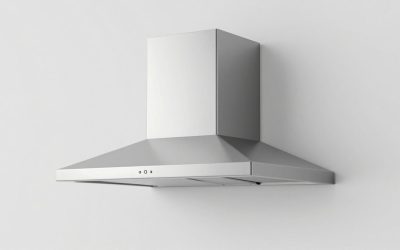
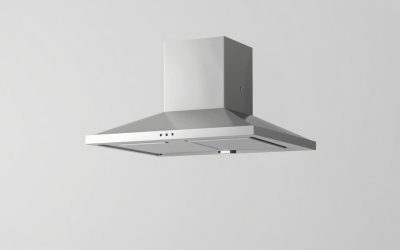
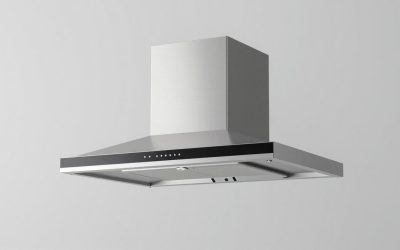
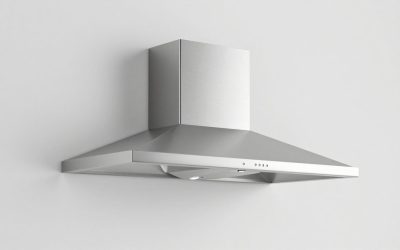
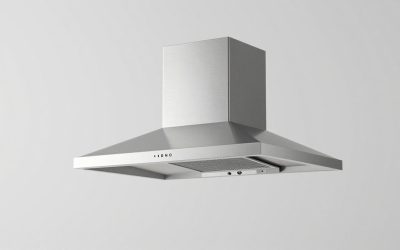
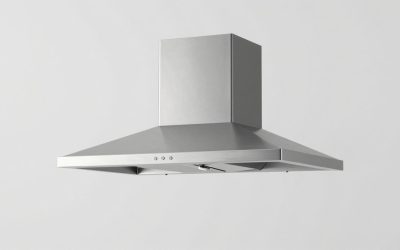
A wall-mount hood, often called a chimney hood, is exposed above the range rather than hidden beneath a cabinet. Its wider canopy and greater depth can capture steam and grease more effectively, particularly when the cook regularly uses high heat, a griddle, or multiple burners.
For a 36-inch range, a 36-inch hood is the minimum size to consider, while a 42-inch hood can provide more forgiving coverage if the wall and cabinetry permit it. The canopy should extend far enough over the cooking surface to catch rising plumes without forcing you to stand too far forward.
Wall-mount units are also easier to feature as part of the room’s design. Stainless steel is durable and easy to wipe down, while black stainless, painted metal, and glass create different visual effects. Glass can look lighter but shows grease and fingerprints more readily.
Ventilation power and noise
For ordinary electric or induction cooking, approximately 300–600 CFM is often suitable. A high-output gas range, frequent wok cooking, or heavy searing may justify 600–900 CFM, subject to local makeup-air rules. CFM alone does not determine performance: hood depth, baffle design, duct length, elbows, and termination all affect how much air reaches the blower.
Noise is typically expressed in sones. Lower numbers are quieter, but manufacturers may list sound at different airflow settings, so compare like-for-like settings rather than relying on the maximum CFM figure alone. A remote blower can reduce noise near the cooktop, although it increases installation complexity and cost.
Island hoods: select for cross-drafts, not just appearance
An island hood has no wall or cabinet behind it to help contain rising smoke. It therefore needs a generous canopy and careful positioning. For a 36-inch island range, many designers specify a hood approximately 42–48 inches wide when the kitchen has enough space. A larger hood can improve capture, but it must not overwhelm walkways or interfere with sightlines.
Island installations need structural planning. The ceiling support must carry the hood, chimney, and duct connection; drywall anchors alone are not appropriate for a heavy unit. Some decorative island hoods weigh more than 50 pounds, and custom surrounds can add substantially more. Have the support located before ceiling finishes are installed.
Keep adequate clearance around the island for doors, stools, and traffic. A 42-inch aisle is a useful minimum for a one-cook work zone, while 48 inches or more is more comfortable when two people cook or when an oven door opens into the aisle. A hood that is correctly centered but too low can become a head hazard; one that is too high loses capture performance.
Inserts and liners: the best route to a custom hood
An insert is the ventilation mechanism installed inside a custom cabinet or decorative hood surround. It suits kitchens where the hood should match the cabinetry rather than look like a standalone appliance. Inserts are available with internal blowers or remote blowers and can provide some of the highest airflow in residential ventilation.
The opening must be designed around the exact insert dimensions. The surrounding enclosure should be deep and wide enough to create a real capture chamber, not merely a shallow decorative box. Wood, painted MDF, metal, and plaster are all possible, but the enclosure must tolerate heat, grease, moisture, and repeated cleaning.
Inserts are not automatically easier to install. They require precise framing, a suitable electrical connection, duct alignment, and access for filter removal. A custom hood can also make future replacement more difficult if the next insert has different dimensions. Save the model number, installation template, and cabinet drawings for future maintenance.
Head-to-head comparison: what matters most?
| Criterion | Under-cabinet | Wall-mount | Island | Insert |
|---|---|---|---|---|
| Capture area | Small to moderate | Moderate to large | Large; extra width is valuable | Depends on custom enclosure |
| Installation difficulty | Low to moderate | Moderate | High because of ceiling support | High because cabinetry must be built around it |
| Typical ducting | 6–8 inches | 6–10 inches | 8–10 inches is common for stronger models | Varies by blower specification |
| Visual impact | Lowest | Decorative focal point | Decorative focal point over the island | Integrated with cabinetry |
| Maintenance access | Usually simple | Simple if filters are reachable | Can require a step stool | Depends on enclosure design |
Materials, filters, and the maintenance trade-off
Most residential hoods use stainless steel or painted metal for the canopy. Stainless resists corrosion and tolerates frequent degreasing, but brushed finishes can show directional marks. Painted steel offers more color choices and can be easier to blend with cabinetry, though chipped finishes are harder to repair.
Mesh filters are lightweight and commonly dishwasher-safe, but their fine layers can become clogged if cleaning is delayed. Baffle filters use interlocking stainless-steel panels to redirect grease into a collection channel; they are generally more robust for frequent cooking and high-output appliances. A recirculating hood also needs a replaceable charcoal filter, which does not remove moisture and must be changed according to use.
- Wipe the canopy and controls weekly if you cook often.
- Wash metal filters about monthly, or more frequently with heavy frying.
- Clean the grease cup or channel before it overflows.
- Replace charcoal filters on the manufacturer’s schedule.
- Do not use abrasive pads on brushed stainless steel or spray cleaner directly into controls.
How to choose the best range hood for your home
- Match the type to the layout. Wall ranges generally need under-cabinet, wall-mount, or insert ventilation; islands need an island hood or a properly engineered ceiling system.
- Measure the cooking surface and available clearance. Record width, depth, cabinet height, ceiling height, and the distance to nearby doors, windows, and walkways.
- Choose capture before maximum airflow. A wider, deeper canopy with a correctly sized duct often performs better than a compact hood with a larger advertised CFM.
- Confirm duct and electrical requirements. Keep the duct route short and direct, minimize elbows, and have a qualified installer handle exterior termination and makeup-air requirements.
- Plan cleaning access. Every filter, blower compartment, light, and grease channel should remain reachable after cabinets and trim are installed.
For a compact kitchen, the best range hood is usually a ducted under-cabinet model that fits the cabinet run. For a statement wall range, choose a wall-mount hood with enough depth and airflow for the appliance. For an island, prioritize canopy width, ceiling support, and cross-draft protection. For a custom kitchen, an insert delivers the cleanest appearance—but only when the cabinetry is designed around ventilation from the beginning.