Key takeaways
- Measuring to the cabinet face instead of the underside: The cabinet bottom is the actual vertical obstruction. Include any trim, light rail, or decorative molding that projects below it.
- Using spout height as overall height: The handle or top of a gooseneck arch may be several inches higher than the water outlet.
- Forgetting the operating arc: A faucet may technically fit while its handle hits the cabinet. Test the handle’s full lift and swivel path.
- Choosing the tallest faucet for a small sink: More height does not automatically improve performance. A high-arc model over a shallow basin can produce noticeable splashing.
- Ignoring pull-down hose clearance: The spray head must dock fully, and the hose weight needs an unobstructed path under the sink. Plumbing, a garbage disposal, or a filtration system can get in the way.
- Overlooking backsplash depth: A thick backsplash can push the faucet forward, changing its reach and making a rear handle difficult to operate.
The Short Answer
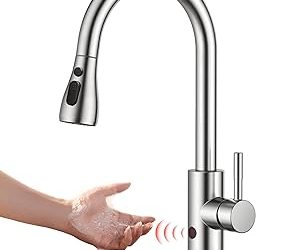
For most kitchens, a faucet that stands 8 to 12 inches (20 to 30 cm) above the countertop works well beneath upper cabinets. Measure from the countertop or sink deck to the faucet’s highest point, not just to the spout. A pull-down faucet with a tall arch may need 18 to 22 inches (46 to 56 cm) of vertical clearance, while a compact pull-out or low-arc model may need only 10 to 14 inches (25 to 36 cm).
The most important rule is to leave room for operation. Aim for at least 2 inches (5 cm) between the faucet’s highest point and the underside of the cabinet. If the cabinet is directly above the sink, a faucet around 12 to 15 inches (30 to 38 cm) tall is usually the practical limit. However, cabinet depth, the location of the sink, and whether the faucet swivels can matter as much as overall height.
Our top picks


As an Amazon Associate we earn from qualifying purchases at no extra cost to you. Ratings are shown as listed on Amazon.
Before shopping in 2026, check the manufacturer’s specification sheet for overall height, spout height, spout reach, and required installation clearance. “Faucet height” can mean the height from the mounting surface to the top of the handle or arch, and it is not always the same as the height of the water outlet.
Standard Sizes
Kitchen faucets generally fall into three height categories. Low-arc faucets are easiest to fit below cabinets. Mid-arc models provide more room for filling tall pots without taking up as much vertical space as a commercial-style faucet. High-arc and pull-down designs offer the greatest clearance inside the sink but can conflict with upper cabinetry.
| Faucet type | Typical overall height | Typical spout height | Typical spout reach | Recommended opening |
|---|---|---|---|---|
| Low-arc or compact pull-out | 10–14 in (25–36 cm) | 7–10 in (18–25 cm) | 7–9 in (18–23 cm) | 12–16 in (30–41 cm) |
| Standard mid-arc | 14–18 in (36–46 cm) | 9–12 in (23–30 cm) | 8–10 in (20–25 cm) | 16–20 in (41–51 cm) |
| High-arc pull-down | 18–22 in (46–56 cm) | 10–14 in (25–36 cm) | 8–10 in (20–25 cm) | 20–24 in (51–61 cm) |
| Commercial-style spring faucet | 20–27 in (51–69 cm) | 10–16 in (25–41 cm) | 8–11 in (20–28 cm) | 24–30 in (61–76 cm) |
These are useful buying ranges rather than universal standards. A single-handle faucet may measure 2 to 4 inches (5 to 10 cm) taller than a comparable two-handle model because of its handle or curved spout. A side sprayer does not usually add to faucet height, but it does require a second sink-deck hole and enough counter space for the sprayer hose.
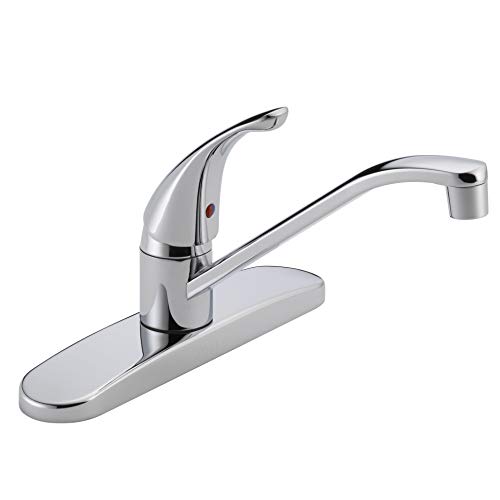
Compact examples such as the Peerless P110LF chrome single-handle faucet and Peerless P115LF with side sprayer are generally suited to cabinet-constrained installations; comparable models often fall near the low- to mid-arc ranges. The Delta Daneri 16879-SS-DST pull-out faucet is another space-conscious style, while the Peerless Precept P199152LF-SS combines a taller, more substantial setup with a side sprayer. Confirm the exact specification before ordering because trim, handle position, and package configuration can change the listed height. Typical retail pricing for these categories ranges from about $45 to $160: budget Peerless models may be around $45–$50, while a Delta Daneri or stainless Peerless Precept model may be about $150–$160.
How to Measure Your Space
- Measure the countertop-to-cabinet height. Place a tape measure on the sink deck or countertop mounting surface and extend it straight up to the underside of the upper cabinet. Standard kitchen cabinets are commonly 18 inches (46 cm) above the countertop, but installations vary.
- Account for the mounting surface. If the faucet sits on a thick sink rim, measure from the top of that rim. For an undermount sink, measure from the countertop surface. Add the thickness of any deck plate if the faucet includes one; it is commonly about 1/8 to 1/4 inch (0.3 to 0.6 cm).
- Subtract a working gap. Reserve at least 2 inches (5 cm) between the faucet’s highest point and the cabinet. Use 3 to 4 inches (8 to 10 cm) if the handle tilts upward, the spout swivels, or you want easier cleaning.
- Compare the overall height. Use the manufacturer’s overall faucet height, including the arch, handle, or highest control. Do not compare only spout height.
- Map the swing. Mark the faucet’s centerline and swing its spout left and right. A spout reach of 8 to 10 inches (20 to 25 cm) should land near the center of a typical 22-inch (56-cm) sink, but a corner sink or offset drain may need a different reach.
- Check the handle path. A forward-tilting handle needs open space above and behind it. If the backsplash or cabinet is close, choose a handle that lifts forward or operates from the side.
- Verify installation details. Check whether the faucet requires one, two, or three holes; whether a deck plate is included; and whether the supply lines and weight can fit below the sink. A common faucet supply connection is 3/8 inch, but the home’s shutoff valve and included hoses should be verified.
By Room or Use Case
Kitchen sink beneath standard upper cabinets
Choose a faucet no taller than about 14 to 16 inches (36 to 41 cm) when the cabinet underside is approximately 18 inches above the counter. A low-arc pull-out is the safest choice, leaving practical clearance for the handle and cleaning. If the sink is centered under the cabinet, a 7- to 9-inch (18- to 23-cm) reach usually provides good coverage without splashing the backsplash.
Deep sink or frequent large-pot use
A mid-arc faucet around 14 to 18 inches (36 to 46 cm) tall can make it easier to fill stockpots and wash baking sheets. Prioritize spout height over total height: the outlet should be high enough for the largest regularly used vessel, but not so high that water falls a long distance and splashes. A pull-out sprayer can provide useful reach without the tall arch of a pull-down design.
Open wall without upper cabinets
With no cabinet above the sink, height is mainly a matter of comfort, sink proportions, and visual scale. A 16- to 22-inch (41- to 56-cm) pull-down faucet can work well, provided it does not interfere with a window, shelf, pendant light, or backsplash ledge. Leave at least 1 inch (2.5 cm) from nearby obstructions and check that the spout does not hit a window when swiveling.
Corner sink or angled installation
Corner sinks benefit from a faucet with a controlled swivel and moderate reach. A 7- to 9-inch (18- to 23-cm) reach is often easier to manage than a very long spout, which may swing into a cabinet wall. Measure diagonally to the nearest cabinet and confirm that the handle can fully operate without striking the backsplash.
Bar, prep, or laundry sink
Smaller sinks usually need a compact faucet measuring 8 to 14 inches (20 to 36 cm) high, with a 5- to 8-inch (13 to 20-cm) reach. A tall kitchen faucet can overwhelm a prep sink and may cause excess splashing. For a laundry sink used to fill buckets, select a longer reach and confirm that the faucet clears the basin’s back edge.
Common Sizing Mistakes
- Measuring to the cabinet face instead of the underside: The cabinet bottom is the actual vertical obstruction. Include any trim, light rail, or decorative molding that projects below it.
- Using spout height as overall height: The handle or top of a gooseneck arch may be several inches higher than the water outlet.
- Forgetting the operating arc: A faucet may technically fit while its handle hits the cabinet. Test the handle’s full lift and swivel path.
- Choosing the tallest faucet for a small sink: More height does not automatically improve performance. A high-arc model over a shallow basin can produce noticeable splashing.
- Ignoring pull-down hose clearance: The spray head must dock fully, and the hose weight needs an unobstructed path under the sink. Plumbing, a garbage disposal, or a filtration system can get in the way.
- Overlooking backsplash depth: A thick backsplash can push the faucet forward, changing its reach and making a rear handle difficult to operate.
FAQ
Can a kitchen faucet touch the underside of an upper cabinet?
It should not. Leave at least 2 inches (5 cm) of clearance, and preferably 3 to 4 inches (8 to 10 cm) where the handle moves upward or the faucet swivels. Contact can damage the cabinet finish, restrict operation, and make the faucet difficult to remove for maintenance.
Is an 18-inch faucet too tall under cabinets?
It depends on the measured opening. If the distance from the mounting surface to the cabinet is 21 inches (53 cm), an 18-inch faucet leaves only 3 inches (8 cm), which may work if the handle does not rise into that space. If the opening is 18 inches, an 18-inch faucet is too tall. Always compare the manufacturer’s overall height with the actual opening.
What faucet height is best for a 9-inch-deep kitchen sink?
A faucet with a spout height of about 9 to 12 inches (23 to 30 cm) is usually a balanced starting point, with an overall height around 12 to 18 inches (30 to 46 cm). Choose a lower model if the sink is shallow or the cabinet is close, and verify that the spout reach places the water near the drain rather than against the front or rear wall.
Are pull-down faucets taller than pull-out faucets?
Usually, yes. Pull-down faucets commonly use a high arch and measure about 18 to 22 inches (46 to 56 cm) overall. Pull-out faucets are often around 10 to 16 inches (25 to 41 cm) tall. Neither style is automatically better; the right choice depends on cabinet clearance, sink depth, and whether you regularly wash large cookware.