Key takeaways
- Deep kitchen counters create a deceptively simple faucet problem: the faucet may be far enough from the user that a standard deck-mounted model feels short, awkward, or difficult to aim. The choice is not simply between two appearances. It affects…
Deep kitchen counters create a deceptively simple faucet problem: the faucet may be far enough from the user that a standard deck-mounted model feels short, awkward, or difficult to aim. The choice is not simply between two appearances. It affects sink reach, backsplash construction, installation cost, cabinet access, cleaning, and how easily you can change the kitchen later.
A wall-mounted faucet attaches to plumbing inside the wall behind the sink. A deck-mounted faucet attaches to the countertop or sink deck. Either can work well with a deep counter, but the right choice depends on how far the sink sits from the wall, whether the backsplash is structural, and whether you own the home. Here is how the two options compare for a 2026 kitchen project.
Our top picks


As an Amazon Associate we earn from qualifying purchases at no extra cost to you. Ratings are shown as listed on Amazon.
Quick Verdict
Choose a wall-mounted faucet when the sink is set unusually far back, you are already opening the wall, or you want maximum usable counter space around the basin. Wall mounting can deliver a cleaner reach over a deep sink and makes wiping the counter easier.
Choose a deck-mounted faucet when you want the simplest installation, easier replacement, or lower initial cost. A tall commercial-style deck faucet with a pull-down sprayer can solve many deep-counter reach issues without changing the wall plumbing.
For most existing homes, deck mount is the practical winner. For a major remodel with exposed plumbing and a carefully planned backsplash, wall mount is often the more elegant long-term solution.
Side by Side
| Factor | Wall Mount | Deck Mount |
|---|---|---|
| Comfort | Excellent reach when the sink is 10–18 inches from the wall; handle height must be planned | Good with a 9–12-inch spout reach or pull-down sprayer; standard models may feel short |
| Durability | Very durable when blocking and threaded connections are installed correctly | Very durable; easier to replace if the cartridge or body eventually fails |
| Typical faucet price | $200–$900, with premium designs exceeding $1,000 | $80–$600; commercial-style models commonly cost $150–$350 |
| Maintenance | Easy to wipe around, but hidden leaks can require wall access | Easy to service from below; more counter seams and hardware to clean |
| Space needed | Uses wall space and needs a clear backsplash zone, usually 6–10 inches high | Uses one to three counter or sink holes and needs room behind the basin |
| Look | Minimal, architectural, and visually open | Familiar, flexible, and available in the widest range of styles |
| Resale | Appeals to design-focused buyers but may narrow the audience | Recognized by nearly every buyer and easier for a future owner to change |
| Best for | New construction, full remodels, deep sinks, and open counters | Existing kitchens, rentals, budget upgrades, and quick replacements |
Where Wall Mount Wins
The strongest argument for a wall-mounted faucet is reach. If the front edge of the sink is 24–30 inches from the wall, a wall faucet can be positioned directly over the basin instead of starting several inches forward on the counter. A spout with an 8–10-inch reach is often enough, although the exact dimension depends on the sink centerline and the faucet’s installation height.
Wall mounting also keeps the counter clear. There is no faucet base occupying a hole behind the sink, and there is less hardware collecting dust, flour, and water. That matters on deep counters where the area behind the sink can already be difficult to access. A wall-mounted design can make a narrow cleaning path feel more open.
It is especially attractive with an undermount sink and a continuous stone or quartz surface. The visual effect is streamlined: the faucet emerges from the backsplash, while the countertop remains uninterrupted. A separate wall-mounted pot filler is not a substitute for a kitchen faucet, but the same planning principle applies—water outlets placed on the wall can preserve valuable worktop space.
Wall mount can also be comfortable for people who dislike leaning over a deep basin. Set the faucet outlet approximately 7–10 inches above the sink rim, leaving enough clearance for large pots without creating excessive splash. A single-lever handle is usually easier to operate than separate handles when the faucet is mounted behind a deep counter.
The tradeoff is installation. The wall must contain properly positioned hot- and cold-water lines, solid blocking, and threaded fittings set to the manufacturer’s required depth. A typical rough-in may need to be centered within about 1 inch of the sink centerline and placed at a specific height, often around 8–12 inches above the counter, but the faucet’s instructions control. If the plumbing is off by even a small amount, the finished trim may not sit flat.
Because the connections are hidden, a leak can be more disruptive than with a deck faucet. Installers should pressure-test the lines before closing the wall and use an access strategy that fits the backsplash and cabinet layout. In a finished kitchen, opening drywall, tile, or stone can add hundreds or thousands of dollars to the project.
Where Deck Mount Kitchen Faucets for Deep Counters Wins
Deck mounting is usually the safer choice when you are replacing an existing faucet. Most kitchen sinks and countertops already have a 1 3/8-inch faucet hole, and many models are designed to fit a single hole with an optional escutcheon. You can often complete the change without removing the backsplash or altering in-wall plumbing.
Deep counters do require careful sizing. Look for a spout reach of at least 9 inches, and consider 10–12 inches if the sink sits far from the counter edge. The faucet should land near the drain rather than at the back wall. A pull-down sprayer adds practical reach, but check the hose length and counter clearance; some tall commercial-style models need 20–27 inches of vertical space above the counter.
Commercial-inspired deck faucets are one reason this option works well. For reference, the iVIGA Single Hole 27-inch Commercial Kitchen Faucet is listed at $189.99, while the Fapully Commercial Kitchen Faucet, 26-inch three-compartment sink model, is also listed at $189.99. Those products illustrate the tall, high-clearance format often chosen for deep or busy work areas; they are not automatically the right fit for every residential sink.
Before buying, measure from the faucet hole to the sink drain, the distance between the backsplash and sink, and the open height above the faucet. Also check whether the faucet rotates far enough to serve a second basin without swinging into a wall or window. A deck faucet can solve reach problems, but a short 6–7-inch spout may still feel frustrating on a deep counter.
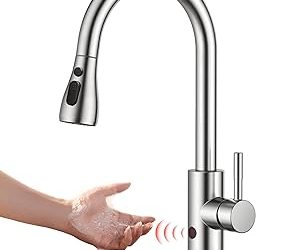
Deck mount is also easier to modify later. If the finish dates, the cartridge fails, or you want a touchless model, replacing the faucet generally does not require opening the wall. That flexibility is valuable in a rental or a starter home.
Cost Over 5 Years
For a straightforward replacement, a deck-mounted faucet typically costs $80–$600, plus about $150–$350 for professional installation. A reasonable five-year budget is therefore $230–$950, assuming no countertop drilling or plumbing repairs. A pull-down commercial-style model in the $150–$350 range often keeps the total near $300–$700.
A wall-mounted faucet may cost $200–$900, with installation ranging from approximately $300 for an already prepared wall to $1,500 or more when a backsplash, drywall, or tile must be opened and restored. A realistic five-year project total is about $500–$2,400. Premium trim, stone repair, or relocated supply lines can push that higher.
Maintenance costs are not guaranteed, but the risk profiles differ. A deck faucet may need a replacement cartridge or hose after several years, commonly adding $25–$150 in parts. A wall faucet may have inexpensive internal parts but a more expensive access problem if a concealed connection leaks. These are planning estimates, not guarantees or lab-tested life spans.
Do not confuse the cost of a wall-mounted kitchen faucet with unrelated wall-mount hardware. For example, TV brackets such as the USX MOUNT Full Motion model, listed at $29.99, and the Mounting Dream Full Motion model, listed at $34.19, are designed for televisions—not plumbing fixtures—and cannot be used to mount a faucet.
Which One for Your Home
Small apartment
Choose deck mount unless the apartment is undergoing a permitted kitchen renovation. It avoids wall damage, fits existing plumbing, and is easier to remove when you move. Select a compact pull-down faucet with a reach of 9 inches or more, a low-flow setting, and a swivel range that will not strike a nearby wall.
Family with kids or pets
A deck-mounted pull-down faucet is generally the most forgiving. The detachable sprayer can fill bowls, rinse muddy items, and reach the corners of a large sink. Choose a magnetic docking system, a weighted hose, and a handle that stays clear of the sink edge. If you prefer wall mount, use sturdy blocking and a simple single-handle design with splash control.
Rental property
Use deck mount. Tenants and future maintenance workers will understand the configuration, replacement parts are widely available, and a standard faucet can be changed without disturbing tile. A $150–$300 model with a 9–10-inch reach is usually a better investment than a custom wall-plumbing installation.
Long-term home
Wall mount is worth considering during a full renovation, especially with a deep 30-inch counter, an undermount sink, and a new backsplash. Have the faucet selected before the plumber sets the rough-in. If the wall is staying closed and the existing deck hole is serviceable, a premium deck faucet may still provide the best balance of comfort and flexibility.
FAQ
How deep can a counter be before a deck faucet feels too short?
There is no universal cutoff, but a 24-inch-deep counter is standard, while a sink set 10–18 inches from the wall often benefits from a 9–12-inch spout reach. Measure to the drain, not just to the sink’s back rim. If the outlet cannot reach the center of the basin, consider a longer faucet or wall mounting.
Does a wall-mounted faucet splash more?
It can if the outlet is too high, too far forward, or aimed at the wrong part of the basin. Position the stream near the drain and keep the outlet roughly 7–10 inches above the sink rim, subject to the faucet’s instructions. A deeper sink and aerated flow can also help control splash.
Can a wall-mounted faucet be installed on tile?
Yes, but the plumbing rough-in and wall blocking must be completed behind the tile. The tile itself cannot support the water connections. Retrofitting a finished tiled wall is possible, but it usually costs more and carries a greater risk of tile damage than replacing a deck faucet.
Which type is easier to repair?
Deck mount is usually easier overall because the supply lines and mounting hardware are accessible under the counter. Wall-mounted faucet cartridges are also serviceable from the front, but concealed supply connections are harder to reach if a leak develops. Follow the installation instructions and pressure-test any new wall plumbing before closing the wall.