Key takeaways
- More usable counter space. Because the faucet does not occupy a hole in the countertop or sink deck, you can use that area for a soap dispenser, filtered-water tap, cutting board, or simply more uninterrupted work surface.
- Easier sink cleaning. A wall mounted fixture leaves fewer seams and less hardware around the back edge of the basin. You can wipe crumbs, standing water, and cleaner directly into the sink instead of working around a faucet base.
- Works well with deep or unusual sinks. A wall faucet can be positioned higher than a deck-mounted model, which is useful for farmhouse sinks, deep workstation sinks, laundry sinks, and large prep basins. A suitable spout reach can also make filling 8- to 12-quart pots easier.
- Flexible placement during a remodel. When the wall is open, you can select the mounting height and location instead of being limited by predrilled sink holes. The fixture can be centered over the basin or positioned to suit a two-bowl sink.
- Distinctive appearance. The design can give a kitchen a professional, vintage, or minimalist character. Commercial-style versions often include a high-arc spout and a separate rinse sprayer, while simpler models can look nearly flush against the backsplash.
- Potentially easier future faucet replacement. If the wall connections are installed correctly and remain accessible, replacing the visible faucet may not require disturbing the countertop or sink. You still need to match the rough-in spacing and connection type.
- Useful for more than kitchens. The same format is practical at a utility sink, mudroom basin, workshop sink, or garage wash station where counter space is limited and a long reach is valuable.
The Short Answer
Yes—if your kitchen wall is already open for plumbing or you are planning a renovation. Wall mounted kitchen sink faucets can free up counter space, simplify sink cleaning, and create a distinctive look. The deciding condition is access to the plumbing inside the wall: if your supply lines are fixed under the counter and the wall is finished, changing to a wall mount can cost far more than the faucet itself.
What You Actually Get
A wall mounted kitchen faucet attaches to water connections in the wall rather than to holes drilled through the sink deck or countertop. Most models use two water supplies, commonly spaced 8 inches apart, although the exact rough-in dimensions vary. Before buying, confirm the faucet’s connection spacing, thread type, spout reach, installation height, and required water pressure.
Our top picks

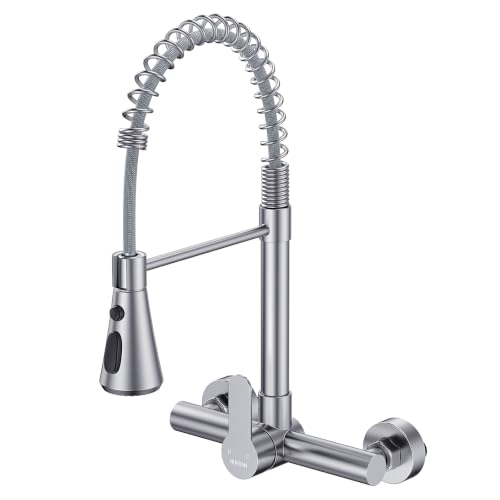
As an Amazon Associate we earn from qualifying purchases at no extra cost to you. Ratings are shown as listed on Amazon.
Typical wall mount models have a spout reach of roughly 8 to 10 inches and a clearance of about 6 to 10 inches above the sink rim. That reach matters more than appearance. A faucet that stops short of the basin can create constant splash and make it difficult to fill large pots. A spout that extends too far may direct water against the front or side of a shallow sink.
Many current designs include a pull-down or pull-out sprayer, two spray settings, or a separate side sprayer. Basic utility-style faucets may have a fixed or swiveling spout instead. Prices commonly range from about $60 to $250 for residential products, while specialty brass, commercial-style, or designer models can cost considerably more. Installation may add approximately $150 to $600 when a plumber must open, modify, and repair the wall; local labor and access can move that estimate substantially.
For example, the Hurran Wall Mount Faucet with an 8-inch installation pattern and two spray modes is listed at $89.99. The Hurran Wall Mount Kitchen Faucet in a commercial utility-sink style is listed at $65.99. Those prices make the fixtures relatively affordable, but they do not include wall preparation, new shutoff valves, or professional installation.
Pros
- More usable counter space. Because the faucet does not occupy a hole in the countertop or sink deck, you can use that area for a soap dispenser, filtered-water tap, cutting board, or simply more uninterrupted work surface.
- Easier sink cleaning. A wall mounted fixture leaves fewer seams and less hardware around the back edge of the basin. You can wipe crumbs, standing water, and cleaner directly into the sink instead of working around a faucet base.
- Works well with deep or unusual sinks. A wall faucet can be positioned higher than a deck-mounted model, which is useful for farmhouse sinks, deep workstation sinks, laundry sinks, and large prep basins. A suitable spout reach can also make filling 8- to 12-quart pots easier.
- Flexible placement during a remodel. When the wall is open, you can select the mounting height and location instead of being limited by predrilled sink holes. The fixture can be centered over the basin or positioned to suit a two-bowl sink.
- Distinctive appearance. The design can give a kitchen a professional, vintage, or minimalist character. Commercial-style versions often include a high-arc spout and a separate rinse sprayer, while simpler models can look nearly flush against the backsplash.
- Potentially easier future faucet replacement. If the wall connections are installed correctly and remain accessible, replacing the visible faucet may not require disturbing the countertop or sink. You still need to match the rough-in spacing and connection type.
- Useful for more than kitchens. The same format is practical at a utility sink, mudroom basin, workshop sink, or garage wash station where counter space is limited and a long reach is valuable.
Cons
- Retrofitting can be expensive. Moving supply lines into a finished wall may require cutting drywall, tile, or backsplash material. A faucet that costs $66 to $90 can become a several-hundred-dollar project once plumbing and surface repairs are included.
- Leaks are hidden inside the wall. A loose connection or failed fitting may not be visible immediately. Use a properly secured in-wall support and install an access panel where practical, especially in a cabinet, pantry, or utility area behind the wall.
- Placement must be precise. The rough-in height, horizontal spacing, sink centerline, and spout reach all need to work together. A mistake can leave the water stream too close to the backsplash or outside the basin. Wall-mounted faucets offer less forgiveness than deck-mounted models.
- Not every wall is suitable. Exterior walls, masonry walls, and walls filled with electrical wiring or structural framing may require extra planning. Cold climates also call for careful pipe insulation and placement to reduce the risk of freezing.
- Some models have limited adjustment. A deck faucet can often rotate around its base or be replaced with another model that fits the same opening. A wall faucet is tied to its in-wall connections, so future changes may require adapters or additional work.
- Sprayers can be less convenient. A pull-down hose has to return fully into the spout, and a separate commercial-style sprayer may need a dedicated holder. If the hose rubs against the backsplash or the sink, cleaning and retraction can become annoying.
- Water may splash if the geometry is wrong. High clearance is not automatically better. The stream should land near the center of the basin at a comfortable angle. Check the manufacturer’s spout reach and installation diagram rather than choosing by height alone.
- Style can limit matching options. Wall mount faucets are less common than standard single-hole or three-hole kitchen faucets. Matching a replacement in the same finish, spacing, and shape may take more searching.
Who Should Buy It
Buy a wall mounted kitchen faucet if you are remodeling, replacing a backsplash, building a new kitchen, or installing a sink where the wall can be opened. It is especially well suited to farmhouse sinks, deep single-bowl sinks, compact kitchens, and utility areas that need maximum clear counter space.
It is also a sensible choice for homeowners who care about easy cleanup and have selected the sink and faucet together. Measure the basin first. A faucet with an 8-inch reach may suit a compact sink, while a broad 30- to 36-inch sink may need a longer spout or a sprayer for comfortable coverage. If you are hiring a plumber, have the product’s installation sheet available before the wall is closed.
Who Should Skip It
Skip it if your kitchen is finished, the existing faucet works well, and you are looking for a quick cosmetic update. The plumbing alterations and wall repairs can outweigh the benefits. A wall mount is also a poor fit if you cannot verify the wall condition, do not have access to the opposite side for inspection, or frequently change fixtures and want the widest range of replacements.
Renters and homeowners with limited renovation budgets will usually get better value from a standard deck-mounted faucet. The same applies if your sink has a highly unusual shape or if the faucet location is not centered over the basin.
Cheaper Alternatives
| Option | Cost | Trade-off |
|---|---|---|
| Basic single-hole deck-mounted faucet | $40–$120 | Usually installs without moving wall plumbing, but uses counter or sink-deck space. |
| Three-hole faucet with side sprayer | $60–$180 | Good basin coverage and easy replacement, but requires three compatible openings. |
| Countertop or sink-deck faucet with pull-down sprayer | $70–$220 | Offers many styles and features, though the base can collect grime and limit counter space. |
| Budget wall mount faucet | $60–$100 | Provides the wall-mounted look, but finish durability, handle feel, and replacement support may be less consistent. |
FAQ
Are wall mounted kitchen faucets difficult to install?
They are straightforward during new construction or a major remodel, but they are not usually a simple swap. The plumber must install stable blocking, position the supply connections accurately, and test for leaks before the wall is closed. Retrofitting a finished wall is the more difficult and expensive scenario.
How high should a wall mounted kitchen faucet be?
There is no universal height, but the spout should clear the sink rim and direct water into the basin without hitting the back wall. Many installations place the faucet body roughly 6 to 10 inches above the rim. Follow the faucet diagram, account for backsplash thickness, and test the projected water path before finalizing the rough-in.
Do wall mounted faucets fit standard plumbing?
Some use common household supply connections, but compatibility is not guaranteed. Check the center-to-center spacing—often 8 inches—the inlet thread, included adapters, and the required hot and cold orientation. Do not assume that an existing wall connection will match simply because the faucet looks similar.
Are wall mounted faucets worth the money?
They can be, when the wall is already being opened and the faucet’s reach matches the sink. The fixture itself may cost about $60 to $250, but installation is the real budget question. For a planned remodel, the cleaner counter and easier sink maintenance may justify the choice. For a finished kitchen, a deck-mounted faucet is usually the better value.