Key takeaways
- When choosing a kitchen faucet, the question is not simply whether the head “pulls.” The real decision is how far the spray head can travel, how comfortably it moves around your sink, and how reliably the hose returns to the…
What's inside
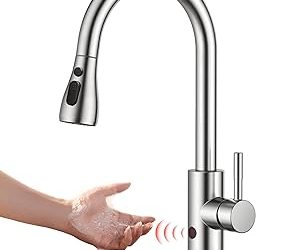
When choosing a kitchen faucet, the question is not simply whether the head “pulls.” The real decision is how far the spray head can travel, how comfortably it moves around your sink, and how reliably the hose returns to the spout. In other words, pull down vs pull out kitchen faucet hose reach is a question of workflow as much as faucet style.
Pull-down faucets usually offer a taller spout and a spray head that travels downward into a deep basin. Pull-out faucets generally have a shorter, more forward-projecting spout and a hose that extends farther across the sink or nearby counter. Neither is universally better. The right choice depends on sink depth, counter clearance, dishwashing habits, and whether you want maximum vertical clearance or broader horizontal reach.
As an Amazon Associate we earn from qualifying purchases at no extra cost to you. Product prices and availability are accurate as of the date shown and are subject to change.



Quick Verdict
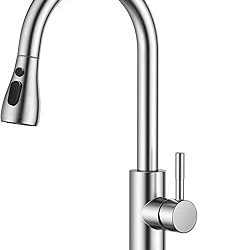
Choose a pull-down faucet if you have a deep or divided sink, regularly fill tall pots, and prefer a modern high-arc look. Its hose reach is usually most useful below the spout, where it can rinse dishes, wash produce, and direct water into a basin without requiring much wrist movement.
Choose a pull-out faucet if you have a shallow sink, limited overhead clearance, or need to spray across a wide area. The lower-profile design often gives you more practical horizontal reach, including toward the front edge of the sink or a countertop drying mat.
For many households, a pull-down hose extends about 8 to 20 inches from the spout, while a pull-out head commonly provides roughly 10 to 24 inches of usable extension. These are broad design ranges, not guarantees. The actual reach depends on the hose length, counter thickness, spout geometry, spray-head weight, and how much hose remains under the sink.
Side by Side
| Factor | Pull-Down Faucet | Pull-Out Faucet |
|---|---|---|
| Typical hose reach | About 8–20 inches from the spout; strongest vertical reach | About 10–24 inches; often better horizontal reach |
| Comfort | Natural for rinsing inside deep bowls and tall cookware | Easy to hold and aim across shallow or wide sinks |
| Durability | Fewer extreme bends when used below the spout; docking mechanism matters | Hose may experience more side-to-side flexing; quality of the hose guide matters |
| Typical price range | About $80–$600, with premium models above that range | About $60–$450, depending on finish and valve quality |
| Maintenance | Clean spray-face buildup and check the docking weight or magnet | Clean the spray head and inspect the hose for rubbing under the counter |
| Space needed | Usually needs 20–24 inches of vertical clearance above the deck | Often works under 18–20 inches of clearance |
| Look | Tall, contemporary, prominent focal point | Lower profile, streamlined, and less visually dominant |
| Resale appeal | Strong in updated kitchens and with deep undermount sinks | Practical appeal where low clearance or compact layouts are common |
| Best for | Deep sinks, large pots, frequent rinsing, and high-arc styling | Small kitchens, shallow sinks, broad spray coverage, and low cabinets |
Where Pull Down Wins
A pull-down faucet is usually the better match for a sink that is at least 8 inches deep, particularly when the bowl is wide or divided. Pulling the head straight down gives you control close to the drain, which helps when rinsing plates, scrubbing a roasting pan, or washing vegetables without splashing water onto the backsplash.
The tall spout also creates useful clearance for cookware. A pull-down model with a spout height of 15 to 22 inches can make it easier to slide a stockpot beneath the outlet. Check the faucet’s spout height and reach before buying, however. A high arc does not automatically mean a long hose. Some heads extend only a few inches beyond the end of the spout.
Docking is another advantage. Many pull-down heads use a counterweight or magnetic catch to return the sprayer to the faucet body. A strong docking system keeps the head from hanging loosely and reduces the chance of accidentally dragging the hose across the sink edge. For a family kitchen, look for a head that switches between stream and spray with one hand and has a pause button.
Pull-down designs also tend to suit current kitchen aesthetics. Their arched silhouettes pair well with apron-front, workstation, and large single-bowl sinks. If you are replacing a faucet during a broader kitchen update in 2026, the pull-down form is often the easiest style to coordinate with other contemporary fixtures.
Where Pull Out Kitchen Faucet Hose Reach Wins
Pull-out faucets earn their advantage when reach needs to extend outward rather than downward. Their spray heads typically detach from a shorter spout and can be aimed toward the front, side, or corner of the sink. That makes them useful for shallow basins, compact bar sinks, and sinks installed beneath cabinets.
A pull-out head can also reach a countertop container or a dish placed beside the basin, although you should avoid stretching the hose to its limit. A stated hose length of 20 inches does not necessarily provide 20 inches of comfortable working reach. The faucet’s mounting position, the curve of the spout, and the point where the hose exits beneath the deck all reduce the usable distance.
Low overhead clearance is a particularly strong reason to choose pull out. Many models stand approximately 6 to 10 inches above the counter, compared with 15 inches or more for a high-arc pull-down. Measure from the countertop to the lowest cabinet, shelf, or window obstruction, leaving at least 1 to 2 inches of breathing room where possible.
Pull-out faucets can be less visually imposing, too. In a galley kitchen or small apartment, a lower profile may preserve sightlines and make the room feel less crowded. Their horizontal hose movement can be more convenient than lifting a pull-down head high enough to clear a deep basin.
Cost Over 5 Years
Purchase price is only part of the comparison. A basic pull-out faucet may cost $60 to $150, while a midrange model commonly costs $150 to $300. Pull-down faucets often begin around $80 and reach $250 to $600 for better finishes, stronger docking systems, touch controls, or commercial-style construction.
Installation usually adds about $100 to $300 when handled by a professional, depending on access and whether an old faucet must be removed. If the sink has an escutcheon, an extra hole may need a cover plate; that typically costs $10 to $40.
Over five years, budget approximately $170 to $500 for a straightforward pull-out installation and $190 to $900 for a pull-down installation, including the faucet and typical labor. These are planning ranges, not guarantees. Finish upgrades, touchless electronics, supply-line replacements, and difficult under-sink access can raise the total.
Replacement hoses are relatively inexpensive compared with a new faucet. For example, compatible 68-inch pull-down or pullout hose kits are listed at $18.99 and $20.99. Confirm the faucet brand, connector style, and model number before ordering; a similar-looking hose may not lock into the spray head or valve.
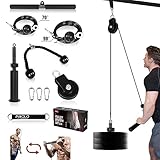
Also be careful when shopping online: “pull-down” can refer to products unrelated to plumbing. A GOIMU LS01 LAT Pulldown Machine is a $269.99 home-gym cable station, while the Mikolo Fitness LAT and Lift Pulley System is listed at $39.99. Neither is a kitchen faucet component, despite the shared terminology.
Which One for Your Home
Small Apartment
Pick a pull-out faucet when overhead cabinets, a window, or a low shelf limits vertical space. A model around 6 to 10 inches high can provide useful spray coverage without dominating a compact sink. Prioritize a hose that extends at least 12 inches and a spout reach of about 8 to 10 inches, while checking that the spray head docks securely.
Family With Kids or Pets
A pull-down faucet is often easier for repeated rinsing and filling. The head can reach into a deep basin, and a pause button can reduce running time while you reposition a bowl or wash muddy paws. Choose a durable finish, a large lever, and a magnetic docking system. Keep the hose path clear under the sink so children cannot pull it against plumbing or storage bins.
Rental
Choose based on the existing sink and countertop holes rather than style alone. A single-hole pull-out or pull-down faucet is usually the simplest swap, but verify whether the current installation uses one hole or three. A pull-out may be the safer choice if cabinets restrict clearance. Keep the original faucet and hardware for move-out, and avoid drilling or modifying the counter without permission.
Long-Term Home
Start with measurements and daily habits. For a deep workstation or farmhouse sink, a pull-down faucet with a 15- to 22-inch spout height is likely to feel more natural. For a shallow, wide sink or low window, select a pull-out with a longer horizontal working range. In either case, buy from a brand with replacement cartridges, spray heads, and hoses available separately.
FAQ
Which faucet has the longer hose, pull down or pull out?
There is no universal standard. Pull-out faucets often offer slightly more horizontal extension, commonly about 10 to 24 inches, while pull-down faucets are designed for controlled vertical movement, often about 8 to 20 inches. Read the manufacturer’s hose and spout measurements together rather than relying on the style name.
Does a longer hose always mean better reach?
No. Extra hose can bunch beneath the sink, rub against plumbing, or make the spray head harder to dock. A 68-inch replacement hose, for example, describes the hose itself, not the distance the spray head will comfortably travel above the counter. The faucet’s routing and counter position determine practical reach.
Can a pull-down faucet replace a pull-out faucet?
Often, but not automatically. Check the number and diameter of mounting holes, counter thickness, supply-line connections, and clearance above the sink. The new faucet must also fit the sink’s bowl size; a tall pull-down can be awkward in a very shallow basin.
How do I measure hose reach before buying?
Measure from the faucet’s mounting point to the farthest place you want to rinse. Then measure the sink’s depth, front-to-back width, cabinet clearance, and distance to nearby windows or shelves. Leave several inches of slack so the hose does not remain taut, and confirm that the spray head can return fully to its dock.