Key takeaways
- Excellent sink coverage. The long arm and pull-down head make it easier to reach every corner of a wide or deep basin. This is especially useful with a single-bowl sink.
- Convenient for oversized cookware. You can direct the spray into stockpots, roasting pans, Dutch ovens, and tall pitchers without awkwardly lifting or rotating them.
- Useful pause and spray controls. Many models let you switch between a steady stream and a concentrated spray at the nozzle. A pause button can reduce water use while you reposition a dish.
- Strong professional look. The spring coil creates a restaurant-inspired appearance that works particularly well with stainless steel, industrial, contemporary, and transitional kitchens.
- Easy one-handed operation. A single lever lets you adjust temperature and flow without setting down a soapy pan.
- Good value in the middle of the market. You do not necessarily need to spend several hundred dollars. Many functional residential models fall between approximately $70 and $180.
- Often easier to repair than a heavily integrated faucet. Spray heads, hoses, cartridges, and aerators are commonly replaceable, provided the manufacturer sells compatible parts.
What's inside
The Short Answer
Yes, a commercial spring neck kitchen faucet is worth buying if you regularly wash large pots, baking sheets, cutting boards, or produce and have enough clearance around your sink. If you mainly rinse plates and fill a coffee maker, a standard pull-down faucet usually gives you the same practical benefit for less money and with a less imposing design.
The biggest question is not whether a spring neck faucet looks professional. It is whether your sink area can comfortably handle its height, exposed coil, and wide spray reach. Before buying, measure from the faucet mounting hole to the nearest cabinet, shelf, window, or light fixture. Most commercial-style models stand roughly 20 to 24 inches tall and can extend 8 to 10 inches over the sink. A low shelf or shallow cabinet may make installation impossible or awkward.
As an Amazon Associate we earn from qualifying purchases at no extra cost to you. Product prices and availability are accurate as of the date shown and are subject to change.


What You Actually Get
A commercial spring neck faucet uses a tall, flexible metal coil around the faucet’s main arm. The spray head usually pulls down from the end of that arm, while a separate support bracket holds it in place when it is not being used. Most models offer two spray settings: an aerated stream for filling containers and a stronger spray for loosening food debris.
Unlike a true restaurant pre-rinse faucet, a residential commercial-style model is designed for a normal kitchen water line and sink cabinet. You typically get a single-handle control, a 360-degree or near-360-degree swivel, flexible supply lines, and mounting hardware for a one-hole installation. Some include an adapter for a three-hole sink; others require a separate deck plate.
Expect a faucet body weighing approximately 5 to 8 pounds, although heavier brass-bodied models may weigh more. Water flow is commonly rated around 1.8 to 2.2 gallons per minute, depending on the model and local regulations. Higher flow does not automatically mean better cleaning. Spray pattern, handle control, and the distance between the nozzle and sink often matter more.
The coil is usually stainless steel or plated metal. It adds visual interest and protects the inner hose, but it also collects dust, grease, and water spots more readily than a smooth-armed pull-down faucet. The exposed design is part of the appeal—and part of the maintenance.
Pros
- Excellent sink coverage. The long arm and pull-down head make it easier to reach every corner of a wide or deep basin. This is especially useful with a single-bowl sink.
- Convenient for oversized cookware. You can direct the spray into stockpots, roasting pans, Dutch ovens, and tall pitchers without awkwardly lifting or rotating them.
- Useful pause and spray controls. Many models let you switch between a steady stream and a concentrated spray at the nozzle. A pause button can reduce water use while you reposition a dish.
- Strong professional look. The spring coil creates a restaurant-inspired appearance that works particularly well with stainless steel, industrial, contemporary, and transitional kitchens.
- Easy one-handed operation. A single lever lets you adjust temperature and flow without setting down a soapy pan.
- Good value in the middle of the market. You do not necessarily need to spend several hundred dollars. Many functional residential models fall between approximately $70 and $180.
- Often easier to repair than a heavily integrated faucet. Spray heads, hoses, cartridges, and aerators are commonly replaceable, provided the manufacturer sells compatible parts.
Cons
- It may be too tall. The most common buying mistake is ignoring overhead clearance. A 22-inch faucet can collide with a cabinet door, block a window, or visually overwhelm a compact kitchen.
- The coil needs cleaning. Grease and mineral deposits can settle between the turns. Wiping the spring periodically takes more effort than cleaning a smooth faucet arm.
- Spray hoses can feel stiff. The metal coil protects the hose but can limit how freely the spray head moves. Some inexpensive models also have a bulky head or a hose that does not retract smoothly.
- Water can splash more easily. A high-velocity spray aimed at a shallow sink may bounce onto the counter. Sink depth, nozzle angle, and water pressure all affect this.
- The industrial appearance is not universal. It can look out of place beside ornate cabinetry, traditional bridge faucets, or a very small bar sink.
- Quality varies widely. Low-cost faucets may use thin coatings, loose spray-head buttons, weak magnets, or cartridges that become difficult to operate. A low price is attractive, but replacement parts and warranty support matter.
- It does not improve water temperature or pressure by itself. The faucet cannot compensate for poor household water pressure, clogged shutoff valves, or undersized plumbing.
Who Should Buy It
Buy a commercial spring neck faucet if you cook frequently, wash large items by hand, or want a spray head with more reach than your current faucet provides. It is particularly practical for a deep single-bowl workstation sink, a busy family kitchen, or a home where one person often prepares food while another cleans.
It is also a good choice when you like a bold focal point and have at least about 24 inches of open vertical space above the mounting surface. Leave room for the handle to operate fully and confirm that the faucet’s swivel range will not spray outside the basin.
Prioritize a ceramic cartridge, clearly labeled flow rate, braided supply lines, a replaceable spray head, and a mounting system that matches your countertop thickness. If your water is hard, look for silicone spray nozzles that can be wiped clean with a finger.
Who Should Skip It
Skip this style if your faucet must fit beneath a low cabinet or shelf, if you rarely use the spray function, or if you prefer a quiet, understated fixture. A commercial spring neck can also be a poor match for a shallow sink, where its strong spray may create more splashing than convenience.
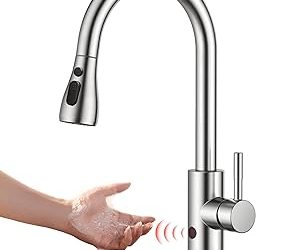
Consider another style if you want touchless operation, a filtered-water dispenser built into the faucet, or a discreet faucet that disappears behind a window line. Those features are available in other designs, but they are not usually the main strengths of an exposed spring-neck model.
Cheaper Alternatives
| Option | Cost | Trade-off |
|---|---|---|
| OWOFAN Kitchen Faucet Pull Down Sprayer, Stainless Steel, Brushed Nickel | $49.99 | Much less expensive and generally easier to fit under cabinets, but it lacks the full commercial spring-neck look and may offer less reach around a very large sink. |
| Fapully Commercial Pull Down Kitchen Sink Faucet with Sprayer, Brushed Nickel | $104.62 | Provides the commercial appearance and broad spray coverage at a moderate price, but its taller profile still requires careful clearance measurements and may have more exposed surfaces to clean. |
| Standard pull-down faucet from a major home-improvement brand | Approximately $80–$180 | Smoother styling, easier cabinet clearance, and often better parts support; usually less dramatic and slightly less flexible than a spring-neck design. |
| Basic pull-out faucet | Approximately $50–$130 | Compact and comfortable for a small sink, but the shorter hose and lower reach are less convenient for large cookware and wide basins. |
The $49.99 OWOFAN is the value-oriented choice for ordinary rinsing and everyday cleanup. The $104.62 Fapully sits closer to the commercial-style experience without entering premium-faucet pricing. Either can make sense, but compare warranty terms, mounting dimensions, hose length, and replacement-part availability rather than judging by finish alone.
FAQ
Are commercial spring neck faucets hard to install?
Most are manageable for a careful DIYer if the sink already has a compatible hole and the shutoff valves work properly. Installation commonly involves connecting two braided supply lines, securing the faucet from below, attaching the hose weight or guide, and checking for leaks. Allow about 30 to 90 minutes, depending on access beneath the sink. A three-hole sink may need a deck plate.
Do commercial spring neck faucets splash more?
They can, especially when installed over a shallow basin or operated at full flow. Aim the spray toward the sink wall or the bottom of a pot instead of straight down. Choosing a model around 1.8 gallons per minute, rather than an unusually high-flow version, can also make everyday use more controlled.
How tall should the faucet be?
Measure from the faucet hole to the lowest nearby obstruction, then leave several inches of practical clearance for the handle and spray head. Because product dimensions vary, do not assume a model listed as “compact” will fit. A faucet around 20 inches tall may work under more cabinets than one measuring 24 inches, but the coil and support bracket also need room.
Is a commercial spring neck faucet durable?
It can be, but durability depends on the cartridge, hose, coating, and quality of the internal connections—not simply on the commercial appearance. Look for a ceramic cartridge, a solid mounting plate, corrosion-resistant supply lines, and a stated warranty. Clean mineral buildup with a soft cloth and manufacturer-approved cleaner, and avoid abrasive pads that can damage the finish.