Key takeaways
- The listing gives only overall height and omits reach, hole size, handle clearance, or mounting thickness.
- “Stainless steel” appears in the title, but the body material is not identified anywhere in the specifications.
- The faucet has no clear flow-rate information, replacement-part listing, installation manual, or warranty terms.
- Reviews repeatedly mention a loose spray head, hose that fails to retract, leaking connections, or an unstable base.
- A wall-mount model does not state its center-to-center measurement, or the advertised measurement does not match your plumbing.
- The faucet is unusually cheap but includes a complex pre-rinse system with no information about cartridges, hoses, or seals.
What's inside
A commercial-style kitchen faucet can make a home sink faster to use, but the restaurant-inspired look is not automatically a sign of better performance. One common mistake is buying the tallest faucet that fits the budget, then discovering that it blocks a window, splashes into a shallow basin, or hits an upper cabinet. Another is comparing finish and price while overlooking mounting requirements, hose reach, replacement parts, and the difference between a true wall-mount faucet and a deck-mount model.
This guide explains what to look for in a commercial style kitchen faucet, from clearance and spray performance to construction, warranty coverage, and delivery. The goal is not to choose the most industrial-looking model; it is to choose one that fits your sink, cooking habits, and maintenance tolerance.
As an Amazon Associate we earn from qualifying purchases at no extra cost to you. Product prices and availability are accurate as of the date shown and are subject to change.


Decide These 3 Things First
- Where will it mount? Most residential commercial-style faucets install through one deck hole, usually 1 3/8 inches in diameter. Wall-mount models require water connections in the wall and commonly use an 8-inch center-to-center spread. These are not interchangeable installations.
- How much clearance do you have? Measure from the countertop to the lowest cabinet, shelf, or window obstruction. Commercial-style faucets are often 20 to 25 inches tall, while the pull-down head and spring arch can extend several inches farther forward.
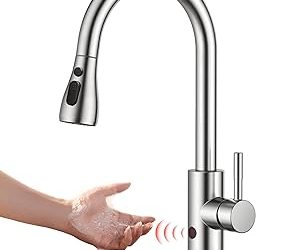
- Which functions will you actually use? A pre-rinse spring coil, pull-down sprayer, separate side spray, swivel spout, and pause button all add convenience, but they also add parts that may eventually need cleaning or replacement.
Size and Clearance
Measure before shopping, not after delivery. A faucet height of 18 to 20 inches is often manageable beneath standard cabinets, while models around 24 to 25 inches may need an open backsplash area. Also measure the distance from the faucet hole to the center of the sink. A spout reach of 8 to 10 inches generally works for many single-bowl sinks, but a very deep or wide sink may benefit from 10 to 11 inches.
Check the swivel range as well. A spout that rotates 90 degrees can serve one bowl without projecting too far over an adjacent drainboard; a 360-degree swivel is useful for filling pots on the counter but may spray outside the sink if the faucet is left turned on while rotated.
Do not evaluate height alone. A 25-inch wall-mount faucet may have a 9- to 10-inch add-on swing spout, increasing its useful reach and its space requirements. For a compact kitchen, look for a total height under 20 inches, a reach of about 8 inches, and at least 1 inch of clearance between the handle and backsplash.
Material and Finish
Look for a brass or stainless-steel faucet body rather than relying on the word “stainless” in a product title. Some faucets use a brass body with stainless or zinc-alloy exterior components; others use stainless steel for the main waterway. The specification sheet should identify the body material and the material of the pull-down head, handle, and spring.
Brushed nickel and stainless finishes are forgiving around water spots and fingerprints. Matte black creates a sharper contrast but can show mineral deposits, especially in hard-water areas. A coated finish should be described as corrosion-resistant or PVD-treated, though finish language alone is not a guarantee of long-term durability.
Look for a ceramic cartridge. It is generally preferable to a basic compression-style mechanism because it allows smooth, quarter-turn operation and is designed to resist dripping. If the cartridge is replaceable, confirm that replacement parts are available in the United States.
Construction and Installation
Commercial styling often includes a visible spring, exposed hose, or pre-rinse coil. Inspect how those pieces attach. A metal spring or metal-bodied head can feel more substantial, but a flexible hose inside the coil is still a wear item. A weighted hose, secure docking mechanism, and a mounting nut that can be tightened from below are more important than an especially dramatic coil.
Most deck-mount faucets need one hole, a supply-line connection commonly sized for U.S. plumbing, and a counter or sink deck no thicker than the manufacturer’s stated limit. Many installations work with decks up to approximately 2 inches thick, but this varies. A faucet plate may be included for a three-hole sink; if not, budget roughly $15 to $40 for a compatible escutcheon.
Wall-mount installation is more involved. An 8-inch center measurement must match the rough-in, and the connections need to be firmly secured inside the wall. Do not assume decorative trim will hide an incorrect spacing. For a new wall-mount installation, a plumber may be worthwhile, particularly if the supply lines need to be moved.
Comfort and Performance
The best faucet is easy to operate with a wet or soapy hand. A single lever that moves forward can prevent the handle from striking a backsplash, while a side-moving handle may need at least 2 inches of clearance. Test whether the lever offers enough resistance to make small temperature adjustments without feeling stiff.
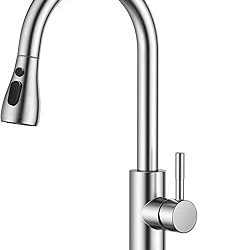
A pull-down head should dock securely and retract without requiring excessive force. A 20- to 24-inch hose is common, but usable reach depends on the faucet’s height and the sink’s position. A pause button can save water during rinsing, although it should not be treated as a substitute for turning off the tap.
Most home faucets deliver about 1.5 to 1.8 gallons per minute. A higher flow rate may fill large pots faster, but it can increase splashing in a shallow sink. Two spray patterns—stream and spray—are usually enough. A third pattern or a separate pre-rinse valve is helpful if you frequently wash large cookware, but it adds complexity.
Check the aerator and spray nozzles for easy cleaning. Silicone nozzles can be wiped to remove mineral buildup. If your water pressure is weak, a restrictive spray head may perform poorly even when the faucet itself is well made.
Price Tiers
Price is a useful screening tool, not a guarantee. Budget commercial-style faucets generally cost about $50 to $120. At this level, you may find a stainless or brass-look body, a pull-down sprayer, and a two-function head. The trade-offs can include less precise finish quality, shorter warranties, and fewer replacement parts.
Midrange models typically cost $120 to $250. They are more likely to offer a ceramic cartridge, better docking, a smoother swivel, a more convincing metal construction, and clearer installation documentation. The KRAUS KPF-1610MB, listed at $229.95, sits near the top of this range, while a model such as the iVIGA wall-mount example at $149.93 shows how configuration can affect price.
Premium residential commercial-style faucets commonly cost $250 to $600 or more. You are paying for refined operation, stronger parts support, better finish consistency, and sometimes a longer warranty—not necessarily dramatically higher water flow. Examples such as the Fapully at $104.62 and OWOFAN at $49.99 illustrate why comparing specifications is more useful than comparing appearance alone.
Warranty and Replacement Parts
Look for at least a 1-year warranty on budget models and a limited lifetime warranty on many midrange or premium residential faucets. Read the exclusions: finishes, hoses, spray heads, labor, and damage caused by improper installation may have separate coverage.
Before buying, search the manufacturer’s parts page or manual for the cartridge, aerator, hose, spray head, and mounting hardware. A replacement hose costing $20 to $50 is much easier to live with than replacing an entire faucet. Confirm whether warranty service requires proof of purchase and whether the company provides a U.S. phone number or email address.
Delivery and Assembly
Check the package dimensions and weight if the faucet will be delivered to an apartment, upper floor, or job site. A faucet itself often weighs approximately 4 to 8 pounds; a wall-mount kit with a long spout and extensive hardware may weigh more. Inspect the box before discarding it, and photograph any damaged finish or bent tubing on arrival.
Installation may take 30 to 60 minutes when the plumbing and mounting hole already match the faucet. Allow longer if you need to remove an old faucet, add a deck plate, or adjust the counterweight. Wall-mount work can require several hours or a plumber because the connections may be inside the wall. Never use the faucet’s flexible supply lines to compensate for badly aligned plumbing.
Spec Checklist
| Spec | Budget | Mid | Premium |
|---|---|---|---|
| Typical price | $50–$120 | $120–$250 | $250–$600+ |
| Height | 16–22 in. | 18–24 in. | 18–25 in. |
| Spout reach | 8–10 in. | 9–11 in. | 9–12 in. |
| Flow rate | 1.5–1.8 GPM | 1.5–1.8 GPM | 1.5–1.8 GPM |
| Spray functions | Stream and spray | Stream, spray, often pause | Two or more, with refined controls |
| Cartridge | May be unspecified | Ceramic is common | Replaceable ceramic cartridge |
| Warranty target | 1 year | 5 years to limited lifetime | Limited lifetime |
Red Flags
- The listing gives only overall height and omits reach, hole size, handle clearance, or mounting thickness.
- “Stainless steel” appears in the title, but the body material is not identified anywhere in the specifications.
- The faucet has no clear flow-rate information, replacement-part listing, installation manual, or warranty terms.
- Reviews repeatedly mention a loose spray head, hose that fails to retract, leaking connections, or an unstable base.
- A wall-mount model does not state its center-to-center measurement, or the advertised measurement does not match your plumbing.
- The faucet is unusually cheap but includes a complex pre-rinse system with no information about cartridges, hoses, or seals.
FAQ
Are commercial-style kitchen faucets practical for a home?
Yes, if the height and reach suit the sink. They are especially useful for filling tall pots and rinsing large pans. Their exposed coils can collect grease and dust more readily than a streamlined residential faucet, so they need occasional wiping.
What height should a commercial-style faucet be?
Choose a model around 18 to 20 inches tall when it must fit below cabinets. Models from 21 to 25 inches are better suited to open wall space. Measure the faucet hole to the lowest obstruction and leave room for the handle and spray head to operate.
Is a wall-mount faucet better than a deck-mount faucet?
Neither is universally better. A wall-mount faucet keeps the counter clear and can work well with a deep, wide sink, but it requires accurately placed wall plumbing. A deck-mount model is usually simpler for a standard sink replacement.
How much should I spend on a commercial-style kitchen faucet?
Plan on $50 to $120 for basic functionality, $120 to $250 for a stronger balance of construction and parts support, and $250 or more for premium finish, operation, and service. Spend extra first on correct dimensions, a ceramic cartridge, secure docking, and accessible replacement parts.