Key takeaways
- Name the verified problem: hardness, free chlorine, sediment, iron, odor, or another constituent.
- Match the exact model’s certified claim to that problem.
- Confirm thread size, housing clearance, shower-arm support, and usable flow.
- Calculate annual cartridge, salt, electricity, water, and service costs.
- Preserve access for replacement and record the installation date.
- Reject medical or contaminant claims exceeding documented evidence.
White crust on a shower head is evidence of minerals left after water evaporates. It is not proof that a shower filter will solve the problem. Many shower cartridges target free chlorine, odor, or sediment; conventional water softening targets dissolved calcium and magnesium through a different process. Buying by the word “filter” can therefore produce a fresh cartridge and the same scale.
The sensible sequence is diagnose, contain, then treat. Identify what is in the water, separate cosmetic deposits from flow problems, choose the smallest intervention matching the evidence, and monitor whether it works.
Our top picks
 Aquabliss High Output Revitalizing Shower Filter
- Set Name: SF100
- Item Dimensions D x W x H: 3.3"D x 3.3"W x 4.7"H
- External Testing Certification: UL


 weAQUA Heavy Duty Shower Filter for Hard
- Elegantly packaged heavy-duty showerhead water filter
- Marketing gimmicks like Energy & Ceramic Balls are…
- High quality, laboratory tested and certified filtration media…


As an Amazon Associate we earn from qualifying purchases at no extra cost to you.
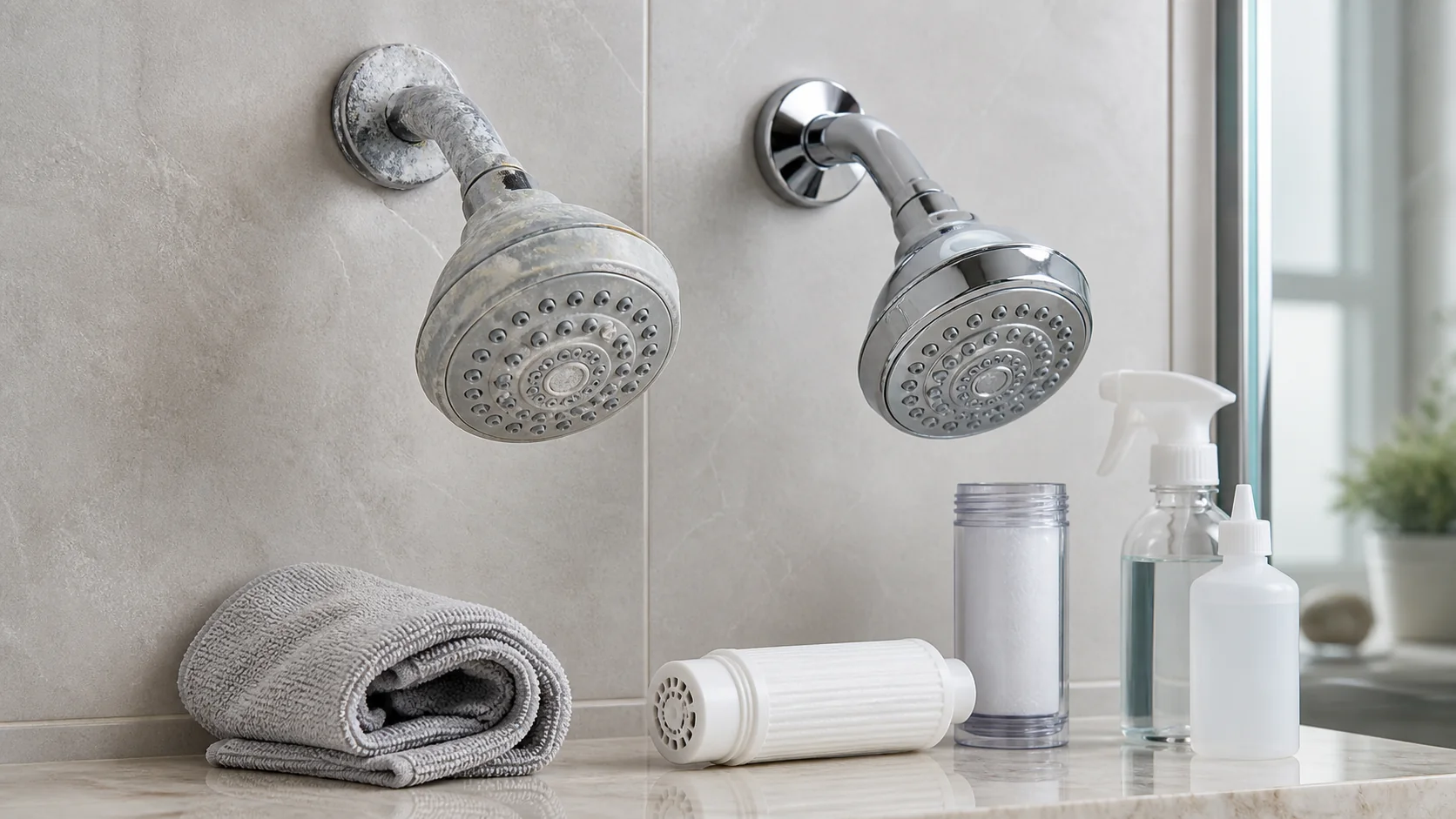
Read the Clues Before Selecting Equipment
Hardness commonly appears as chalky white or gray residue on nozzles, glass, tile, and metal. Soap may lather poorly and leave film. Orange staining can point toward iron; black or brown particles may come from corrosion, sediment, or deteriorating components. A pool-like odor may involve disinfectant rather than hardness. These symptoms can overlap, so appearance is a screening tool, not a laboratory result.
Start with the water supplier’s current consumer confidence report if the home uses public water. It provides system-level information but may not describe water at one shower after traveling through the building. For a private well, unusual staining, taste, odor, or health concern, use an appropriate certified laboratory and local health guidance. The home water-quality testing guide helps define a test question before ordering a kit.
Use a Symptom-to-Solution Ladder
| Finding | First response | Escalate when |
|---|---|---|
| Light spots, normal spray | Dry surfaces and descale per fixture instructions | Deposits return unusually fast or damage finishes |
| Uneven jets or reduced spray | Clean accessible nozzles and inspect inlet screen | Pressure remains poor after maintenance |
| Confirmed hardness throughout home | Compare whole-home softening options | Scale affects heater, laundry, and many fixtures |
| Confirmed chlorine concern | Evaluate an independently certified claim | No appropriate listing or test data exists |
| Iron, odor, or unknown particles | Obtain targeted testing | Results show a health or plumbing concern |
This ladder avoids turning every symptom into a whole-house project. It also avoids expecting a cleaning routine to alter incoming water chemistry.
Know What a Shower Filter Can Claim
NSF/ANSI 177 addresses shower filtration systems intended to reduce free available chlorine. That is a specific performance category, not a general certification that a cartridge softens water, removes every contaminant, or treats a medical condition. Check the exact model in the certifier’s listing and read the named reduction claim, rated life, flow conditions, and replacement instructions.
Activated carbon, KDF-type media, calcium sulfite, and sediment screens are described differently across products. Media names alone do not establish performance. Independent certification for the exact unit is stronger evidence than broad marketplace language. The filtered shower-head cartridge guide provides a focused purchasing framework.
A cartridge creates maintenance obligations. Flow can decline as debris accumulates; media performance changes with chemistry, temperature, usage, and time. Price replacements over a full year and confirm availability. A cheap housing paired with costly proprietary cartridges may have the higher ownership cost.
When Whole-Home Softening Makes More Sense
If testing confirms hardness and scale affects faucets, the water heater, dishwasher, laundry, and several bathrooms, treating one shower does not address the broader load. Ion-exchange softeners replace hardness ions with sodium or potassium ions and require correct sizing, regeneration, salt management, drainage, and maintenance. They are not universally suitable, and local restrictions may apply.
Ask a treatment professional to size equipment from measured hardness and demand rather than bedroom count alone. Discuss iron, manganese, sodium considerations, septic implications, bypass arrangements, and service access. Request a written performance objective and consumables estimate. “Scale-free” language without a test basis is insufficient.
Remove Deposits Without Damaging Finishes
Daily moisture control has a disproportionate effect. Squeegee glass, wipe metal where spotting is visible, and improve ventilation so droplets do not sit until they evaporate. Flexible silicone spray nozzles are easier to rub clean than tiny recessed jets. A removable hand shower can simplify rinsing walls and doors.
Follow the fixture maker’s care instructions. Mild acid can dissolve mineral deposits on compatible materials, but it can etch natural stone, affect grout, and damage some plated or specialty finishes. Never mix acidic cleaners with chlorine bleach; the combination can release dangerous gas. Ventilate, protect yourself, and rinse within the approved contact time.
Do not soak an entire shower head unless its manufacturer permits it. Liquid may reach joints or finishes not intended for prolonged exposure. A cloth applied only to the compatible scaled area may be safer. The shower-filter maintenance guide offers a cartridge and housing inspection sequence.
Diagnose Low Flow Separately
Deposits can restrict nozzles, but weak spray has other causes: a clogged inlet screen, kinked hose, partially closed valve, pressure problem, flow regulator, failing cartridge, or debris released during plumbing work. Compare other fixtures and note whether the change was sudden or gradual. A sudden whole-house drop suggests a different cause than one shower slowly becoming uneven.
Clean only serviceable parts identified by the manufacturer. Do not drill openings, remove required components, or improvise with chemicals. If pressure is abnormal, a valve is difficult to operate, or concealed piping may be restricted, call a plumber.
Run a Four-Week Verification
Before changing equipment, photograph the same section of glass and spray face, record how quickly scale returns, and note spray consistency. After cleaning or treatment, repeat under similar use. A solution that changes water feel should not be credited with hardness reduction without measurements.
- Week 0: document deposits, odor, spray pattern, and test data.
- Week 1: apply the new wiping routine and inspect nozzles.
- Week 2: evaluate filter flow or treatment operation, not fragrance alone.
- Week 4: compare photographs and cleaning frequency, then decide whether to escalate.
Buying Checklist
- Name the verified problem: hardness, free chlorine, sediment, iron, odor, or another constituent.
- Match the exact model’s certified claim to that problem.
- Confirm thread size, housing clearance, shower-arm support, and usable flow.
- Calculate annual cartridge, salt, electricity, water, and service costs.
- Preserve access for replacement and record the installation date.
- Reject medical or contaminant claims exceeding documented evidence.
Frequently Asked Questions
Will a shower filter remove hard water?
Do not assume so. Most shower-filtration certifications focus on free chlorine reduction, while dissolved hardness normally requires a softening process designed for that job.
Why does scale return immediately after cleaning?
Cleaning removes existing deposits; it does not change incoming water. Faster drying, frequent wiping, easier-clean fixtures, or correctly selected treatment can reduce the burden.
Can vinegar be used on every finish?
No. Acid can harm stone and some finishes or seals. Follow each manufacturer’s care guide and never combine acid with bleach.
Does slippery-feeling water prove a softener works?
Feel is subjective and influenced by soap. Use hardness testing, equipment settings, salt use, and service checks.
When is professional help warranted?
Seek help for unexplained color or odor, unsafe test results, persistent pressure loss, corroded connections, concealed leaks, or whole-home equipment selection.
Bottom Line
The best hard-water shower solution begins with the correct diagnosis. Clean existing scale safely, select fixtures that are easy to maintain, use filtration only for its documented claim, and consider whole-home softening when measured hardness affects the property. Evidence first prevents an endless cycle of replacement cartridges and unchanged deposits.
Sources
- NSF: NSF/ANSI 177 Shower Filtration Systems
- USGS: Hardness of Water
- U.S. EPA: Private Drinking Water Wells
- CDC: Chlorine safety