There is no universally best kitchen sink material. A family that drops heavy pans, a careful baker using pale counters, and a homeowner restoring an older kitchen expose a basin to different hazards. The useful question is not “Which material wins?” but “Which failure would bother us most?” Comparing stains, chips, scratches, noise, heat, and structural weight produces a more honest answer than ranking finishes by showroom appeal.
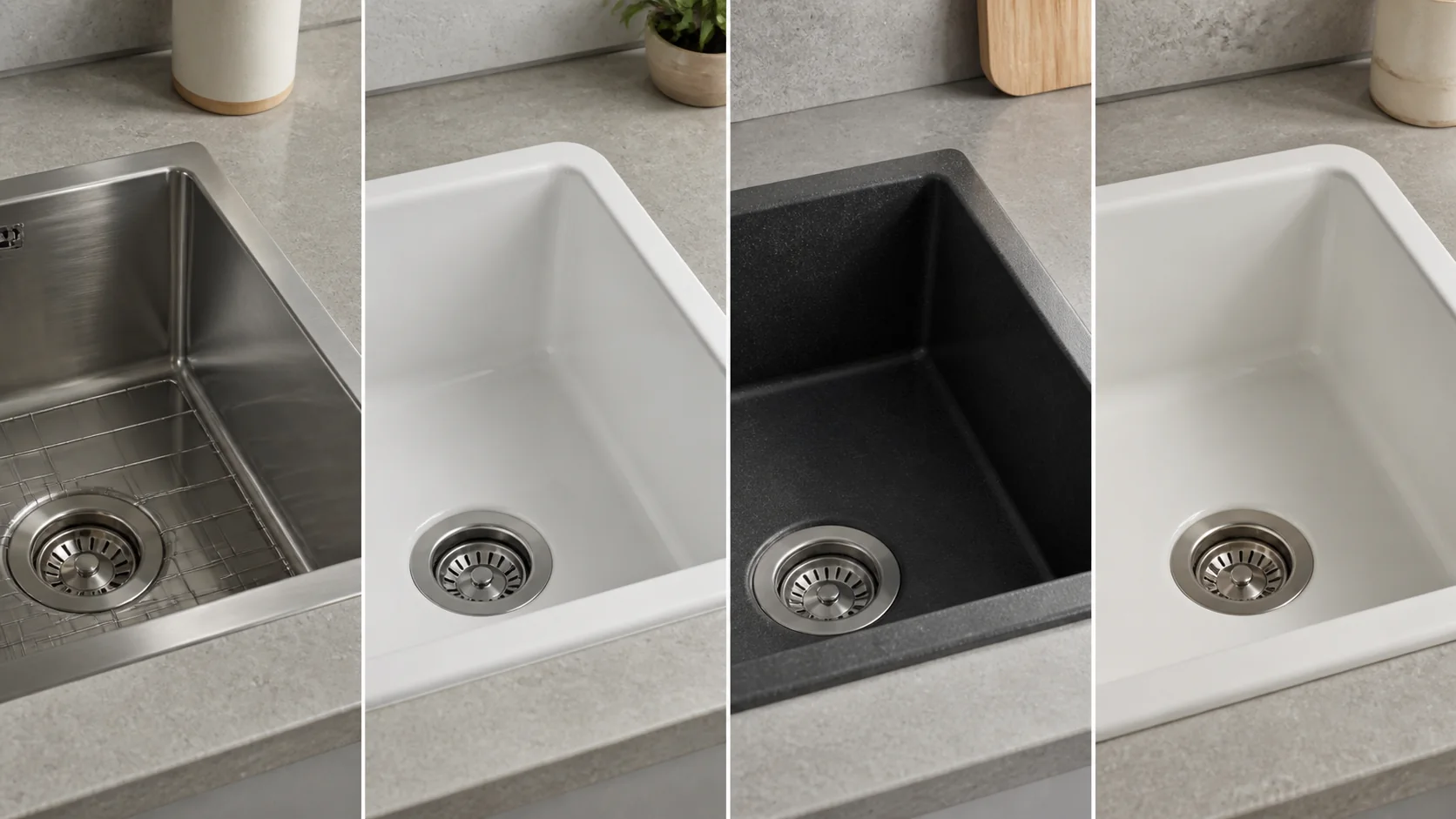
The Failure-Mode Scorecard
| Material | Usually handles well | Watch closely | Installation consequence |
|---|---|---|---|
| Stainless steel | Impact, thermal shock, modest weight | Scratching, spots, vibration | Large bowls still need sound support |
| Fireclay | Stains, heat, classic gloss | Edge chips | Heavy; fired dimensions can vary |
| Enameled cast iron | Rigidity, heat, color | Enamel chips exposing iron | Very heavy; reinforce cabinet |
| Granite composite | Muted sound, color through body | Mineral film, model-specific heat limits | Exact cutout rules matter |
| Copper | Distinctive patina | Reactive color and cleaner sensitivity | Gauge and handmade dimensions vary |
These are category tendencies, not promises. Formulas, steel thickness, enamel systems, surface treatments, and warranties differ. Read the care sheet for the exact model. Claims such as scratchproof, antimicrobial, or heatproof need test conditions and exclusions before they influence a purchase.
Our top picks



As an Amazon Associate we earn from qualifying purchases at no extra cost to you.
Stainless Steel: Forgiving Structure, Visible History
Stainless steel tolerates dropped utensils without chipping and is relatively light. It suits large undermount bowls without the mass of cast iron. Its weakness is cosmetic: directional scratches, scuffs, water spots, and occasional surface contamination appear. A brushed finish usually disguises use better than mirror polish.
Gauge numbers run backward—lower gauge indicates thicker sheet—but gauge alone does not predict quality. Bowl geometry, forming, alloy, mounting, pads, and undercoating affect stiffness and sound. Compare the complete construction. Clean along the grain; steel wool and chloride-heavy products can damage the passive surface.
Fireclay: Glazed Face, Vulnerable Edges
Fireclay is formed from clay and fired with glaze, producing the deep apron-front appearance associated with traditional kitchens. The glazed face generally resists food stains and heat, but a hard strike at a rim can chip it. A bottom rack reduces direct cookware impacts, though the rack becomes another item to scrub.
Firing can produce dimensional variation, so use the physical sink—not a generic template—to coordinate custom cabinetry and countertop work. Some farmhouse aprons must be scribed. Weight and load path should be settled before delivery. Repair may disguise a chip but cannot recreate a factory-fired surface.
Enameled Cast Iron: Mass Under a Glass-Like Skin
Cast iron offers rigidity, a dense feel, and low vibration. Its enamel supplies color and familiar cleaning behavior. That mass is also the planning issue: cabinetry and installers must safely support and maneuver it. A large model can be difficult to remove without disturbing adjacent finishes.
The iron core is tough, but concentrated impact can chip enamel. Once iron is exposed, rust and discoloration become concerns. Abrasives dull gloss. This material fits owners who prioritize permanence and color over easy handling.
Granite Composite: Quiet and Sensitive to Water Film
Composite sinks combine mineral aggregate with binder. They tend to feel solid, absorb sound, and offer color through the body. Dark versions may show pale mineral deposits; light colors can reveal food residue. Regular drying and approved descaling matter in hard-water areas.
Composition varies by brand, so never transfer heat or chemical limits from one model to another. Confirm hot-pan rules and excluded cleaners. The focused guide to granite composite vs stainless steel helps when these are the final candidates.
Copper: A Living Surface
Unsealed copper develops patina as it reacts with air, water, foods, and cleaners. Acidic foods may temporarily brighten areas, while aggressive chemicals create uneven change. Factory patinas and protective coatings bring their own care restrictions.
Quality discussions should include thickness, seams, treatment, drain compatibility, and documentation—not simply whether a bowl is handmade. Copper suits a buyer who welcomes evolution. Anyone wanting identical color year after year should choose another surface.
Four Household Tests
The cookware test
List the heaviest pan and how it enters the sink. Frequent impacts favor steel; controlled placement broadens the options. A rack changes impact exposure but adds maintenance.
The water test
Hard water leaves different evidence on dark composite, steel, and gloss. Judge samples after dried droplets, not only under showroom lighting. See the kitchen sink cleaning guide for care boundaries.
The cabinet test
Heavy materials transfer load to cabinetry, not merely the counter edge. Confirm support, cutout tolerances, and handling access. The installation guide explains why drain height can reject an otherwise attractive basin.
The future-repair test
Imagine a chip, deep scratch, failed coating, or changed patina. Ask what repair the manufacturer permits and what outcome is realistic. Choose an aging pattern you can accept, not the pristine sample alone.
A Weighted Decision Example
Assign 40 points to the household’s dominant risk, 25 to cleaning compatibility, 20 to installation, and 15 to appearance. A rental may put impact and serviceability first; a heritage kitchen may reverse those weights. Score only from documented properties. This prevents one dramatic feature from overwhelming daily constraints.
Finish Color Can Distort Material Judgments
Color changes what maintenance looks like without changing the underlying material. Pale composite may conceal dried mineral droplets yet reveal tomato or coffee residue. Black composite can reverse that pattern. Polished stainless reflects spots more sharply than a satin grain. White enamel makes dark scuffs obvious but allows rapid visual inspection for residue. Copper deliberately refuses color uniformity.
Bring a cabinet-door sample, countertop sample, and the actual sink finish together under the kitchen’s daytime and evening light. Then add clean tap water to the sample when possible and let it dry. This exercise is more predictive than matching online swatches, which vary with screens and photography. Also record the manufacturer’s exact color or finish code: descriptive names are not standardized across brands.
Accessories Alter the Ownership Experience
Bottom grids, colanders, cutting boards, and drying racks can protect or expand a basin, but they change cleaning labor. A grid shields against impact while creating intersections that collect debris. A fitted board can reduce counter clutter, though wet storage may encourage odor. Before assigning value to a workstation bundle, verify that replacement accessories can be ordered and that their dimensions are documented.
Frequently Asked Questions
Which material is easiest to maintain?
Stainless is often forgiving because it does not chip like glaze, but it records scratches and spots. “Easy” depends on whether the household dislikes marks, mineral film, racks, patina, or special cleaner restrictions.
Can boiling water damage composite?
Heat and thermal-shock limits are model-specific. Confirm the current manual and avoid assuming all mineral composites share one formula.
Is thicker stainless always quieter?
No. Thickness contributes, but bowl shape, pads, undercoating, mounting, cabinet acoustics, and disposal vibration also matter.
What works with quartz countertops?
Several materials work when cutout, support, and mounting are engineered correctly. See choosing a sink for quartz countertops.
Sources and Verification
The right material is the one whose weakness matches the household’s tolerance. Rank actual hazards, inspect the exact care guide, verify cabinet support, and view a sample after fingerprints and dried water—not only under retail lighting.