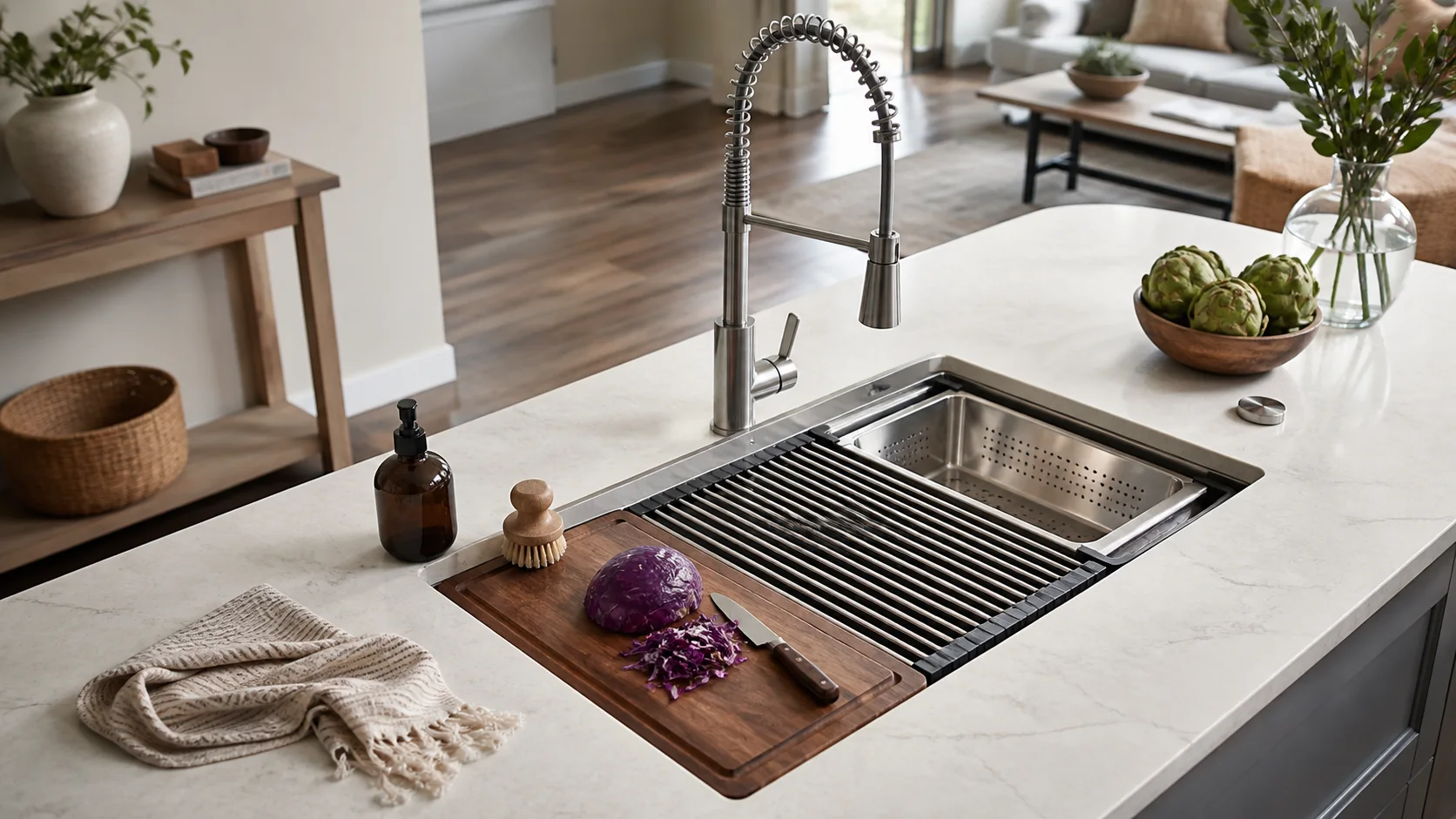
A workstation sink adds ledges inside the rim so a cutting board, colander, rack, or tray can sit over the bowl. That arrangement may reclaim counter space, but only when the rail geometry suits the cook and the sink fits the cabinet. A ledge that looks efficient in a photograph can crowd large cookware, put prep at an uncomfortable height, or create another groove to clean.
Affiliate disclosure: This article may contain affiliate links. We may earn a commission from qualifying purchases at no additional cost to the reader.
Our top picks


As an Amazon Associate we earn from qualifying purchases at no extra cost to you.
Editorial method: No sink was carefully researched here. Manufacturer pages and specification documents were checked on August 26, 2026. Models were chosen to illustrate graduated ledges, a conventional single rail, and a smaller nominal footprint. Their order is not a performance ranking, and the complete model suffix must be verified before purchase.
Three Workstation Layouts Worth Comparing
| Exact model | Documented format | Main decision |
|---|---|---|
| KOHLER Prolific K-5540-NA | 33-inch undermount stainless single bowl with three graduated ledges | Accessories can operate at different heights |
| Kraus Kore KWU110-32 | 32-inch undermount, 16-gauge stainless single bowl with integrated ledge | Familiar one-level rail and rear-offset drain |
| Ruvati Roma RVH8300 | 30-inch undermount, 16-gauge stainless single bowl with front-to-back ledges | Smaller nominal width for tighter projects |
Nominal width is not the minimum cabinet size or countertop opening. Download the drawing for the exact model, then give it to the cabinet installer and countertop fabricator. Cutout, reveal, clip access, corner radius, drain clearance, and support method decide whether the sink is actually compatible.
Ledge Geometry Beats Accessory Count
KOHLER’s Prolific differs because its rails sit at graduated levels. A colander can rest below a cutting board, creating vertically separated washing and chopping zones. The benefit is flexible staging; the tradeoff is a more sculpted interior. Simulate where each accessory will sit and confirm the lowest rail does not obstruct the household’s largest pan.
Kraus Kore and Ruvati Roma use the more familiar front-to-back working ledge. A board or roll-up rack bridges the bowl near counter height. The layout is simple, yet two accessories may compete for the same rails. Compare actual accessory widths and required bearing surfaces instead of counting pieces in a bundle.
A household that chops daily may value one stable board and a dishwasher-safe colander more than five rarely used inserts. Determine where wet accessories will dry, whether replacements use proprietary dimensions, and whether an aftermarket board can span the opening safely. Accessories without a storage plan usually become counter clutter.
Measure Usable Space Below the Rail
Outside dimensions conceal the working volume. Ledges, corner radii, wall slope, drain flange, bottom grid, and accessory overhang reduce usable room. Measure the largest roasting pan, sheet pan, stockpot, or wok that enters the current sink, then compare that object with the proposed interior at the height where it will rest.
Depth creates a separate ergonomic tradeoff. A deep bowl hides dishes and limits splash, but it lowers the working surface and occupies cabinet volume. When a board rests on the ledge, its finished height may suit one user and strain another. Mock up that level with a board across the existing basin before approving a deeper model.
A workstation does not erase the need for counter space. Raw-food preparation may require a removable board that can be sanitized separately. Hot cookware needs a heat-safe landing zone. Wet inserts need ventilation. The design succeeds only when it improves a documented sequence of tasks rather than holding every accessory simultaneously.
Drain Position Rewrites the Cabinet Plan
A rear-offset outlet can preserve open space toward the cabinet front. It may also complicate a centered trap, disposal, dishwasher hose, or filter installation. Draw the system in plan and elevation: sink outlet, disposal body, trap arm, wall connection, stops, faucet hoses, filter cartridges, and any drawer.
Disposal weight belongs in the support calculation. The approved mounting system must carry the loaded sink and attached equipment. Silicone controls water at the rim; it is not the sole structural support. Future access to clips, the disposal ring, and plumbing joints should remain possible without removing cabinetry.
An offset outlet is not automatically easier to plumb. The trap arm still needs a compliant route and slope to the wall. If the concept depends on corrugated flexible drainage or inaccessible joints, ask a plumber to redesign it before countertop fabrication begins.
Read Stainless Specifications in Context
All three examples are stainless steel, while Kraus and Ruvati identify 16-gauge construction. Gauge alone does not predict the experience. Bowl forming, finish, mounting, cabinet structure, bottom grid, and sound-damping coverage also affect vibration, dent resistance, drainage, and perceived noise.
Brushed steel disguises some use marks, but it still develops a patina of fine scratches. Clean along the documented grain, rinse salt and food acids, and never leave ordinary steel wool or wet cast iron in the bowl. Follow the maker’s care sheet rather than a universal cleaning hack.
Sound pads and undercoating can reduce ringing, yet marketing names are not standardized acoustic tests. Noise-sensitive buyers should request construction details and preserve a practical return option before the countertop is cut. Once the opening matches a particular rim and radius, switching products becomes expensive.
Coordinate Counter, Cabinet, and Faucet
Obtain the physical sink before the opening is finalized whenever the fabricator requests it. Templates can change, and similarly sized products may have different radii. Agree on positive, zero, or negative reveal because that choice changes the exposed rim, cleaning edge, faucet setback, and finished cutout.
Inspect the cabinet interior rather than trusting its labeled width. Face-frame stiles, side thickness, corner braces, leveling hardware, and adjacent boxes reduce the opening. Retrofitting may require rebuilding upper rails, and those changes need approval before demolition.
The faucet should reach the primary wash zone without firing directly onto an accessory edge. Check handle clearance at the backsplash and space for a dispenser or air switch. Below, reserve an unobstructed route for the pull-down hose so its weight cannot hit the offset drain, disposal, or filtration equipment.
Exact-Model Fit Notes
KOHLER Prolific K-5540-NA
Choose Prolific when multi-level preparation is the reason for buying a workstation. KOHLER documents a 33-inch undermount bowl with three graduated ledges. Confirm the current included-accessory list and arrange those pieces on a full-size sketch. The complex rail transitions also deserve a deliberate wiping routine.
Kraus Kore KWU110-32
Kore suits a buyer seeking a conventional ledge, 16-gauge construction, and rear-offset drain in a 32-inch format. Retail bundles may differ, so compare the seller contents with the manufacturer page. Test the outlet location against the disposal and wall stub rather than assuming it creates useful storage.
Ruvati Roma RVH8300
The 30-inch RVH8300 is the narrowest example here. Its rails support the workflow accessories documented by Ruvati. A smaller outside dimension does not remove cabinet, cutout, or clip requirements; use the exact drawing instead of subtracting nominal inches from the cabinet label.
A Twenty-Minute Preorder Mock-Up
- Measure the three largest items regularly washed.
- Mark proposed bowl width and depth on the current counter.
- Place a board at the intended rail height and perform a chopping motion.
- Sketch drain, disposal, trap, stops, filter, and wall outlet below.
- Plot faucet reach and spray-hose travel.
- Ask both fabricator and installer to approve the exact drawing.
- Check replacement availability for boards, grids, racks, strainers, and drains.
Reject any candidate while a critical measurement remains unknown. A smaller compatible workstation is more useful than a feature-rich model that forces weak support, awkward plumbing, or a bowl the household cannot operate comfortably.
Coordinate the next decision with the compare kitchen sink materials.
Frequently Asked Questions
Does a workstation sink help in a small kitchen?
It can convert part of the bowl into temporary prep space. The gain depends on quick accessory storage and enough remaining basin area for the largest cookware.
Are boards interchangeable between brands?
Not reliably. Rail span, thickness, radius, and bearing area differ. Use exact dimensions and never bridge a bowl with an inadequately supported board.
Is an offset drain always better?
No. It may free cabinet floor area or may complicate the existing trap and disposal. The wall outlet and full equipment layout determine the answer.
Can silicone support an undermount sink?
No. Sealant is not a replacement for the mechanical or structural support required by the sink and countertop instructions.
What should be checked at delivery?
Verify model suffix, rim flatness, corners, drain opening, finish, accessories, hardware, template, and shipping damage before the return window closes.
The Well-supported Choice
Select Prolific when graduated levels solve a genuine multi-stage workflow; select Kore when a 32-inch single-rail layout and rear drain suit the cabinet; consider RVH8300 when the project requires a narrower nominal sink. None is the automatic winner. The right workstation is the model whose interior, rail height, outlet, support, and accessories survive a full-size mock-up and an installer review.
Sources
- Kohler official product page
- Kohler specification document
- Kraus KWU110-32 specification sheet
- Ruvati RVH8300 specification sheet