Kitchen corners create a geometry problem: two cabinet runs meet, but a conventional door cannot expose the full interior. A lazy Susan, articulated pull-out, corner drawer system, or well-planned shelf can improve access, yet each uses the available volume differently. The best solution depends on the corner shape, door opening, stored items, budget, and whether the project is a retrofit or new cabinetry.
Do not select an organizer from cabinet width alone. Confirm the interior shape, clear opening, hinge position, and manufacturer template. Some systems require cabinet dimensions and door configurations that cannot be created economically after installation.
Our top picks


As an Amazon Associate we earn from qualifying purchases at no extra cost to you.
Place the corner within the wider small kitchen organization plan, then verify hardware using the exact maker drawing. The Architectural Woodwork Institute standards resources provide authoritative context for cabinet workmanship and tolerances.
Identify the Corner Cabinet Type
A diagonal corner cabinet presents an angled front and a relatively large opening. An L-shaped corner often uses a hinged pair of doors and an interior that follows both walls. A blind corner extends behind the neighboring cabinet and exposes only one portion through a narrow door. These forms accept different hardware.
Measure opening width and height, interior depth in both directions, shelf positions, face-frame projections, hinge arms, and any plumbing. Note whether the door is attached to the organizer. Draw the cabinet from above; a photo alone may hide the blind area.
Lazy Susans: Simple Rotating Access
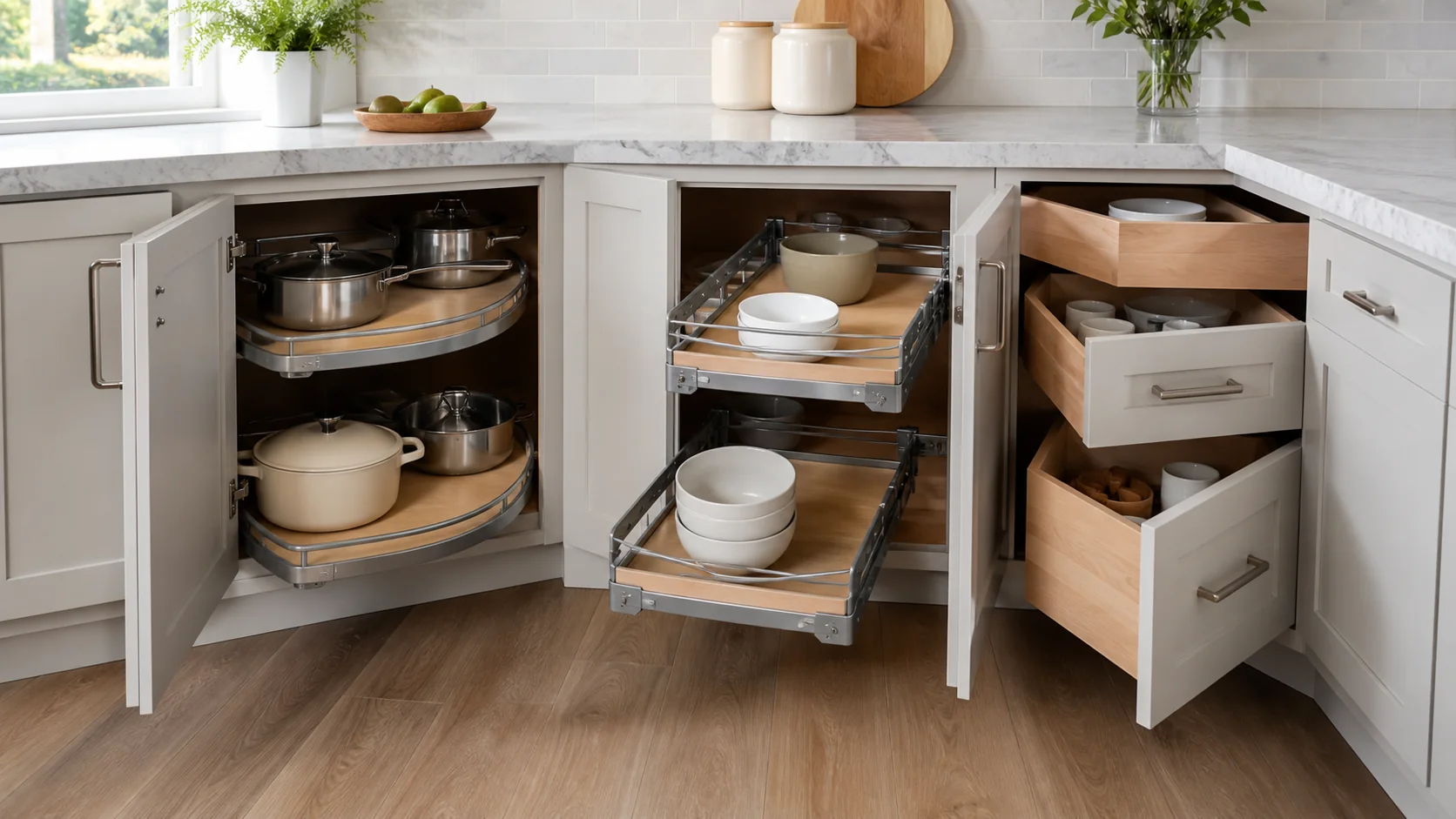
A lazy Susan rotates shelves around a central post or bearing. Full-circle versions suit some diagonal cabinets, while kidney and pie-cut shapes serve L-shaped openings. Rotation brings stored items to the front and keeps the mechanism relatively understandable.
The circular shelf cannot use every corner of a square cabinet, so some volume is lost. Tall or unstable items can tip, and small packages may fall off an unprotected edge. Look for raised rims, smooth bearings, independently rotating shelves, and adjustable height where needed.
Lazy Susans work well for pots, mixing bowls, and larger pantry containers. Avoid overloading one side and respect the published rating. A center post may interfere with wide cookware, while a post-free shelf may impose different support limits.
Blind-Corner Pull-Outs: Better Reach with More Hardware
Blind-corner systems use linked trays that slide and pivot through the door opening. They can make the hidden area accessible without reaching deeply into the cabinet. Some bring all trays outside; others move the front baskets aside to reveal rear shelves.
The tradeoffs are cost, lost volume around the mechanism, and strict dimensional requirements. Hinges, adjacent appliance handles, or insufficient aisle space can obstruct the travel path. The extended trays also carry substantial leverage, so the cabinet must be sound and the mounting exact.
Before buying, verify left- or right-hand orientation, opening width, door attachment, tray load rating, and required side clearances. Use a cardboard sweep template to see whether the organizer would collide with an island or opposing cabinet.
Corner Drawers: Direct Access in New Cabinetry
Corner drawers present angled or L-shaped fronts that pull straight out, dividing the corner into visible layers. They eliminate deep reaching and can organize utensils, dishes, or cookware. Full-extension slides improve access.
Drawer boxes and hardware occupy considerable volume, and their unusual shape can limit large items. The surrounding cabinet must be designed for the system; retrofitting ordinary corner boxes is rarely simple. Drawer fronts also need precise alignment where two cabinet runs meet.
Corner drawers are most attractive during a new cabinet order, when the manufacturer can coordinate boxes, slides, fronts, and warranty. Confirm usable internal dimensions rather than judging the broad exterior fronts.
Fixed Shelves and Low-Tech Alternatives
A basic shelf has no moving parts, preserves more raw volume, and costs less. It can work when the corner stores large, infrequently used appliances or bulk cookware. The drawback is access: small objects migrate into the back and become forgotten.
Improve simple shelves with large handled bins, a removable turntable, or clear category containers. Avoid stacking heavy appliances where retrieval requires twisting. A half shelf can preserve vertical room for tall items while keeping smaller goods visible.
Sometimes the best design closes off a small inaccessible void and gives more useful storage to the adjoining cabinet. Maximum cubic volume is not the same as practical capacity.
Compare Access, Capacity, and Maintenance
For easiest mechanical maintenance, simple shelves and basic rotating trays lead. For maximum front-facing access, a quality pull-out or drawer system performs better. For broad pots and bowls, check center posts and tray shapes. For small pantry packages, contained shelves reduce falling.
Moving systems require cleaning and periodic inspection. Crumbs can collect in tracks, fasteners can loosen, and overloaded trays can sag. Choose hardware with replacement parts and an accessible adjustment method. A complicated organizer has little value if it cannot be removed for cabinet cleaning.
Installation and Safety Checks
Follow the full-size template supplied with the system. Confirm the cabinet is square and securely fastened. Mount into sound material using specified screws and spacers. Door-linked systems need careful hinge and front adjustment so the door closes without rubbing.
Test empty, then add weight gradually. Watch the complete movement from above and at hinge level. Keep fingers clear of pivot points, and use child locks where needed. Never allow a child to climb on an extended tray.
If installation requires cutting cabinet structure, moving plumbing, or altering an electrical box, stop and consult the appropriate professional. A storage upgrade should not weaken the cabinet or conceal a service connection.
Make the Decision with a Storage Test
Before ordering hardware, place the items intended for the corner on a table and measure the largest pieces. Sketch the usable tray or drawer shapes at full scale on paper or cardboard. A wide stockpot may fit a cabinet but not pass through its door, while several small appliances may exceed a moving shelf’s combined rating. This test converts catalog dimensions into usable capacity.
Compare the complete installed system, including mounting kits, door hardware, fillers, and professional labor. Ask whether replacement trays, bearings, or slides will remain available. If two solutions provide similar access, the simpler one may be easier to clean and maintain over the cabinet’s life.
For a retrofit, preserve the ability to return to ordinary shelves if the mechanism fails. Avoid irreversible cuts unless a cabinet professional confirms that the panel is nonstructural. For new cabinetry, review a shop drawing that shows both exterior door alignment and interior clearances. Finally, test the display model with representative weight rather than spinning an empty tray. Smooth movement under load is more informative than showroom appearance.
Frequently Asked Questions
Which corner cabinet solution holds the most?
Simple shelves often preserve the greatest raw volume, but organizers can make a smaller amount of space more usable. Compare accessible capacity for the items you actually store.
Can a blind-corner pull-out be retrofitted?
Often, if the opening, interior depth, hinges, and cabinet strength match the product specification. Measure carefully because these systems have strict fit ranges.
Are corner drawers better than a lazy Susan?
They offer direct layered access but consume space with drawer boxes and usually suit new cabinetry. A lazy Susan is simpler and may be easier to retrofit.
What should be stored in a corner cabinet?
Use it for items that fit the chosen mechanism: pots and bowls on broad rotating shelves, pantry groups in contained trays, or occasional appliances on simple shelves.
Why does my lazy Susan rub or wobble?
The post may be out of plumb, shelves may be overloaded, hardware may be loose, or the door adjustment may be incorrect. Follow the maker’s adjustment procedure.