Water can look, smell, and taste normal while containing a contaminant that requires attention. It can also have an unpleasant mineral taste without posing the same health concern. Testing replaces guesswork with measurements, but only when the sample, laboratory method, and list of analytes match the water source and suspected problem.
This guide provides a planning framework, not medical or regulatory advice. Contact the water utility or local health department promptly for an advisory, known spill, illness cluster, flood-affected well, or suspected acute contamination.
Our top picks


As an Amazon Associate we earn from qualifying purchases at no extra cost to you.
Use the EPA directory of certified drinking-water laboratories to find the appropriate state program. After results arrive, our softener versus filter guide helps translate measured problems into a treatment category.
Identify the Water Source
Public water systems routinely test source and distribution water and publish reports. Those reports describe regulated contaminants at the system level, but conditions can change within a building through service lines, solder, fixtures, or stagnation. Testing at the tap can answer a plumbing-specific question.
Private wells are the owner’s responsibility. Well depth, geology, nearby septic systems, agriculture, industry, flooding, and construction can influence risks. Local health agencies are the best source for a region-specific panel and recommended frequency.
Choose Tests Based on Risk
Common baseline well testing may include total coliform bacteria, E. coli, nitrate, pH, and total dissolved solids, with additional analytes based on location. Lead and copper may matter in homes with relevant plumbing. Arsenic, uranium, fluoride, iron, manganese, hardness, pesticides, volatile organic compounds, or PFAS may be appropriate in some regions.
Symptoms do not identify a contaminant reliably. Rotten-egg odor, metallic taste, blue-green stains, scale, or cloudy water can guide questions, but laboratory analysis is needed. Do not order an enormous generic panel without discussing local risks; it may add cost while missing a specific concern.
Know When to Test
Follow local guidance for routine private-well testing, commonly including annual bacterial and nitrate checks. Test after flooding, well repair, loss of pressure, disinfection, nearby chemical release, change in taste or appearance, or unexplained recurring gastrointestinal illness. Pregnancy, infants, and immunocompromised household members may justify additional consultation.
For municipal water, test when the utility advises it, when a service line or fixture is changed, or when building plumbing may contribute lead or other metals. A vacant home or long stagnation period may require a specific sampling protocol.
Select a Qualified Laboratory
Use a laboratory certified by the relevant state or national authority for the requested analytes. Certification is method-specific. Ask for the correct bottles, preservatives, holding times, detection limits, chain-of-custody form, and collection instructions.
Home strips can screen hardness, chlorine, or pH but generally cannot replace certified analysis for health decisions. A handheld total-dissolved-solids meter measures conductivity-related dissolved content, not whether the water is free from lead, bacteria, pesticides, or other contaminants.
Collect a Valid Sample
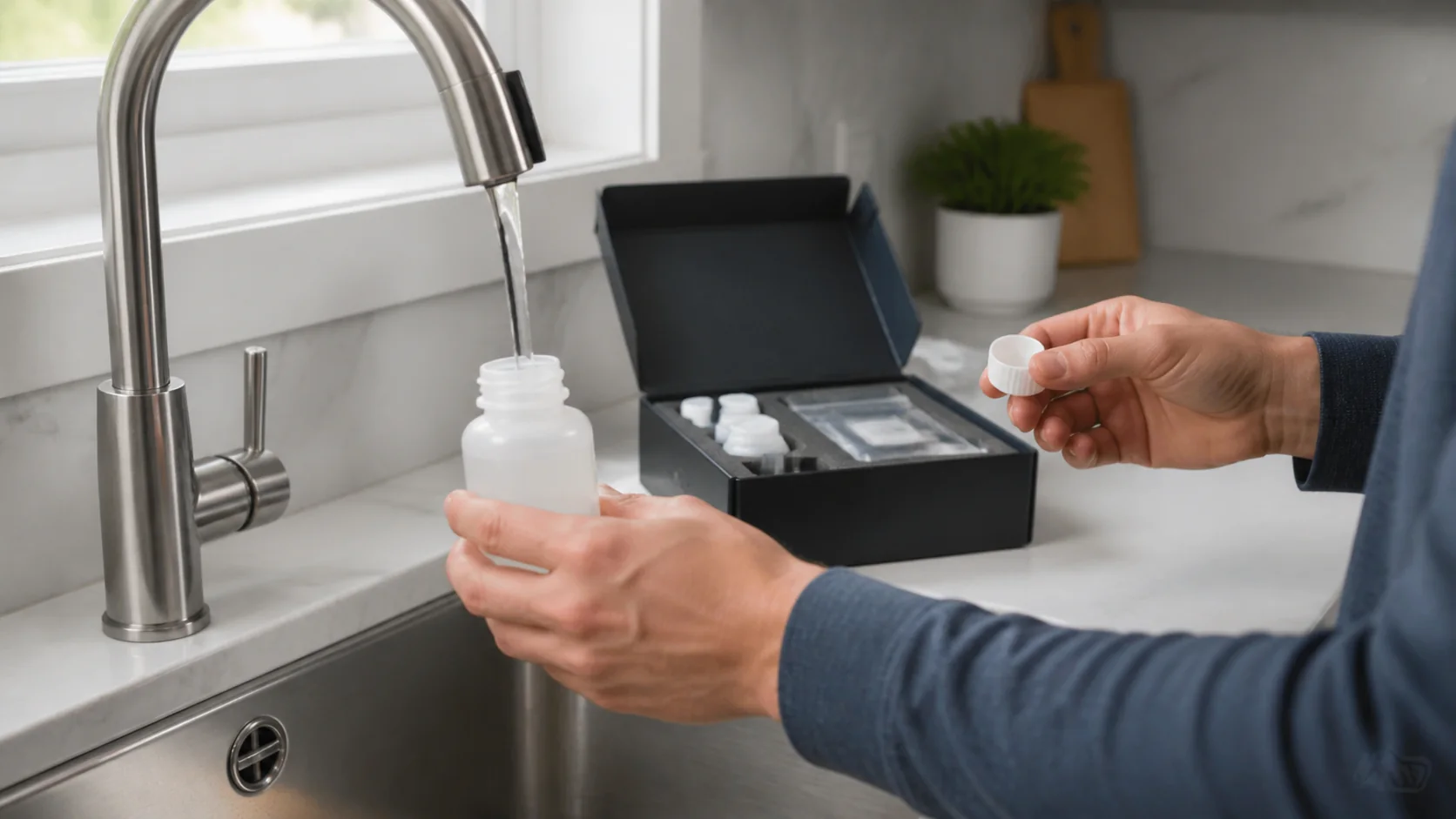
Follow the laboratory instructions exactly. Some samples require first-draw water after stagnation; others require flushing. Bacteria samples often require a sterile bottle and careful avoidance of contact with the cap or bottle interior. Some taps must have aerators removed, while other protocols specify otherwise.
Choose the sampling location that answers the question. A kitchen cold tap may represent drinking water. A sample before and after treatment evaluates treatment performance. Label bottles accurately, keep them at the required temperature, and deliver them within the holding time.
Do not rinse a preserved bottle or transfer water into a household container. Record date, time, tap, flushing time, recent plumbing work, and treatment status so results can be interpreted.
Read Results in Context
Compare results with the applicable drinking-water standard, health advisory, or laboratory reference, using the same units. Milligrams per liter and micrograms per liter differ by a factor of one thousand. “ND” usually means not detected above the method’s reporting limit, not absolute zero.
A single result may require confirmation. Sampling error, seasonal conditions, and plumbing stagnation can affect measurements. Contact the laboratory or health department rather than selecting equipment from an online chart.
Respond to a Problem Safely
If a result exceeds a health-based limit, follow official guidance about drinking, cooking, bathing, and alternative water. Boiling can inactivate many microorganisms, but it does not remove metals or nitrate and may concentrate dissolved contaminants. Do not boil unless the advisory calls for it.
Correct the source where possible: repair a well cap, improve drainage, replace plumbing, or address cross-connections. Then select certified treatment matched to the contaminant and retest after installation. Maintain filters, lamps, salt, membranes, and disinfection schedules.
Create a Household Water Record
Keep laboratory reports, the sampling address and tap, well construction records, treatment manuals, filter changes, disinfection events, and plumbing repairs in one file. Record unusual weather, flooding, loss of pressure, or long vacancy near the sample date. This context helps a health official or treatment professional distinguish a source change from a plumbing or maintenance issue.
Trend results using the same certified method where possible. A value below a limit can still be worth watching if it changes sharply over time. Conversely, small differences near a method’s reporting limit may reflect normal analytical variation. Do not compare results with different units until they are converted correctly.
If the home changes ownership, provide well and treatment records to the next owner where appropriate. Label treatment bypass valves and leave current service contacts. For renters, report concerns to the responsible property party and local authority rather than modifying building plumbing without permission.
A record also prevents unnecessary equipment. When a salesperson proposes treatment, the household can compare the claim with independent results and request a post-installation confirmation. Testing is most useful as a cycle—measure, interpret, correct, verify, and maintain—not as a one-time purchase.
Sampling plans should distinguish an immediate exposure question from a system-performance question. A first-draw lead sample, a flushed source sample, and a post-filter sample can produce different results because they answer different questions. Do not combine water from several taps unless the laboratory specifically instructs a composite sample. If a result is surprising, preserve the report and ask the laboratory whether quality-control flags, holding-time problems, or an unsuitable detection limit affect interpretation. Repeat sampling should use the prescribed protocol rather than changing taps and flushing times until a preferred number appears. Consistency and transparent records are central to a trustworthy conclusion.
When comparing laboratories, confirm that the reporting limit is low enough for the health benchmark being evaluated. A result reported only as “below 10” cannot demonstrate compliance with a benchmark of 5 in the same units. Ask before sampling so the laboratory can select an appropriate method and bottle.
Frequently Asked Questions
How often should private well water be tested?
Follow local health guidance. Annual testing for bacteria and nitrate is commonly recommended, with broader testing based on local geology and events.
Are home water test kits accurate?
They can screen certain properties but should not replace a certified laboratory when health or regulatory decisions are involved.
Should I sample before or after a filter?
Sampling both locations can distinguish source quality from treatment performance. Tell the laboratory what each sample represents.
Does clear water mean safe water?
No. Many contaminants have no visible, taste, or odor signal.
What if bacteria are detected?
Contact the local health authority, follow immediate-use advice, inspect the source, disinfect or repair as directed, and confirm correction with repeat testing.