Key takeaways
- EPA WaterSense faucet resources — efficiency and labeled-product context.
- NSF drinking-water resources — relevant when a filter shares the cabinet.
- International Plumbing Code — verify local adoption and requirements.
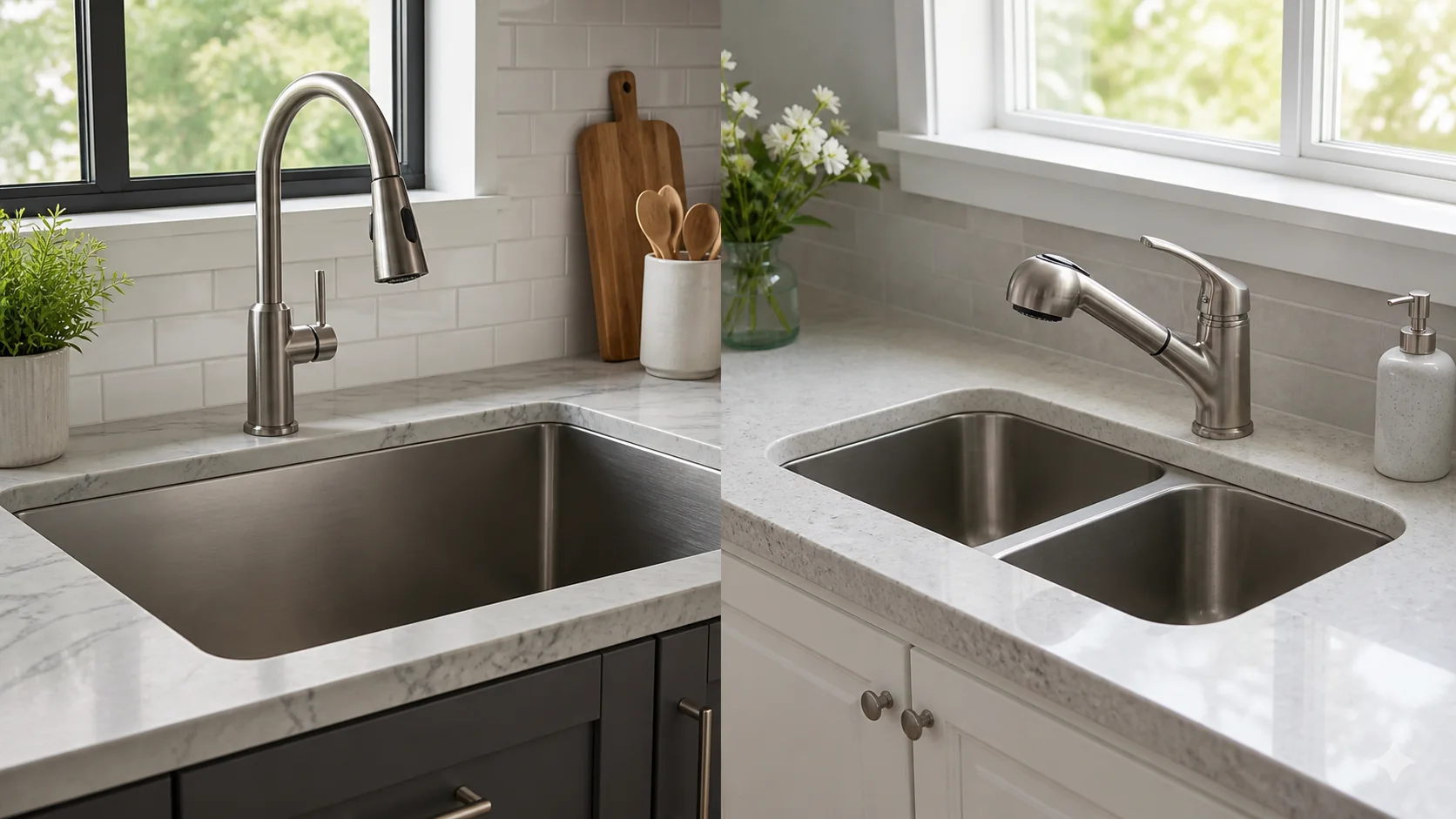
The difference between pull-down and pull-out kitchen faucets is a motion, not a feature count. A pull-down head leaves a high-arc spout and travels mainly toward the basin. A pull-out head is usually part of a lower-profile body and travels toward the user. Both can rinse cookware and fill containers, but the better layout is the one whose hose path matches the room and whose head returns reliably after hundreds of ordinary uses.
The Thirty-Second Motion Test
Stand at the sink and mime three actions: rinse the back corner, fill a pot on the counter, and wash a tall stockpot. If the hand naturally rises and drops into a deep central bowl, a pull-down design often feels direct. If the hand travels horizontally to a shallow double bowl, side counter, or nearby coffee maker, a pull-out can provide a more comfortable approach.
Our top picks

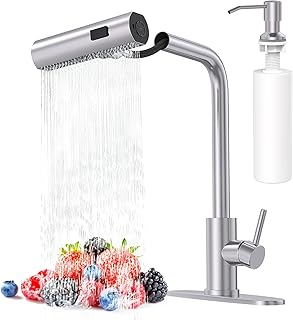
 Brushed Nickel Kitchen Faucets with Pull Down
- DOWN SPRAYER WITH 14.5" HOSE FOR FILLING TALL…
- A thumb-toggle switch on the sprayer head cycles…
- INCLUDED 10" DECK PLATE: The included 10-inch brushed…



As an Amazon Associate we earn from qualifying purchases at no extra cost to you.
This is not a guarantee. Exact hose length, swivel range, spout reach, spray-head angle, and cabinet routing determine usable reach. Compare dimension drawings for actual models rather than relying on category labels.
| Situation | Pull-down tendency | Pull-out tendency |
|---|---|---|
| Deep single bowl | Natural downward aiming | Works, but horizontal grip may feel less direct |
| Low shelf or window | High arc may conflict | Lower body often fits |
| Filling beside sink | Depends on hose and spout geometry | Horizontal reach often advantageous |
| Splash-prone shallow bowl | High outlet can amplify splash | Lower outlet may improve control |
| Large cookware | High arc adds vertical workspace | Lower spout can limit clearance |
Measure the Water Landing Point
Spout height gets attention, but spout reach determines where the stream lands. Ideally, the aerated stream reaches a useful zone near the drain without striking the bowl wall. Trace the distance from mounting-hole center to drain center, then compare it with the manufacturer’s spout-reach dimension. On a double bowl, consider both drain positions and divider height.
High arcs create room beneath the outlet but do not automatically improve reach. In a shallow basin, extra fall distance can increase splash. Water pressure, aerator pattern, bowl curvature, and the objects being washed contribute too. If splash control is the main issue, evaluate the entire water path rather than choosing the lowest or tallest silhouette.
The Hidden Decision Is Below the Counter
Retractable hoses need an unobstructed corridor. The hose, weight, or spring must clear shutoff handles, drain tubing, disposal, filter system, appliance lines, and stored supplies. Pull the hose to full extension, rotate the faucet, and imagine the return path. A weight that hits a shelf will produce poor docking even if the head’s magnet is strong.
Check whether the maker uses a gravity weight, spring system, magnetic dock, or mechanical latch. Ask whether the hose, docking insert, check valve, aerator, and spray head are separately replaceable. Service diagrams and parts availability are more valuable than an extra spray mode. For setup details, use the kitchen faucet installation guide.
Evaluate the Spray Head as a Hand Tool
A spray head should be easy to grip when wet. Compare weight, button position, mode labeling, and whether spray selection resets when water stops. Some users prefer a persistent mode; others want a predictable return to aerated flow. Neither behavior is inherently better, but surprise behavior can be irritating.
Move the head with the non-dominant hand. Users with limited grip strength may favor a larger, lighter head and a dock that does not require precise alignment. A swivel that rotates too freely can point outward when the head returns; one that is too stiff makes corner rinsing awkward.
Four Tasks Reveal More Than a Showroom Demo
- Rinse a baking sheet: note whether the hose reaches all edges without twisting.
- Fill a heavy pot: decide whether it can remain on the counter and whether the head can be set down safely.
- Clear food debris: check if the spray angle drives debris toward the drain rather than over the rim.
- Clean the sink: confirm that the head reaches the rear wall, rim, and divider while the hose stays clear below.
If shopping online, recreate these paths with a string cut to the listed hose reach. The string cannot predict stiffness or retraction, but it exposes exaggerated assumptions about distance.
Hard Water, Docking, and Long-Term Care
Minerals accumulate at nozzles, aerators, swivels, and docking interfaces. Flexible silicone nozzles can simplify routine removal, but only the maker’s approved method should be used. Soaking a complete spray head may expose seals or finishes to a chemical the manufacturer prohibits.
Inspect the hose periodically for abrasion, bulges, dampness, and contact with sharp cabinet edges. Keep its travel zone empty. If retraction weakens, first check for obstructions and a displaced weight rather than pulling harder. The faucet maintenance checklist provides a recurring inspection routine. Homes with significant scale should also review faucets for hard-water conditions.
A Decision Rule That Avoids Tie-Breaking by Style
First reject any model that conflicts with overhead clearance, mounting holes, sink reach, or the under-counter hose corridor. Among survivors, give 35 percent of the score to task reach, 25 percent to docking and hose serviceability, 20 percent to splash control, 10 percent to grip and controls, and 10 percent to finish. Adjust those weights only when a documented household need demands it.
This method may select a less dramatic faucet, but it makes the reason visible. If two models tie, choose the one with clearer installation documentation and purchasable service parts.
Coordinate the Faucet With the Sink, Not the Catalog
A compact faucet can still overshoot a small basin if its outlet projects beyond the drain, while a tall professional-style silhouette may dominate a shallow sink and backsplash. Plot three points on a side-view sketch: mounting-hole center, outlet center, and drain center. Add the bowl’s front and rear walls. The drawing reveals whether the normal stream lands on a curved surface that could throw water outward.
Also account for the handle envelope. A rear-swing lever may strike a backsplash before reaching full hot flow. Side controls can conflict with a raised rim or adjacent soap dispenser. Touch or motion activation does not remove these geometric constraints; it adds power, sensor, and override questions. If hands-free operation is important, compare those requirements separately in the touchless vs standard faucet guide.
What to Inspect at Delivery
Do not discard packaging after a quick finish check. Match the model and finish suffix to the order, inventory adapters and mounting hardware, examine the hose for kinks, and confirm that the head seats squarely in its dock. Move every control without connecting water. If the hose uses a quick connector, verify the locking piece described in the manual is present. Reporting missing components before installation preserves more options than discovering them beneath a wet sink.
Frequently Asked Questions
Is a pull-down faucet always taller?
Usually it uses a high arc, but dimensions vary. Compare total height and spout height for the exact model, especially below shelves, shutters, or low windows.
Which style has the longer hose?
The category name does not prove usable extension. Read the specification and distinguish total hose length from reach beyond the dock.
Can either type work with a double sink?
Yes, if reach, swivel, spray angle, and hose travel cover both bowls without hitting the divider or backsplash.
Why does a spray head stop retracting?
Common causes include an obstructed hose, shifted weight, twisted line, debris at the dock, or worn component. Follow model-specific troubleshooting and replace damaged parts.
Sources to Confirm Before Ordering
- EPA WaterSense faucet resources — efficiency and labeled-product context.
- NSF drinking-water resources — relevant when a filter shares the cabinet.
- International Plumbing Code — verify local adoption and requirements.
Choose by tracing the hand, water, and hose through the real kitchen. The correct category becomes obvious only after overhead clearance, landing point, cabinet obstacles, service parts, and the household’s most frequent task are placed on the same drawing.