Key takeaways
- The real decision is not simply whether an under-cabinet or wall-mount range hood looks better. It is whether the hood can capture smoke, grease, steam, and cooking odors before they spread through the kitchen—and whether its airflow fits the way…
The real decision is not simply whether an under-cabinet or wall-mount range hood looks better. It is whether the hood can capture smoke, grease, steam, and cooking odors before they spread through the kitchen—and whether its airflow fits the way you cook, the space above your range, and the ductwork your home can support.
Under-cabinet hoods are typically the practical choice for compact kitchens, standard electric ranges, and homeowners who need storage cabinets above the cooktop. Wall-mount hoods make more room for a larger capture area and higher airflow, which can matter with gas burners, wok cooking, searing, and open-plan homes. But a bigger CFM number alone does not guarantee better real-world performance. Hood width, mounting height, duct size, filter condition, and whether the unit vents outdoors all affect results.
Our top picks



As an Amazon Associate we earn from qualifying purchases at no extra cost to you. Ratings are shown as listed on Amazon.
Quick Verdict
Choose an under-cabinet range hood when you have limited kitchen space, want to retain upper cabinetry, cook moderately, and need a straightforward replacement. Typical ducted models run about 200 to 600 CFM, with some premium options reaching higher. They are often less expensive to buy and install.
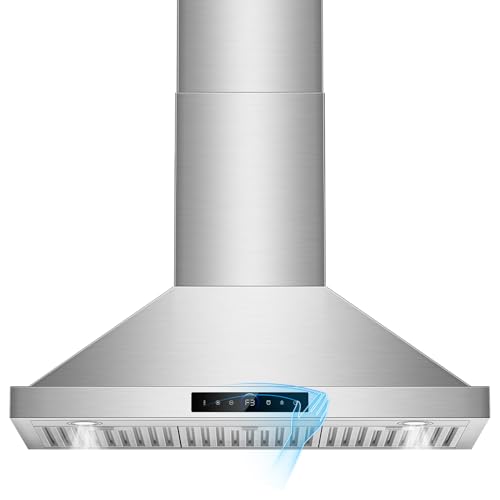
Choose a wall-mount range hood when suction power is a priority, especially for a 30- to 36-inch gas range, frequent high-heat cooking, or a kitchen that opens to living areas. Many wall-mount models offer roughly 400 to 900 CFM, while high-output models can reach 1,000 to 1,200 CFM. For example, a 36-inch wall-mount stainless-steel hood rated at 1,200 CFM is listed at $436.99, and the BRANO 30-inch wall-mount hood with a DC motor and 1,000 CFM rating is listed at $519.
For most homes, the best choice is the widest hood that fits the range and kitchen layout, vented outdoors through the shortest practical duct run. In 2026, that basic rule still matters more than trend-driven finishes or an inflated maximum airflow claim.
Side by Side
| Buying Factor | Under-Cabinet Range Hood | Wall-Mount Range Hood |
|---|---|---|
| Suction power | Usually 200–600 CFM; suitable for everyday cooking and many electric or lower-output gas ranges. | Often 400–900 CFM; high-capacity versions may reach 1,000–1,200 CFM for heavier cooking. |
| Comfort and noise | Can be quiet at low speeds, but compact blower housings may sound louder when pushed to maximum speed. | More internal volume can support larger blowers; still, high-CFM operation is not silent. |
| Durability | Simple designs have fewer decorative components; cabinet-adjacent finishes can show heat and grease over time. | Stainless chimney sections and baffle filters are built for regular cleaning, though installation quality matters. |
| Typical purchase price | About $100–$500 for most ducted units; premium or specialty sizes can cost more. | About $250–$1,000 or more, depending on width, motor, controls, and finish. |
| Maintenance | Mesh filters need frequent degreasing; charcoal filters must be replaced on recirculating models. | Dishwasher-safe baffle filters are common and handle heavy grease well; chimney exterior needs wiping. |
| Space needed | Fits beneath an existing 12- to 15-inch-deep upper cabinet; preserves the cabinet itself. | Requires a clear wall above the range and usually removes or replaces upper cabinet space. |
| Look | Low-profile, integrated, and less visually prominent. | Creates a focal point; works especially well in contemporary, industrial, and transitional kitchens. |
| Resale appeal | Appropriate and expected in compact or builder-grade kitchens. | Can add a more upscale visual impression when proportioned correctly to the range and room. |
| Best for | Apartments, galley kitchens, rentals, and cooks who need overhead storage. | Long-term homes, serious home cooks, larger ranges, and open-concept kitchens. |
Where Under Cabinet Wins
Under-cabinet hoods win on efficient use of space. If your kitchen has a standard run of upper cabinets, replacing one with a wall-mount hood can mean losing 24 to 36 inches of valuable storage. An under-cabinet model mounts directly to the bottom of the existing cabinet, usually above a 30- or 36-inch range, and keeps everyday dishes, glasses, or pantry goods within reach.
They also make sense when the duct path is already in place. A straightforward replacement may use a 3¼-by-10-inch rectangular duct or a 6-inch round duct, depending on the hood and existing construction. Reusing a properly sized, clean, exterior-vented duct can keep labor and disruption lower than rebuilding cabinetry and rerouting ventilation.
For light to moderate cooking, huge airflow is often unnecessary. Someone who mostly boils pasta, reheats food, bakes, and cooks on an electric cooktop may be well served by a ducted 250- to 400-CFM under-cabinet hood. The key is capture coverage: select a hood at least as wide as the cooktop, and ideally wider if cabinetry allows. A 36-inch hood over a 30-inch range provides better reach at the front burners than a same-width 30-inch hood.
Under-cabinet hoods can also coordinate neatly with practical under-cabinet accessories. A black self-adhesive under-cabinet paper towel holder, listed at $7.98, can keep cleanup supplies off the counter, while rechargeable 10-inch motion-sensor under-cabinet lights such as a two-pack listed at $16.98 can improve task lighting where built-in hood lights do not fully illuminate the counter. Keep accessories away from heat, grease, and the hood’s intake path.
The tradeoff is that compact hoods have less physical depth and less room for broad capture panels. When a pan is smoking on a front burner, vapors naturally rise beyond the back half of the cooktop. A shallow under-cabinet hood may need a higher fan speed—and more noise—to keep up.
Where Wall Mount Range Hood Suction Power Wins
Wall-mount hoods have the advantage when cooking creates a lot of airborne grease, steam, or combustion byproducts. Their chimney-style form allows a larger canopy and frequently a deeper capture area than a conventional under-cabinet hood. That extra coverage can be as important as the motor rating, particularly when sautéing, frying, grilling indoors, or cooking with oversized pots.
Higher CFM can be useful, but it must match the installation. A 1,000-CFM or 1,200-CFM hood cannot perform as intended through a narrow, kinked, or excessively long duct. Many powerful hoods call for an 8-inch or 10-inch round duct. Reducing that outlet to a 6-inch duct can increase resistance, airflow noise, and grease buildup. Always follow the manufacturer’s duct-size requirements and local code.
Wall-mount models are particularly compelling over gas cooking. A common planning guideline starts around 100 CFM per 10,000 BTU of total gas burner output, but this is a starting point rather than a substitute for local requirements or the hood manufacturer’s instructions. A range with 50,000 BTU of combined burner output may point a buyer toward approximately 500 CFM or more, especially if high-heat cooking is routine.
A larger wall-mounted canopy also helps in open kitchens, where odors travel quickly into adjacent living and dining spaces. Choose a width equal to or greater than the range: 30 inches for a standard 30-inch range, or preferably 36 inches when wall space permits. Mounting height is commonly about 24 to 30 inches above an electric cooking surface and 26 to 30 inches above gas, but the hood’s installation manual is the final authority.
One caution: very high airflow can depressurize a tightly sealed home. In some jurisdictions, hoods above 400 CFM may trigger make-up-air requirements. That may add equipment and installation cost, but it helps replace air exhausted from the house and supports safe appliance operation.
Cost Over 5 Years
Purchase price is only part of the equation. Over five years, an under-cabinet hood commonly costs about $250 to $1,200 in combined equipment, basic installation, filters, and electricity. A simple $150 to $350 ducted unit may be relatively economical when it replaces an existing hood using the same cabinet and duct opening. Professional installation can range from roughly $150 to $500 for a simple swap, while new wiring, duct repairs, or exterior vent work raise the total.
A wall-mount hood may land around $700 to $2,500 or more over five years. The hood itself may cost $250 to $1,000, followed by roughly $400 to $1,500 for installation, depending on chimney work, electrical changes, duct routing, wall repair, and whether cabinets must be modified. High-CFM installations that require larger ducts or make-up air can cost substantially more.
Electricity is usually a smaller line item than installation. Many hood blowers draw roughly 100 to 300 watts at higher speeds, while LED lights often use only a few watts. Running a 200-watt blower for 30 minutes a day uses about 36.5 kWh annually. Filter care matters more: washable metal filters should be cleaned about monthly for regular cooks, while recirculating charcoal filters often need replacement every three to six months, depending on use.
Which One for Your Home
Small apartment
Choose a ducted under-cabinet hood if the building allows exterior venting and the existing layout supports it. A 250- to 400-CFM model, at least as wide as the range, is usually a sensible balance of space, cost, and performance. If exterior venting is impossible, a recirculating hood can reduce some grease and odors but will not remove heat, moisture, or combustion gases from the room.
Family with kids or pets
A wall-mount hood is often worth considering for an active kitchen, especially in an open floor plan. Look for a 36-inch-wide hood over a 30-inch range and use lower speeds for everyday meals, reserving high speed for frying or searing. Prioritize easy-to-remove baffle filters, bright cooktop lighting, and controls that are simple to clean.
Rental
An under-cabinet replacement is usually the least disruptive option. Match the existing width, duct orientation, electrical connection, and cabinet depth before ordering. Avoid expensive structural changes unless the landlord approves them in writing. A modest ducted unit generally delivers better value than a decorative wall-mount conversion.
Long-term home
For homeowners planning a kitchen renovation or cooking frequently with gas, a wall-mount hood is often the stronger long-term investment. Build the cabinetry, duct route, and electrical plan around the hood rather than treating ventilation as an afterthought. Choose the correct duct diameter, keep runs short and smooth, and confirm make-up-air obligations before selecting a high-CFM model.
FAQ
Is a higher CFM range hood always better?
No. Higher CFM can improve smoke and odor removal, but only when the hood has adequate canopy coverage and correctly sized ductwork. An oversized blower on a poor duct path can be loud without delivering the expected capture performance.
What CFM should I choose for a 30-inch range?
For typical electric or moderate cooking, 250 to 400 CFM is often enough when vented outdoors. For gas cooking, frequent frying, or high-output burners, many buyers should consider 400 to 600 CFM or more. Match the recommendation to burner output, hood width, duct size, and local code.
Can an under-cabinet hood be as powerful as a wall-mount hood?
Some under-cabinet models offer strong airflow, but wall-mount designs more often pair higher CFM with a larger, deeper capture area. For heavy cooking, the wall-mount format generally has the advantage. For ordinary daily use, a well-installed under-cabinet hood can be highly effective.
Should I choose ducted or ductless?
Choose ducted whenever practical. A ducted hood sends contaminated air outdoors, while a ductless model filters and recirculates air back into the kitchen. Recirculating hoods can help with grease and some odors, but they do not remove humidity, heat, or combustion pollutants as effectively.