Key takeaways
- Require the exact sink model and mount style.
- State whether the countertop opening changes.
- Identify cabinet support or face-frame work.
- List faucet, drain, disposal, and dishwasher connections.
- Include removal, haul-away, surface protection, cleanup, and testing.
- Define exclusions, change-order rates, warranty, and payment milestones.
A kitchen sink quote can describe anything from dropping a same-size stainless basin into an existing opening to rebuilding a cabinet for an apron-front model. Those jobs should not share one budget. The useful question is not simply “What does installation cost?” but “Which parts of my sink system must change?”
This guide uses U.S. cost references checked on August 26, 2026. Prices vary by region, access, contractor minimums, sink material, countertop, and plumbing condition. The figures below are planning benchmarks, not bids.
Our top picks



As an Amazon Associate we earn from qualifying purchases at no extra cost to you.
Affiliate disclosure: If this page contains product links, the site may earn a commission from qualifying purchases at no added cost to the reader.
Current Kitchen Sink Cost Benchmarks
Two independent sources illustrate why scope matters. HomeGuide’s cost guide, updated October 16, 2025, places a kitchen sink installation at $380 to $1,400, including removal, a new sink, and labor. It lists sink-and-faucet projects at $600 to $2,000 and sink-plus-disposal projects at $560 to $1,750. See the HomeGuide sink installation dataset.
Angi’s July 9, 2026 national dataset reports $216 to $663 for professional sink installation and says broader installed sink projects can span $100 to $1,600. It separately notes that farmhouse configurations cost more than common drop-in work. See Angi’s 2026 sink installation data.
A retailer provides a narrower reference for a limited service. Home Depot lists an average of $339 for stainless kitchen sink installation, with a $199 to $469 range, but its service page says sink cost and plumbing rework are excluded and that available service does not cover undermount or farmhouse sinks. That figure fits an eligible basic drop-in replacement, not every kitchen sink. See Home Depot’s sink cost guide.
Build the Budget as Six Separate Packages
Instead of starting with one national average, price six packages. A project may need only the first two, or all six.
| Package | What belongs in it | Question that unlocks the price |
|---|---|---|
| Sink | Basin, drain, clips, strainers, grids, delivery, tax | Is the exact model approved for the cabinet and cutout? |
| Mount | Removal, setting, support, sealant, curing and testing | Drop-in, undermount, flush-mount, or apron-front? |
| Countertop | Cutout, edge finishing, drilling, repair or replacement | Can the existing opening safely accept the new template? |
| Plumbing | Drain alignment, trap, supplies, valves and vent implications | Do connections remain in their present locations? |
| Disposal | Flange, unit transfer or replacement, discharge and power | Is the disposal compatible and is electrical service compliant? |
| Controls | Permit, protection, haul-away, cleanup and risk allowances | Which uncertain conditions have not been inspected? |
This package method exposes omissions. If one proposal includes stone fabrication and disposal reconnection while another does not, their grand totals are not comparable.
Scenario 1: Like-for-Like Drop-In Replacement
This is the simplest case: a replacement top-mount sink fits the existing opening, the cabinet is sound, and the faucet, drain, supplies, and disposal connections remain compatible. The Home Depot range is most relevant to this narrow labor scope, while HomeGuide’s installed range captures a broader selection of sinks and local labor.
Verify the cutout rather than relying on the old sink’s outside dimensions. The rim must cover the opening, mounting rails need clearance, and bowl depth must not collide with shelves, a disposal, or the trap arm. Budget for new strainers, sealant, clips, and possibly supply lines; reusing worn sealing parts to save a small amount increases leak risk.
Ask whether the installer will remove the faucet before lifting the old basin and whether its reinstallation is included. A corroded mounting nut, short supply line, or incompatible hole pattern can create a separate faucet task even though the planned change was “sink only.”
Scenario 2: Undermount Sink and Countertop Work
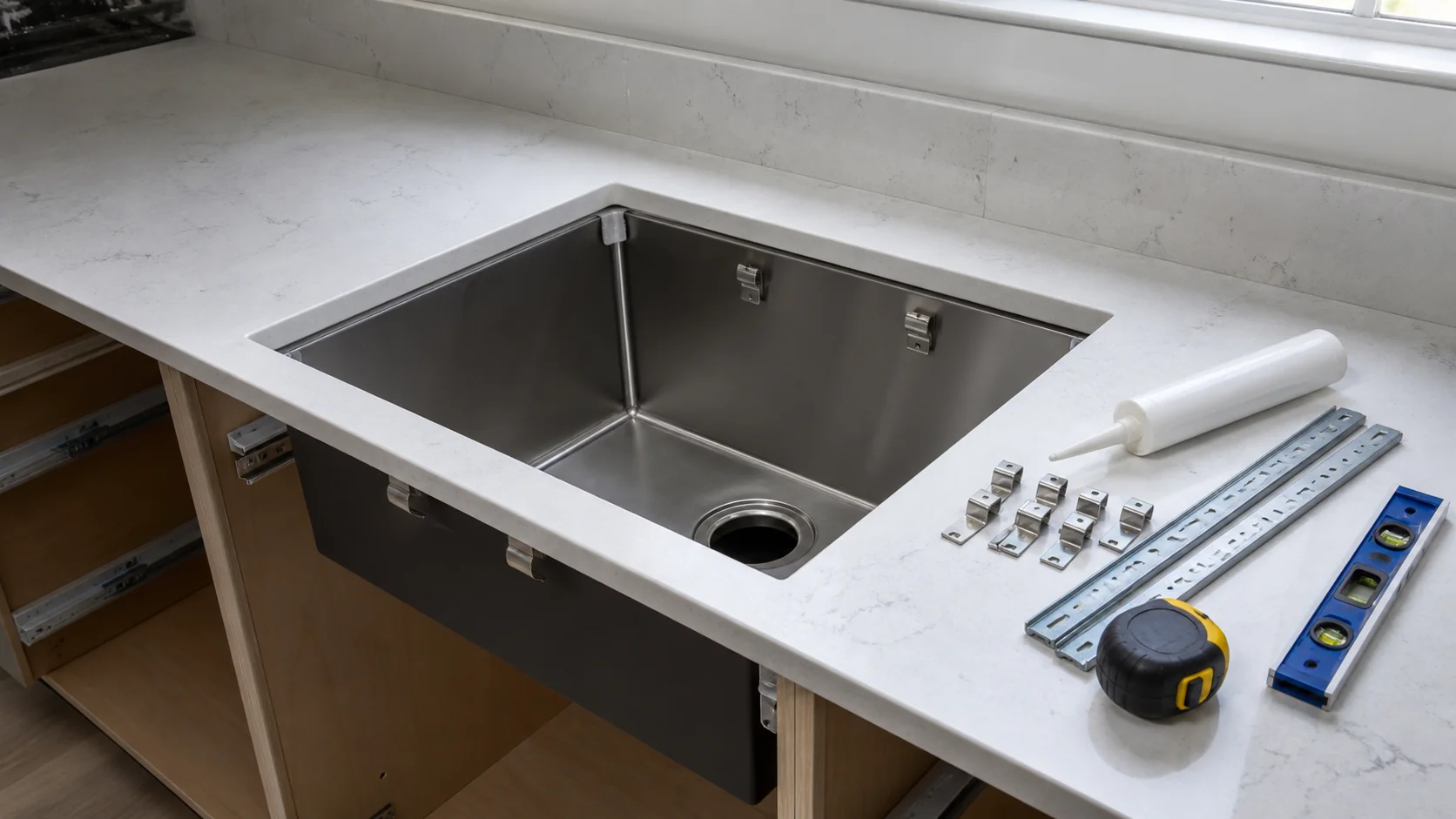
An undermount sink turns the countertop into part of the installation system. The fabricator must confirm that the material can support the mounting method, that the opening matches the manufacturer’s template, and that the exposed edge can be finished. Heavy sinks may require brackets or cabinet-supported rails rather than adhesive alone.
Price countertop work independently from plumbing. Ask who templates, cuts, polishes, supports, and warrants the opening. Existing stone can crack during modification, while laminate may not be suitable for a conventional exposed undermount edge. A new countertop changes sequencing: the sink model commonly must be available before templating, and plumbing reconnection follows fabrication.
Specify the reveal—positive, negative, or flush—before cutting. The chosen reveal affects cleaning, appearance, faucet clearance, and how accurately the opening must follow the bowl. Include removal and replacement of backsplash or countertop seams if access requires disturbance.
Scenario 3: Farmhouse or Apron-Front Conversion
An apron-front sink may require cutting the cabinet face, altering doors, adding a support platform, and modifying the countertop. The basin must be supported by the cabinet structure according to its instructions; the countertop lip is not a substitute. Because apron dimensions and reveals vary, select the exact sink before cabinet work.
HomeGuide lists farmhouse sinks at $500 to $5,000 installed, a much wider band than common drop-in work. That range reflects products and cabinet/countertop changes of very different complexity. Ask for separate cabinetry, fabrication, sink-setting, and plumbing amounts so an attractive basin price does not conceal the conversion work.
Check door height, false-front removal, adjacent drawer clearance, and the finished edge where the apron meets cabinetry. Painted and stained cabinets require different repair methods. A retrofit apron sink designed for an existing base may reduce cutting, but only its actual dimensions can confirm suitability.
Plumbing and Garbage Disposal Adders
A deeper or differently positioned bowl can move the drain outlet downward or sideways. That affects the strainer, disposal discharge, trap, and wall connection. The trap cannot simply be assembled into an improvised shape to overcome poor alignment. HomeGuide reports $100 to $350 for replacing existing sink pipes and $450 to $1,800 per fixture when new pipes and drain lines are required; use those as separate planning references, not automatic additions.
For a disposal, identify whether it will be transferred, replaced, or omitted. Confirm flange compatibility, vertical space, dishwasher connection, switch method, grounding, and applicable GFCI/AFCI rules. A plumber may handle the drain side while an electrician addresses a new or noncompliant circuit. Never assume the sink installer’s base price includes electrical correction.
Test shutoff valves before installation day. A valve that will not close turns a contained replacement into wider plumbing work. Corroded tubular waste, a leaking disposal, damaged cabinet floor, or incorrectly sloped drain should be documented and priced rather than hidden behind the new sink.
Permits, Contingency, and Quote Comparison
A same-location fixture swap may not require a permit in some jurisdictions, while moved drains, new supply piping, countertop structural changes, or electrical work may. Ask the local building department; national cost pages cannot determine the rule for an address. Make the proposal state who obtains permits and schedules inspections.
Use a risk register instead of one unexplained contingency percentage. List each unknown—stone modification, cabinet rot, failed valves, drain realignment, disposal wiring—and attach an allowance or a preconstruction investigation. Keep upgrades separate from repair reserves.
- Require the exact sink model and mount style.
- State whether the countertop opening changes.
- Identify cabinet support or face-frame work.
- List faucet, drain, disposal, and dishwasher connections.
- Include removal, haul-away, surface protection, cleanup, and testing.
- Define exclusions, change-order rates, warranty, and payment milestones.
Normalize proposals to these lines before comparing totals. Also record whether tax, delivery, parking, travel, and contractor minimum charges are included. Quote expiration matters when stone, metal, or special-order products have changing lead times.
Safety and Installation Limits
Sinks can be heavy and awkward, and stone edges are vulnerable during removal. Water and disposal wiring create combined hazards. Shut off and verify water and power, support the basin as specified, use suitable lifting help, and follow the exact installation template. Stop for damaged wiring, failed shutoffs, mold, rotten cabinetry, cracked stone, or unclear structural support.
This guide cannot inspect a countertop, cabinet, circuit, drain, or local code. Licensed plumbing, electrical, and stone professionals may all be appropriate for one project. Written manufacturer instructions and authority requirements take priority.
Coordinate the next decision with the kitchen sink installation guide.
Kitchen Sink Cost FAQs
Is sink removal normally included?
Some datasets and service packages include removal and haul-away; others price them separately. Require both items in writing.
Can a larger sink use the same countertop?
Sometimes, but only after a fabricator checks the new template, edge distances, cabinet width, material, and support. An opening can often be enlarged but cannot be made smaller without repair or replacement.
Who installs an undermount kitchen sink?
A countertop fabricator often mounts the sink, while a plumber connects the faucet, supplies, drain, dishwasher, and disposal. Assign final leak testing clearly.
Should the disposal be replaced at the same time?
Not automatically. Consider its condition, compatibility, leaks, noise, warranty, mounting system, and the labor required to transfer it.
Why is a farmhouse sink quote so high?
The scope may include cabinet cutting, new support, countertop fabrication, door modification, plumbing movement, and finish repair. Request those as separate lines.
Final Budget Recommendation
Classify the project before setting a budget: compatible drop-in replacement, undermount with fabrication, apron-front conversion, or relocated sink. Then total the six packages—sink, mount, countertop, plumbing, disposal, and project controls. Compare at least two current datasets with itemized local quotes, but let the verified site scope decide the budget. The most reliable estimate is the one that explains every interface beneath and around the basin.