Key takeaways
- Install fresh batteries during setup and note the date; most touchless faucets run 6-12 months per set depending on use.
- Choose a faucet with a manual handle backup so you can still control temperature and use it if the sensor battery dies.
- Pick a pull-down model with a magnetic dock; it holds the sprayer head firmly and looks tidier than a spring clip.
- Adjust the sensor sensitivity after installation so it does not trigger every time you reach into the sink.
A touchless kitchen faucet earns its keep the first time you wave a raw-chicken-covered hand under the spout and water flows without you smearing the handle. Beyond hygiene, motion activation saves water and simply feels modern, but the category spans $50 budget models to $340 designer fixtures, and the specs that matter are not always the obvious ones.
This guide explains how touchless faucets work, what to check before you buy, and how the sensor, power source, and spray features affect daily use. We reference real models across the price range so you can weigh convenience against budget and pick a faucet that fits both your sink and your habits.
Our top picks




As an Amazon Associate we earn from qualifying purchases at no extra cost to you.
⚡ Save on Your Next PC — Amazon Prime
Prime members get fast free shipping on the systems above, plus early access to Prime Day & Black Friday PC deals. New members get a 30-day free trial.
Watch: The Ultimate Guide to Selecting a Touchless Faucet for Your Kitchen — Video Review
How Touchless Faucets Work
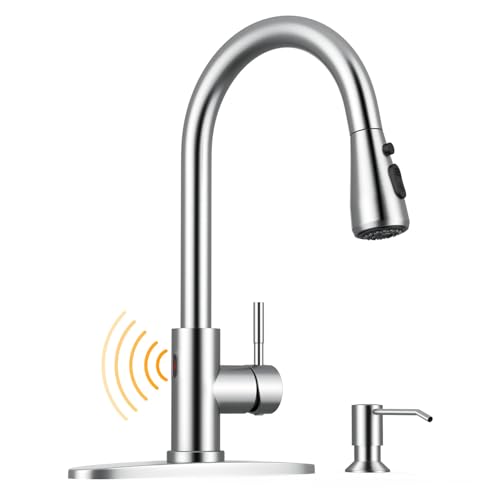
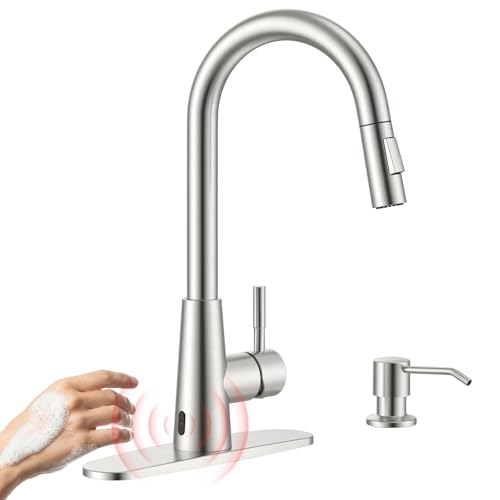
An infrared sensor detects your hand and triggers a solenoid valve to start and stop the flow. Most also keep a manual lever for temperature and backup. Models like the APPASO Kitchen Faucet Touchless with Soap Dispenser and Pull Down Sprayer ($60) and the WEWE Touchless Kitchen Faucet with Soap Dispenser ($123) combine motion activation with a traditional handle so you keep full control.
Power Source: Batteries vs. Plug-In
Most touchless faucets run on batteries (usually AA), which are simple to install anywhere, while some offer AC adapters. Battery models like the GIMILI Touchless Kitchen Faucet with Spring Pull Down Sprayer ($110) avoid needing an outlet under the sink; check battery life and how easy the compartment is to reach.
Spray Modes and Pull-Down Reach
A pull-down sprayer with stream and spray modes covers everything from filling pots to rinsing the sink. Look for a magnetic dock that snaps the head back cleanly, and enough hose length. The Delta Lenta Touchless Kitchen Faucet with Touch Technology ($339) adds both touch and touchless activation for premium flexibility.
Finish and Sink Compatibility
Match the finish to your hardware; brushed nickel, as on the TOYWIA Touchless Kitchen Faucet with Pull Down Sprayer and Soap Dispenser ($53) and the Hiqufet Touchless Kitchen Faucet ($70), coordinates with common appliances. Confirm the number of mounting holes your sink has and whether a deck plate is included.
Extra Features Worth Having
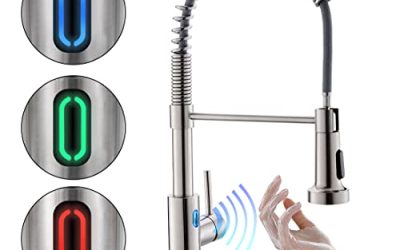
Built-in soap dispensers, LED temperature indicators, and adjustable sensor sensitivity add real convenience. The OWOFAN Touchless Pull Down Kitchen Faucet with LED Light ($119) uses an LED to signal water temperature, and combo sets with soap dispensers reduce clutter around the sink.
Tips
- Install fresh batteries during setup and note the date; most touchless faucets run 6-12 months per set depending on use.
- Choose a faucet with a manual handle backup so you can still control temperature and use it if the sensor battery dies.
- Pick a pull-down model with a magnetic dock; it holds the sprayer head firmly and looks tidier than a spring clip.
- Adjust the sensor sensitivity after installation so it does not trigger every time you reach into the sink.
Frequently Asked Questions
Do touchless faucets need electricity?
Most run on batteries (commonly AA), so no outlet is required, though some offer an AC adapter option. Battery models like the GIMILI install anywhere; just plan to change batteries every 6-12 months depending on use.
Can I still control water temperature on a touchless faucet?
Yes. Nearly all touchless faucets keep a manual lever for temperature, and models like the WEWE and APPASO let you set the mix by hand while the sensor handles on/off. Some add an LED temperature indicator too.
Are touchless faucets hard to install?
No harder than a standard faucet. You connect supply lines, mount the faucet, and attach the sensor’s battery box under the sink. If you can install a regular pull-down faucet, a touchless model like the TOYWIA is well within reach.
What happens if the sensor fails?
You keep using the manual handle. Because touchless faucets retain a mechanical lever, a dead battery or sensor glitch never leaves you without water, which is why the handle backup is worth prioritizing.
Conclusion
A touchless faucet is one of the most satisfying kitchen upgrades for hygiene and convenience, and you do not have to spend $340 to get a good one. Budget models like the TOYWIA and APPASO deliver motion activation and a pull-down sprayer for around $50-$60, while the Delta Lenta adds premium touch-and-touchless flexibility. Confirm your sink’s holes and finish, prioritize a manual backup, and cooking with messy hands will never mean a smeared faucet again.